AI tool
Google EmbeddingGemma 2
Google EmbeddingGemma 2 is a lightweight multimodal model that maps text, code, images, video, and audio into a shared embedding space. It is for developers building private, on-device applications that need to search across different content type...
About Google EmbeddingGemma 2
Google EmbeddingGemma 2 is an open, lightweight multimodal embedding model from Google DeepMind that maps text, code, images, video, and audio into a single shared space. At 740M parameters, it's small enough to run on-device, requiring about 567MB of RAM on a Pixel 11 Pro for the full multimodal model. The model is released under an Apache 2.0 license, with weights available on Hugging Face and Kaggle.
Review
EmbeddingGemma 2 tackles a concrete problem: searching across different content types usually means chaining together separate models-a captioning model for images, speech-to-text for audio, then a text embedder. That pipeline is slow, memory-intensive, and often pushes data to the cloud. EmbeddingGemma 2 replaces that pipeline with a single model that runs locally, keeping data on the device.
Key Features
- Shared embedding space for text, code, images, video, and audio, enabling a single text query to retrieve a photo or a voice memo to find a video clip.
- Modular architecture that lets you load only the encoders you need-as little as 270M parameters for text and code, with optional vision (170M) and audio (300M) encoders.
- 8K token context window, a 4x increase over EmbeddingGemma 1, handling roughly 5.5 minutes of audio, 29 images, or 58 video frames.
- Dimensionality reduction for vectors from 768 down to 512, 256, or 128 dimensions, shrinking storage needs by up to 6x.
- Zero-shot decision engine capability via Google's MediaPipe demo, which scores 500 chess move options per turn in under 100 ms.
Pricing and Value
The model is free and open-source under the Apache 2.0 license. Weights are publicly accessible on Hugging Face and Kaggle. There are no listed usage tiers, API costs, or commercial restrictions beyond what the license specifies. Since inference runs locally on-device, there are no cloud compute fees to account for, though you'll need to factor in the hardware requirements of your target devices.
Pros
- Runs entirely on-device, so data never leaves the user's phone-useful for private search and retrieval applications.
- Modular design lets developers load only the encoders they need, conserving memory and storage.
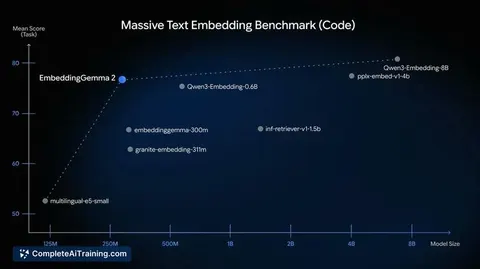
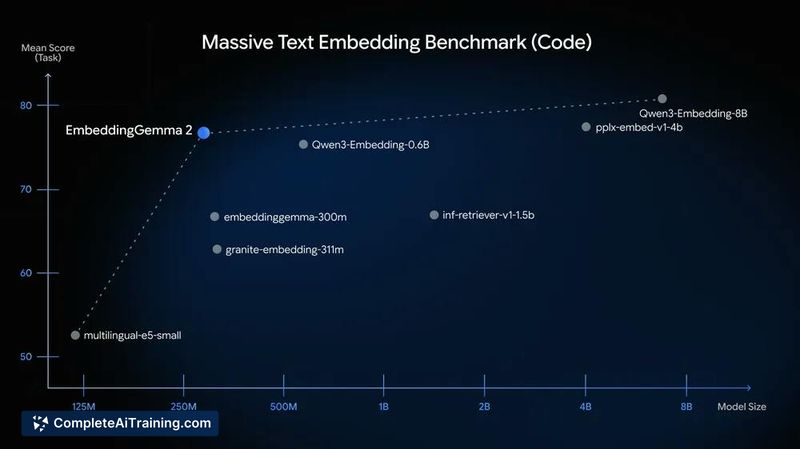
- MTEB Code retrieval score improved from 68.76 to 78.68, a gain of nearly 10 points over the previous version.
- Works with a wide range of frameworks including transformers, sentence-transformers, MLX, vLLM, llama.cpp, Ollama, and LMStudio.
- Shared tokenizer and audio encoder with Gemma 4 means running both together uses less memory than running them separately.
Cons
- Not well suited for teams that need a fully managed cloud embedding service with built-in scaling, monitoring, and zero device-side resource constraints.
- The full multimodal model's 567MB RAM footprint on a Pixel 11 Pro may still be significant for lower-end or older mobile devices.
- As a newly launched model, the ecosystem of tutorials, community troubleshooting, and production deployment stories is still small.
Developers building offline-capable search, RAG pipelines, media retrieval, or local codebase search will find the on-device multimodal approach directly applicable. The modular loading and framework support make it feasible to integrate into existing local inference stacks. For applications where cloud dependency isn't a concern, a traditional API-based embedding service may involve fewer setup steps.