AI tool
Harness²
Harness² lets an AI agent independently adjust its system prompt, tools, and memory for each task. It tests and refines these configurations based on performance, then carries learnings forward to new tasks. This is for developers and researchers ...
About Harness²
Harness² is a plug-and-play recursive agent harnessing framework from Google Research. It lets LLM agents automatically evolve their execution harnesses-the system prompt, tools, memory, skills, and subagents-for open-world tasks without requiring ground-truth verifiers. The framework uses a dual recursion approach: task-level Propose-Probe-Compose refinement combined with harnessing-level accumulation of reusable experience across tasks.
Review
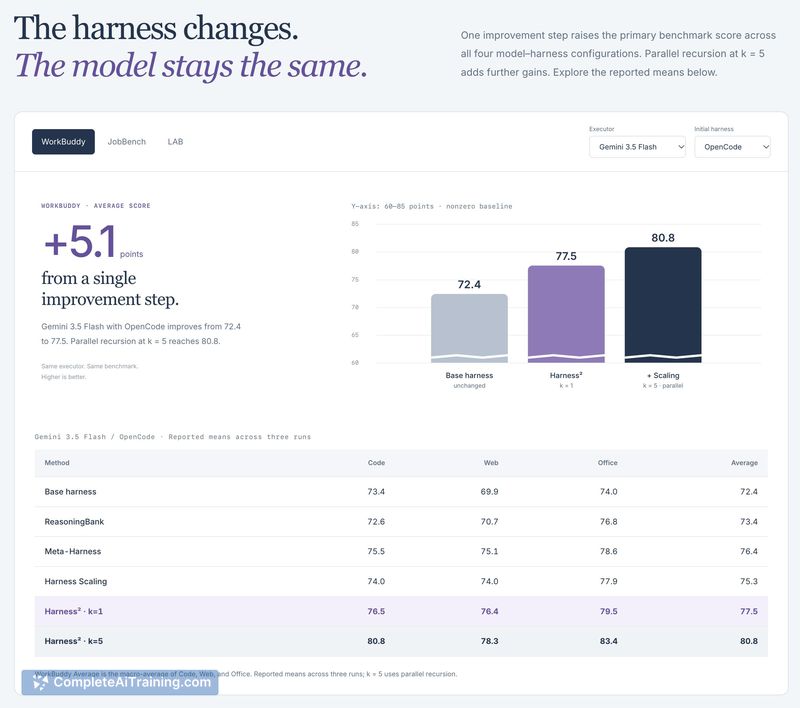
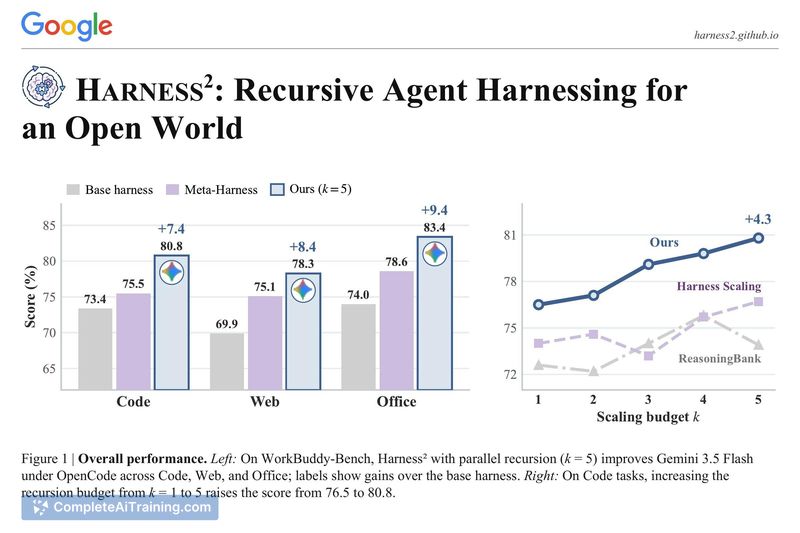
Most LLM agent setups are designed once and stay frozen. Harness² takes a different route, letting the agent adapt its own harness per task while keeping model weights static. The framework proposes changes, tests multiple configurations, and refines based on performance insights from those trials-essentially applying the scientific method to harness evolution.
Key Features
- Dual recursion architecture. Task-level Propose-Probe-Compose refinement runs alongside harnessing-level accumulation, so learnings transfer across tasks rather than starting from scratch each time.
- No ground-truth verifier needed. The agent learns from run-to-run variations, removing the requirement for a defined correct answer or external grader to assess results.
- Cross-task knowledge transfer. Once a task completes, the agent retains the optimized harness and recurring insights. New tasks build on this accumulated knowledge.
- Static model weights. All adaptation happens in the harness layer-prompts, tools, memory, skills-without modifying the underlying model.
Pricing and Value
Harness² is open source and listed as free. Specific licensing terms or any hosted service costs are not yet defined in the available information. The framework targets developers working with LLM agents who want to experiment with self-adapting harness configurations.
Pros
- Eliminates the need for ground-truth verifiers by using run-to-run performance variation.
- Accumulated experience transfers between tasks, reducing repeated setup work.
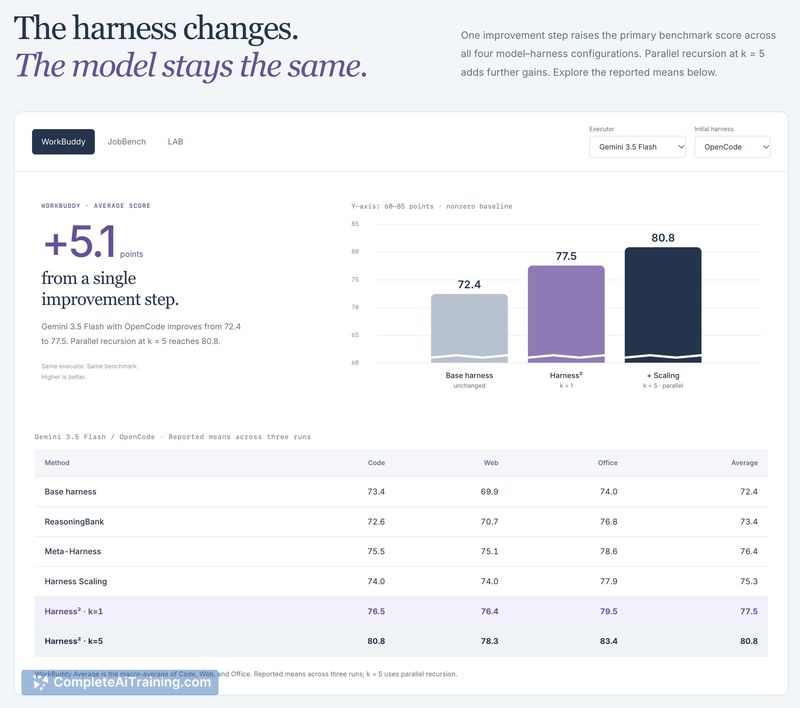
- In trials with Gemini 3.5 Flash and GLM-5, even one round of edits outperformed fixed harnesses on professional benchmarks like WorkBuddy-Bench.
- Open source release allows inspection and modification of the recursive refinement logic.
- Up to +11.5 points improvement on professional benchmarks compared to static harness approaches.
Cons
- Not well suited for teams that prefer deterministic, auditable agent behavior-the self-modifying harness introduces variability between runs.
- The absence of a grader raises questions about how the agent distinguishes helpful changes from harmful ones without external validation.
- Cross-task knowledge transfer between unrelated tasks remains unproven in the publicly shared results, making it unclear how well accumulated experience generalizes.
Harness² fits developers and researchers exploring recursive self-improvement loops for LLM agents, particularly those working on open-world tasks where ground-truth labels aren't available. It's less appropriate for production environments that need consistent, predictable agent behavior or strict audit trails on every configuration change. The framework's real-world utility will become clearer as more users test whether accumulated experience actually transfers across dissimilar task domains.