AI tool
Katzilla
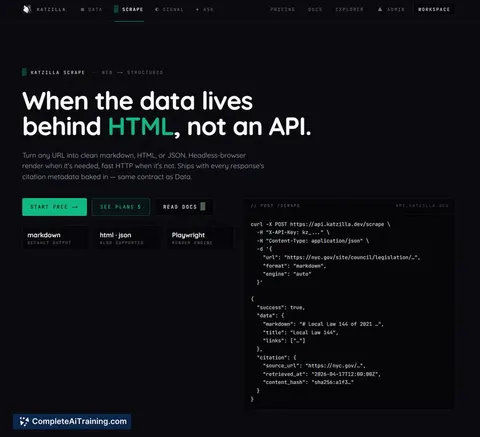
Katzilla is a single API for 250,195+ US government datasets, scrapes, watches and NL queries, returning structured citations (source URL, retrieval timestamp, SHA-256) so agents stop hallucinating and cite primary sources.
About Katzilla
Katzilla is a unified API that gives developers and AI agents structured access to hundreds of thousands of government datasets across 30+ US and foreign agencies. Responses return JSON formatted for agent ingestion and include structured citations (source URL, retrieval timestamp, SHA-256 hash) to support provenance.
Review
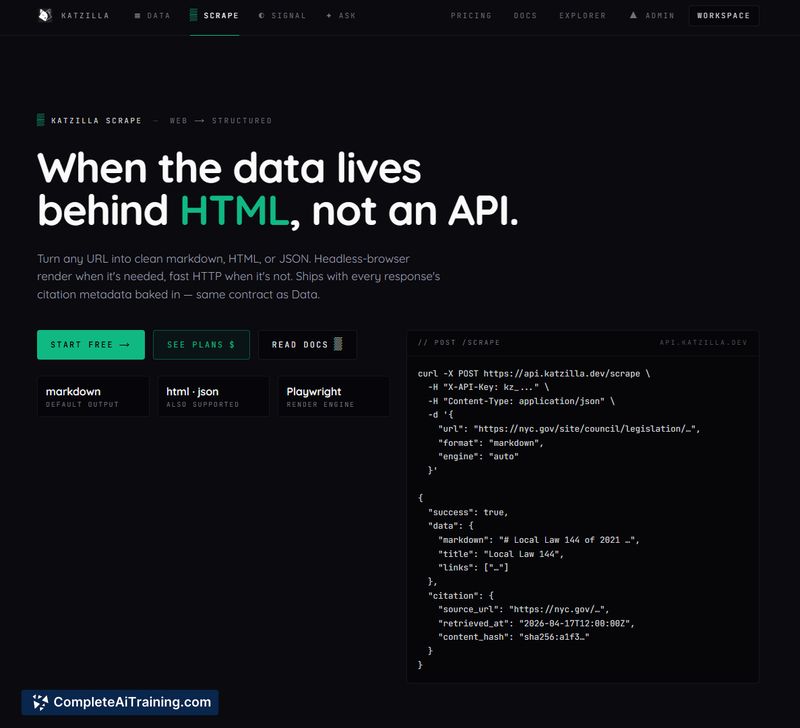
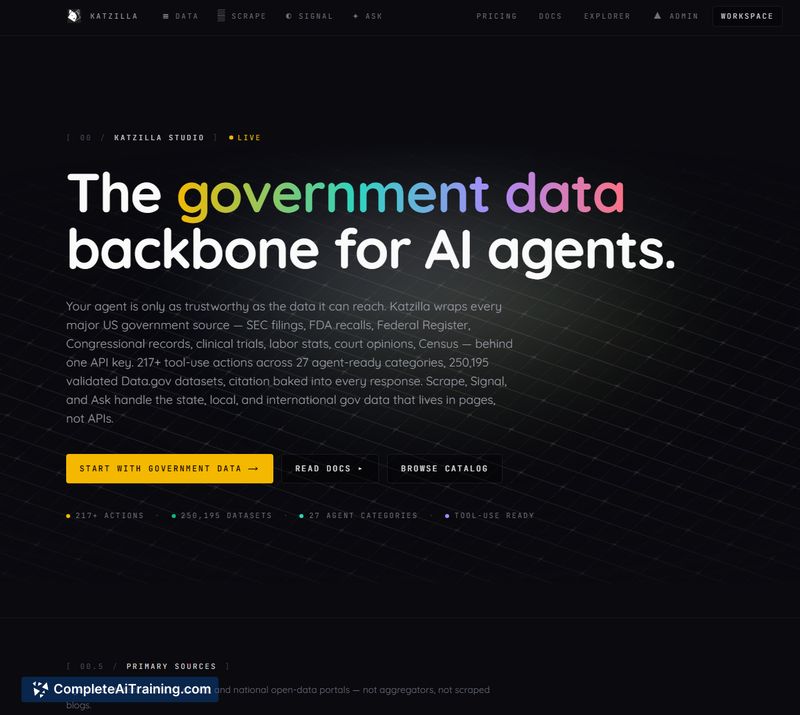
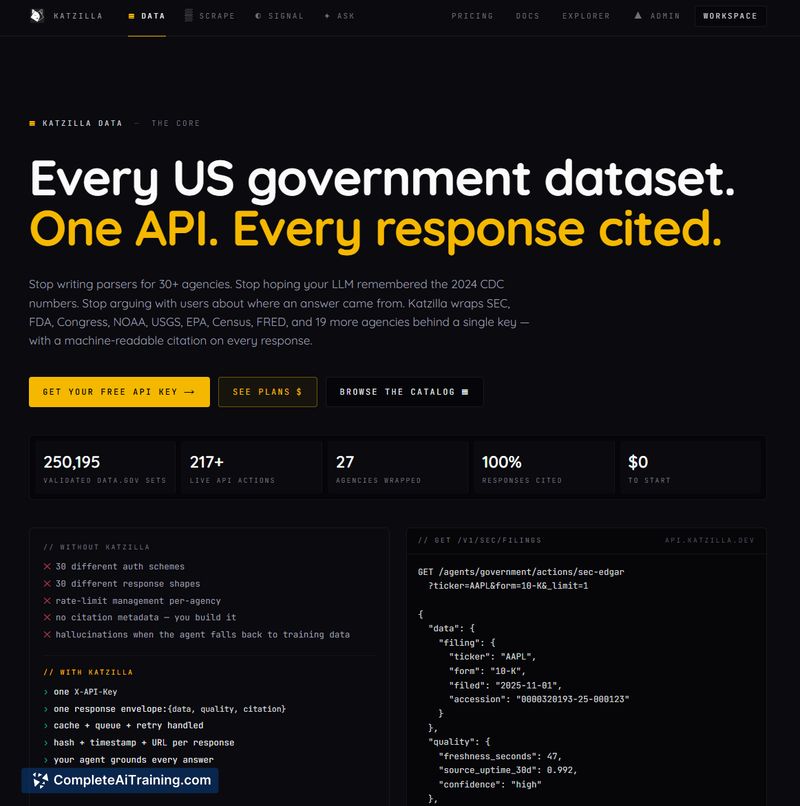

Katzilla acts as application-layer plumbing for agents that need reliable primary-source government data, reducing reliance on stale or uncited model outputs. It bundles multiple agency feeds, supplemental tools for scraping and monitoring, and endpoints that can fan out queries across sources and return synthesized, cited answers.
Key Features
- Unified API access to 250k+ (recently expanded to 391k+) government datasets spanning 30+ agencies, with structured JSON responses.
- Per-response provenance: source URL, retrieval timestamp, and SHA-256 data hash to verify origin and integrity.
- Supplemental actions - Scrape (HTML extraction), Watch (webhooks for changes), Ask (NL queries with citations), and Brief (editorial digests from primary sources).
- Agent-friendly endpoints and routing: /v1/nl supports multi-source routing, /v1/ask and /v1/ask/answer for multi-source queries and synthesized prose with inline citations.
- Developer ergonomics: TypeScript and Python SDKs plus OpenAPI 3.1 compatibility for custom integrations.
Pricing and Value
Katzilla offers a free tier that includes 2,500 requests per month for data endpoints and 1,000 monthly scrape requests with no credit card required. Billing uses a credit model for certain endpoints, and multi-source NL calls that fan out across agencies are billed as a single credit in the current routing design. For teams building agents that must cite primary sources, Katzilla provides value by reducing integration time and adding verifiable citations, though heavy usage or large-scale monitoring will move projects onto paid tiers.
Pros
- Single API surface for many disparate government feeds reduces integration overhead and duplicate glue code.
- Explicit citation metadata and data hashing improve verifiability for research, compliance, and reporting workflows.
- Flexible query options: both parallel multi-source routing and a synthesized-answer endpoint for client convenience.
- SDKs and OpenAPI support make it straightforward to integrate with existing agent frameworks and runtime environments.
- Generous free tier for prototyping and early-stage agent development.
Cons
- Government sources still have individual auth, rate limits, and varying schemas; some client-side handling or schema mapping may still be necessary.
- Complex queries that span many heterogeneous sources can require design decisions about routing, post-processing, and cost management as usage grows.
- Sensitive personal data and certain private records are not provided via government open-data feeds, so Katzilla is not suitable for private-person background checks or similar use cases.
Overall, Katzilla is well suited for developers, data scientists, journalists, and compliance teams that need reliable, cited government data for AI agents, research, or monitoring workflows. It's especially useful when provenance and reproducibility matter; teams that require fine-grained per-source behavior or very high-volume data extraction should plan for rate limits and potential cost trade-offs.
Jobs Katzilla suits
We checked Katzilla against 500+ jobs; these get the most out of it.
Alternatives to Katzilla
Other tools that do the same main job. Our AI compared Katzilla with similar tools and kept the ones you could use instead.