About Laguna by Poolside
Laguna is a foundation model from Poolside, a company building artificial general intelligence for work. The first release, Laguna M.1, is a 23-billion active parameter model with a 256K context window, distributed under the Apache 2.0 license on both checkpoints. It targets agentic coding scenarios and long-horizon tasks where context retention matters.
Review
Laguna M.1 enters the coding-model space as an open-weights release, making it runnable on self-hosted infrastructure. The 256K context window is a central architectural choice, aimed at multi-file refactors and extended agent loops that often hit context limits. As a foundation model, it ships without a built-in agent framework or IDE integration-teams need to bring their own tooling.
Key Features
- 23 billion active parameters, with the full model accessible under open weights.
- 256K token context window for long-horizon coding and agentic workflows.
- Apache 2.0 license on both checkpoints, permitting commercial use, modification, and redistribution.
- Self-hosting capability, allowing teams to run inference on their own hardware and keep code off third-party APIs.
- Fine-tuning readiness-the open weights enable specialization on proprietary codebases or domains.
Pricing and Value
Poolside has not published pricing details for Laguna M.1. The model itself is free to download and use under the Apache 2.0 license. Operational costs depend on the infrastructure used for self-hosting inference or fine-tuning. For teams with existing GPU resources, the open-weights approach can reduce per-token costs compared to closed API services, but it requires in-house engineering effort to deploy and maintain.
Pros
- 256K context window handles long refactors without chunking, which is a known failure mode for many code models.
- Apache 2.0 license removes legal uncertainty for production use and derivative works.
- Self-hosting keeps proprietary source code off external servers, addressing data governance requirements.
- Open weights allow fine-tuning on internal codebases, which can improve accuracy on domain-specific patterns.
- Active parameter count of 23B balances capability with hardware demands, making it feasible to run on a single high-memory GPU.
Cons
- Not well suited for teams without access to GPU infrastructure or the expertise to manage model serving, as there is no hosted API at launch.
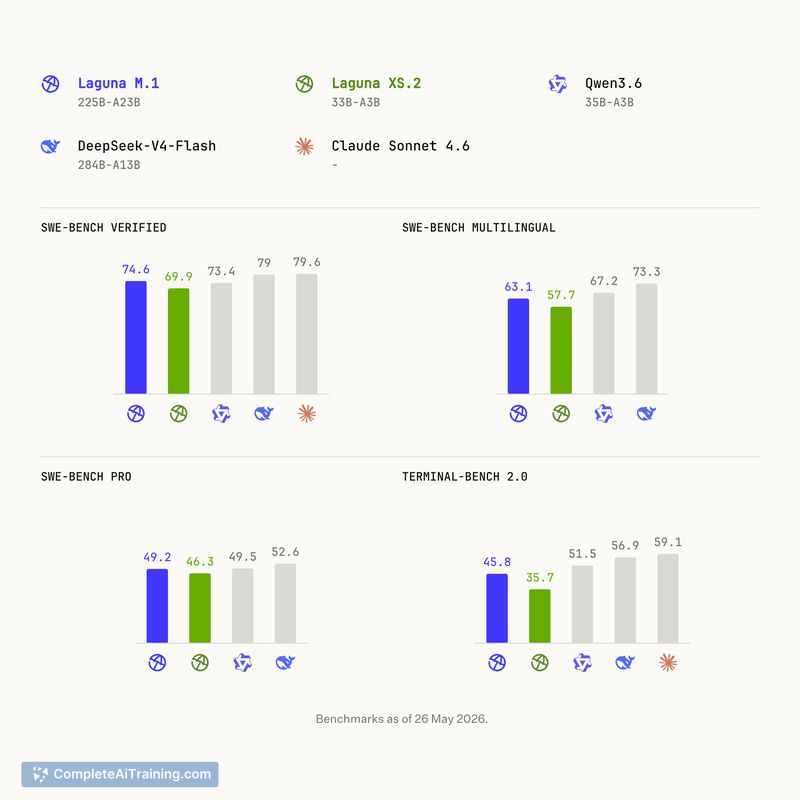
- Real-world performance on multi-file editing tasks is still unverified-current evidence comes from synthetic benchmarks, and early users note that lab numbers often diverge from workflow results.
- No integrated agent loop or coding assistant; users must build their own scaffolding to connect the model to editors, terminals, or CI pipelines.
Laguna M.1 fits organizations that need a coding model they can host and tune entirely within their own environment, particularly where code cannot leave the network. It's a raw model, not a polished developer tool, so teams comfortable with inference engineering and agent orchestration will get the most from it. For those looking for a ready-to-use IDE plugin, this release will feel incomplete.
Open 'Laguna by Poolside' Website
Your membership also unlocks: