About Lamatic 3.0
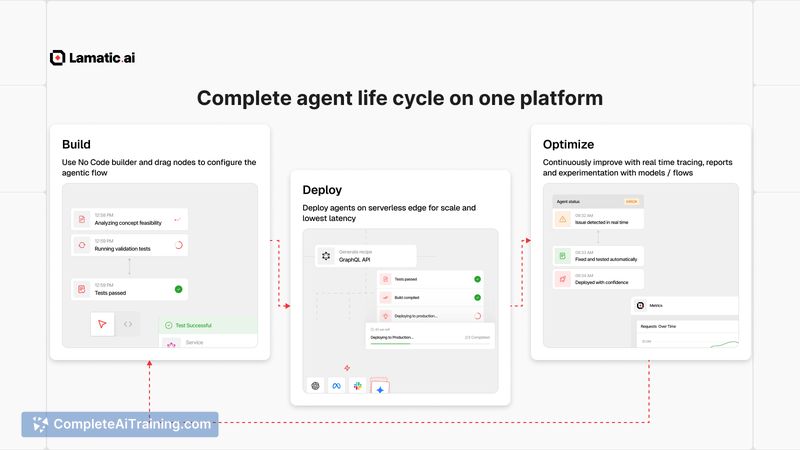
Lamatic 3.0 is an AI middleware platform for building and deploying agentic applications with a visual, low-code interface. It combines a no-code agent builder, serverless edge deployment, and observability tools so teams can iterate on agents without managing complex infrastructure.
Review
Lamatic 3.0 pushes the platform toward a developer- and team-focused workflow by adding a refreshed Studio, GitHub-native version control, and environment support. The release emphasizes faster prototyping and production deployment, with features that help monitor and optimize agents in real time.
Key Features
- No-code visual agent builder with role-based access control and integrated versioning.
- Serverless edge deployment that includes built-in data ETL, VectorDB support, and session memory management.
- Agent Optimization Toolkit: fallbacks, retries, A/B testing, and parallel model execution for more reliable runs.
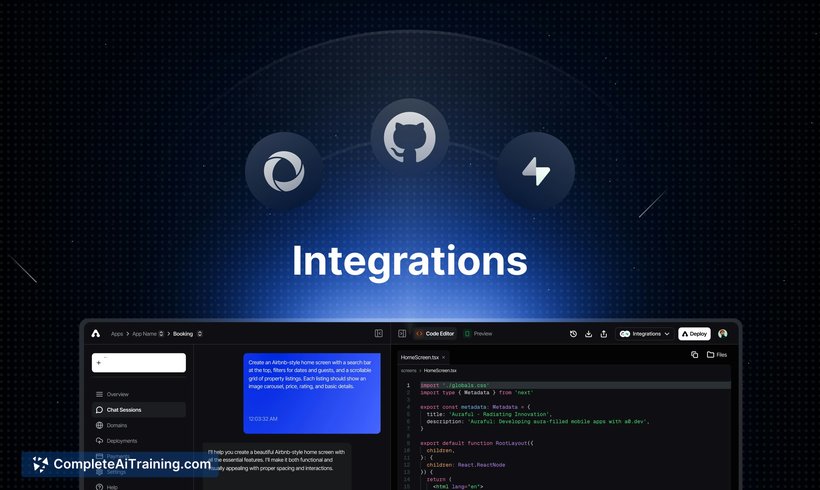
- GitHub-native VCS and environment support plus an open-source SDK and a single federated GraphQL API for integration.
- Real-time traces, experiment logging, a Prompt IDE, and 1-click AgentKit templates for quick launch.
Pricing and Value
There are free options available and periodic launch discounts have been offered (for example, a limited 50% off promotion on three-month plans). Pricing typically follows a tiered SaaS model: a free tier for exploration, paid tiers for team and production usage, and custom plans for enterprise needs. The platform aims to reduce the operational overhead of running agents by bundling deployment, storage, monitoring, and optimization features into a single service, which can deliver strong time savings for teams that need reliable agent behavior without building MLOps pipelines from scratch.
Pros
- Fast path from prototype to production with AgentKits and one-click deployment.
- Team-friendly features like GitHub-native version control, RBAC, and environment management.
- Built-in observability and optimization (traces, experiments, fallbacks) that make iteration measurable.
- Wide set of integrations and an SDK that help connect agents to external data sources and services.
- Visual flow builder and Prompt IDE reduce the need to edit code for many common changes.
Cons
- Onboarding could be smoother for users who have never built agentic systems; more guided samples would help.
- Documentation around advanced logic features and best practices could be deeper for complex production scenarios.
- Detailed enterprise pricing and limits are not always obvious from public pages, which may require sales contact for large deployments.
Lamatic 3.0 is a strong fit for product teams, AI engineers, and domain experts who want to build and run production-grade agents quickly while keeping collaboration and observability in one place. For small teams or proof-of-concept work it offers rapid value; larger organizations should evaluate documentation depth and pricing details against their operational requirements.
Open 'Lamatic 3.0' Website
Your membership also unlocks: