About Lightning Rod
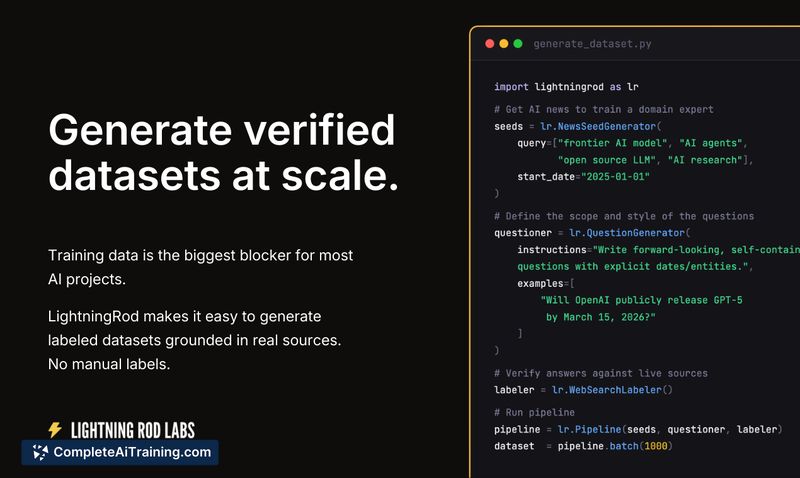
Lightning Rod is a dataset generation SDK and dashboard that converts real-world documents and public news into LLM-ready training datasets using a few lines of Python. It emphasizes automated supervision, provenance for each record, and configurable quality checks to reduce hand-labeling effort.
Review
Lightning Rod focuses on turning historical and public data into structured training examples quickly, using outcomes over time as supervision instead of manual annotation. The platform offers both a developer-focused SDK and a no-code agent, aiming to serve teams that want faster iteration on fine-tuning, evaluation, and dataset preparation.
Key Features
- Python SDK for rapid dataset generation from raw documents, news, filings, and logs.
- Support for private data ingestion (filesets) and public sources, with per-record provenance for auditability.
- Automated scoring, filtering, and deduplication steps with configurable filters and rubrics.
- No-code dashboard and conversational agent to help non-technical users create datasets and fine-tune models.
- Options to run within your cloud or infrastructure to meet data governance and security requirements.
Pricing and Value
Lightning Rod provides free options and offers a $50 free credit for new users. The value proposition centers on reducing time and cost tied to manual labeling by automating dataset generation and quality checks; paid usage is likely based on credits or usage tiers, with enterprise pricing available for larger deployments. For teams that produce many domain-specific datasets, the platform can shorten iteration cycles and lower labeling overhead.
Pros
- Fast generation of training examples from real-world sources, which can shrink dataset creation time from days to hours.
- Provenance per record makes it easier to audit training signal and trace sources back to original documents.
- Configurable quality controls (scoring, filtering, deduplication) help reduce noisy or low-confidence examples.
- Supports proprietary data and on-prem/cloud deployments for teams with strict security or compliance needs.
- No-code agent and dashboard lower the barrier for non-engineering users to produce usable datasets.
Cons
- As a recent launch, public case studies and long-term operational feedback are still limited.
- Quality depends on input data; public sources can introduce bias or noise unless filters and rubrics are tuned carefully.
- Handling of sensitive fields (PII) requires attention from users or deployment inside controlled infrastructure to meet governance needs.
Lightning Rod is well suited for ML engineers and data teams that need to convert internal documents or public signals into labeled training sets quickly, and for product teams that want to prototype fine-tuned models without heavy annotation costs. Smaller teams or non-technical users can also benefit from the no-code agent, though evaluating dataset quality and governance practices remains important before large-scale fine-tuning.
Open 'Lightning Rod' Website
Your membership also unlocks: