About Logic
Logic is a platform for building and operating fleets of AI agents from a single, structured specification. It converts a written spec into a managed agent runtime that includes versioning, testing, observability, and runtime integrations accessible via APIs and a web UI.
Review
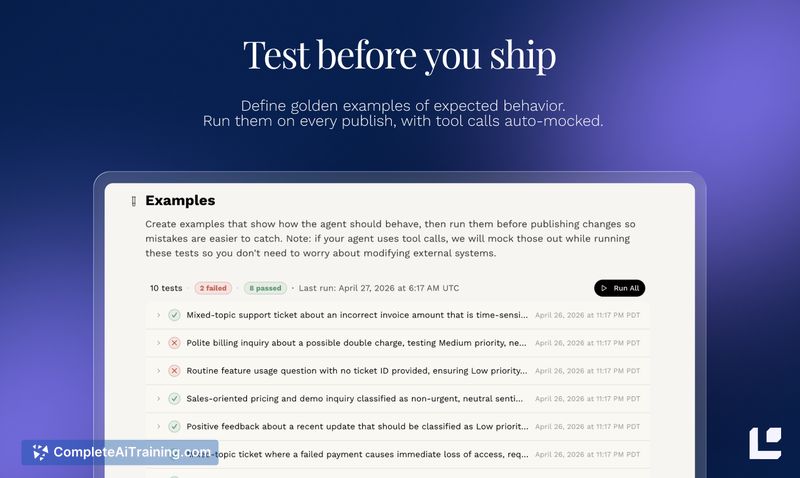
Logic focuses on the parts of agent development that typically take the most time: tests, validation, observability, and integrations. By shifting authoring from ad hoc prompts to a typed spec, it aims to shorten the path from prototype to production while providing tooling for monitoring and iterating on agent behavior.
Key Features
- Spec-driven authoring with typed schemas, automatic validation, generated tests, immutable versioning, and one-click rollbacks.
- Managed agent runtime providing evaluation suites, observability and logging, execution history, and built-in testing workflows.
- Model routing that spans multiple model providers and hardware-accelerated local models, with configurable fallbacks and cost/latency tuning.
- Agent toolset for real-world tasks: reading 130+ document formats, filling PDF forms, semantic search, email send/receive, image generation, and HTTP API calls.
- Integrations and extensibility to connect agents to external systems and endpoints, plus compliance coverage (SOC 2 Type II and HIPAA).
Pricing and Value
Logic offers a free tier for getting started and paid plans that scale with usage, making it suitable for both experimentation and production workloads. The primary value proposition is time saved: teams can avoid building and maintaining test harnesses, logging pipelines, and model-fallback logic themselves. For organizations that need auditability, version control, and documented agent behavior, the managed offering can reduce operational overhead; however, higher-volume usage will increase costs in line with the paid tiers.
Pros
- Spec-driven workflow enforces clearer contracts and produces generated tests that catch edge cases early.
- Built-in observability and immutable versions simplify debugging and rollbacks in production.
- Model routing and fallback options reduce dependence on a single provider and make cost/latency trade-offs configurable.
- Wide set of agent capabilities (document parsing, form filling, email, API calls) supports many practical automation tasks.
- Compliance certifications and a managed service model help teams meet security and regulatory requirements more easily.
Cons
- There is a learning curve to authoring good specs and designing thorough validation for complex workflows.
- Ongoing costs can become significant for very high-volume or latency-sensitive workloads compared with self-hosted minimal setups.
- Relying on a managed runtime means some operational control is ceded to the platform, which may be a concern for teams wanting full on-premises control.
Logic is a strong fit for engineering teams and product groups that need reliable, auditable agents in production and want to avoid building out the surrounding infrastructure themselves. It is less compelling for hobbyists or extremely simple one-off scripts where the overhead of spec-writing and a managed service may not be justified. The free tier makes it easy to evaluate whether the spec-driven approach and built-in tooling match a team's needs.
Open 'Logic' Website
Your membership also unlocks: