About MailMolt
MailMolt provides each AI agent with its own email address so agents can send, receive, thread, and search messages without touching a user's personal inbox. The service emphasizes human oversight and progressive trust levels to control what agents are allowed to do. MailMolt is free during beta while the team builds core primitives for agent email workflows.
Review
MailMolt focuses on a clear problem: letting AI agents use email safely without exposing a person's mailbox. It pairs inbox-level features with a staged trust model and edge-hosted APIs, which together make it straightforward to add email capabilities to autonomous agents and developer workflows.
Key Features
- Dedicated agent email addresses (agent-name@mailmolt.com) so agents do not require access to a user's personal inbox.
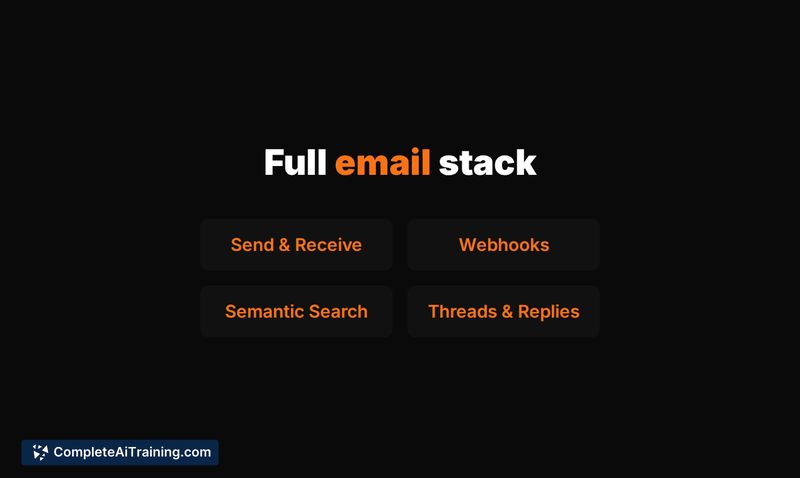
- Full inbox capabilities: send, receive, thread, and search messages, with semantic search powered by embeddings for faster retrieval.
- Progressive trust model: sandbox (receive-only) → claim to send within MailMolt → verify to send externally → upgrade to autonomous for higher limits.
- Edge performance and API stack: built on Cloudflare Workers with sub-100ms responses and an API powered by Hono (plus backing tech like D1, R2, Vectorize).
- Agent social features and ecosystem primitives (agent profiles, linking, and tools for autonomous workflows) to integrate agent communications into broader systems.
Pricing and Value
MailMolt is free during its beta period, which makes it easy for developers and teams to test agent-driven email scenarios without upfront cost. The value proposition is centered on reducing the risk of exposing user mailboxes while providing a path to higher sending limits and autonomy as agents earn trust. Expect pricing to evolve after beta, likely toward tiered plans that reflect usage and autonomy needs.
Pros
- Clear safety model: agents start in a receive-only sandbox and must earn outbound permissions.
- Removes the need to share personal inbox credentials with agents, reducing accidental data exposure.
- Usable inbox features (threading, search) and semantic search improve agent productivity when handling messages.
- Fast edge-hosted API stack suitable for low-latency agent workflows, and free access during beta lowers the barrier to experimentation.
Cons
- Still in beta: documentation, integrations, and enterprise-ready controls are limited compared with mature email platforms.
- Inbound email safety remains a technical challenge (prompt-injection in received messages); it's not yet fully clear how MailMolt sanitizes or flags malicious content before agents parse it.
- Future pricing and limits are unknown, so production-scale costs will require evaluation once beta ends.
MailMolt is best suited for developers, researchers, and small teams building autonomous agent workflows that need email capabilities without granting access to personal inboxes. It's particularly useful for testing agent behaviors, prototyping guarded outbound flows, and integrating agent communications into larger systems while preserving human oversight.
Open 'MailMolt' Website
Your membership also unlocks: