AI tool
Manifest
Manifest is an API that returns a structured JSON action manifest for any webpage to identify clickable and fillable elements. It helps developers building browser agents avoid writing fragile selectors.
About Manifest
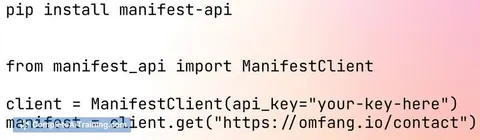
Manifest converts any webpage into a structured JSON action manifest that an AI agent can use to identify clickable elements, fillable fields, and submittable buttons. It returns resolved CSS and role locators for each action, plus a requires field that encodes dependencies between actions (e.g., a field must be filled before a submit button becomes usable). The tool is available as a REST API, a Python SDK, a LangChain integration, and an MCP server.
Review
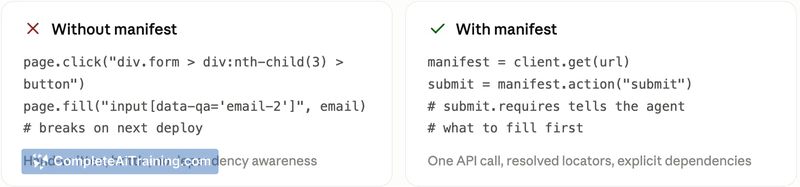
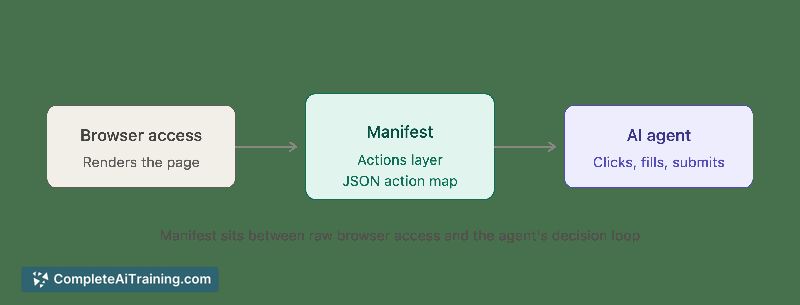
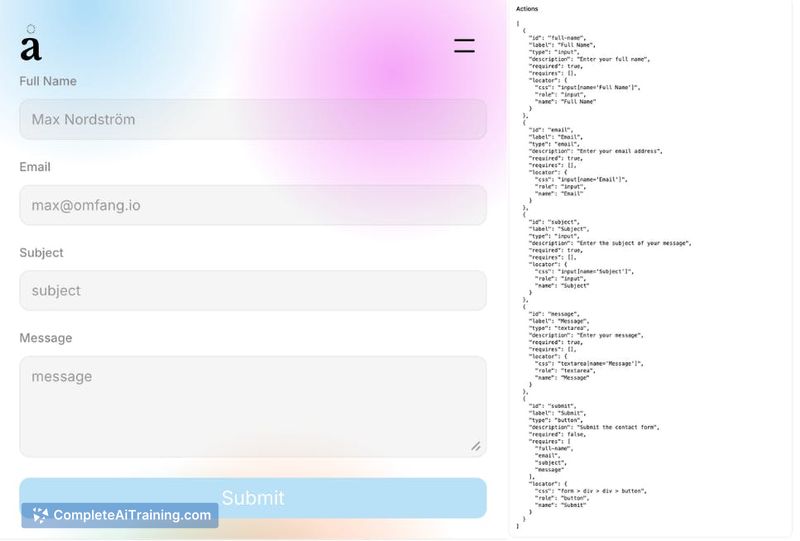

Manifest addresses a specific gap in browser automation for AI agents: the lack of a reliable, machine-readable map of interactive elements and their ordering constraints. Instead of hand-writing fragile selectors, developers can call a single API endpoint to get a snapshot of the current page's actions and dependencies. The requires field is the main differentiator here, capturing dependencies that are often missed by standard accessibility snapshots.
Key Features
- One API call returns a JSON action manifest with locators for clickable, fillable, and submittable elements.
- requires field encodes element dependencies inferred from DOM signals like disabled attributes and form structure.
- Resolved CSS and role locators are included for each action, reducing the need for manual selector maintenance.
- Python SDK, LangChain integration, and MCP server support are available for direct use in agent workflows.
- TTL-based caching (6 hours) keyed on URL, so repeat calls to the same page within the window skip re-extraction.
Pricing and Value
Pricing is not yet defined. The project is currently pre-revenue and offers a free tier, with no sign‑up required to test the demo. As the founder notes, the service is still in an early stage, so commercial terms are expected to emerge later.
Pros
- Delivers structured action data that includes dependency ordering, something accessibility snapshots alone don't provide.
- Integrates directly into existing agent toolchains via LangChain, the MCP server, and a Python SDK.
- Removes the need to hand‑craft and maintain selectors that break when a site's DOM changes.
- TTL caching cuts down on redundant extraction calls for unchanged pages.
- Straightforward API design - one call per page state, with clear documentation of what the requires field represents.
Cons
- Bot-protected sites (Cloudflare, Akamai, HUMAN) may block the headless Playwright extraction, limiting reach on checkout surfaces and other guarded pages.
- The stateless, per‑call design means an agent must re‑fetch the manifest after every state‑changing action, which adds latency and cost in multi‑step flows.
- Not well suited for single‑page applications where a button's availability depends on async server‑side validation that isn't reflected in the initial DOM snapshot; the requires field is inferred from static signals, not live probing.
Manifest is most useful for developers building browser agents who need a quick, structured map of page interactions and can work within its stateless snapshot model. It fits straightforward form‑filling flows and sites where dependencies are visible in the DOM at extraction time. For teams dealing with heavy bot protection or complex SPA workflows that demand runtime state probing, the current limitations mean extra workarounds are still necessary.
Jobs Manifest suits
We checked Manifest against 500+ jobs; these get the most out of it.
Alternatives to Manifest
Other tools that do the same main job. Our AI compared Manifest with similar tools and kept the ones you could use instead.