About MemoryCustodian
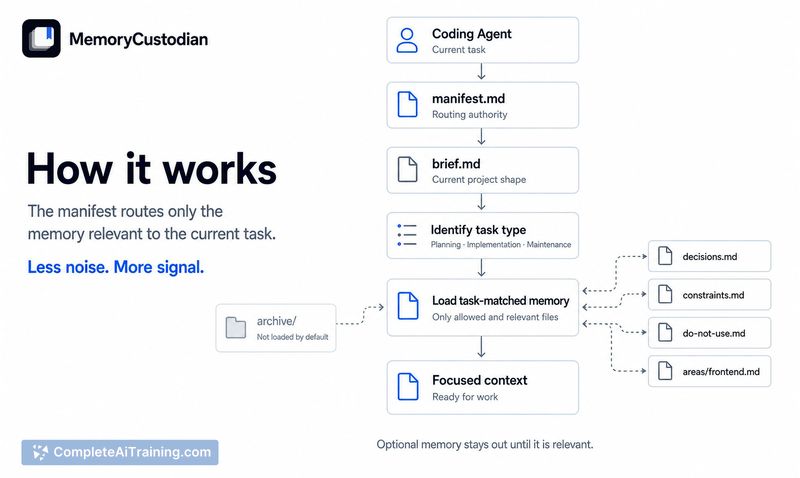
MemoryCustodian is a tool that gives coding agents like Codex, Claude Code, and Gemini durable project memory stored as plain Markdown inside the repository. Rather than injecting every past decision into every prompt, a manifest loads only the memory files relevant to the current task. The memory is local-first, open source, and lives alongside the code where it can be reviewed, versioned, and shared through normal Git workflows.
Review
Coding agents often lose context between sessions, burying important decisions, constraints, and rejected approaches in old chat logs. MemoryCustodian addresses this by keeping project memory as versioned Markdown files that the agent can read and write. A task-specific manifest selects which files get loaded, so the memory can grow without bloating every prompt.
Key Features
- Repo-native memory: all decisions, constraints, and rejected approaches are plain Markdown files committed to the repository, not a separate database.
- Manifest-based selective loading: a manifest maps task categories (e.g., planning, implementation) to a fixed set of memory files so the agent doesn't load the entire history.
- Explicit memory operations: the tool supports updating, correcting, and safely forgetting memory entries, with commands like
memory-custodian readto inspect what gets loaded. - Cross-agent compatibility: works with Codex, Claude Code, Gemini, and generic coding-agent workflows because it relies on file I/O, not agent-specific APIs.
- Free and open source: the project is licensed openly and runs locally without a hosted service.
Pricing and Value
MemoryCustodian is free and open source. There is no paid tier or hosted service. All memory stays in the user's repository, and no external accounts are required.
Pros
- Memory is versioned alongside code, so every change is tracked in Git history and stays on a branch until merged.
- Manifest system avoids polluting every prompt with the full project history-only the relevant subset loads.
- Memory files are plain Markdown, so they are human-readable, diffable, and reviewable outside the agent.
- Supports multiple coding agents without requiring any integration glue beyond file system access.
- No external service means project memory doesn't leave the repo, and the tool works offline.
Cons
- Not designed for multi-repo projects: today each repository has its own memory root, so a constraint set in one repository won't be visible to an agent working in another.
- The manifest relies on the agent correctly classifying the task category; a wrong classification can silently omit relevant memory.
- Git merges can cleanly combine contradictory memory entries without raising an error-v0.9.1 has no built-in contradiction detection.
MemoryCustodian fits well for single-repo projects where a team wants to keep coding agent context in version control and avoid external services. It's less suited for multi-repo setups or workflows that need automatic detection of conflicting memory across branches. The tool's open-source nature and plain-text approach make it straightforward to inspect and adapt to specific project conventions.
Open 'MemoryCustodian' Website
Your membership also unlocks: