AI tool
Microsoft-Decision-1
Microsoft-Decision-1 is a model that scores structured decisions by returning calibrated probabilities for fixed options like yes/no or multiple-choice. It is built for developers who need fast, accurate routing, classification, or verification in...
About Microsoft-Decision-1
Microsoft-Decision-1 is a decision-scoring model built for routing, classification, verification, and agent control. It accepts fixed options and returns a calibrated probability for each in a single pass, producing structured output that software can act on without parsing free text. The model is post-trained from Qwen3.5-9B and is available now in Microsoft Foundry.
Review
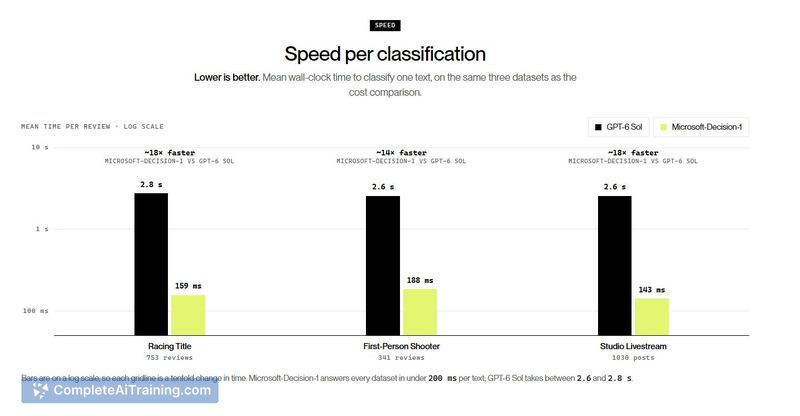
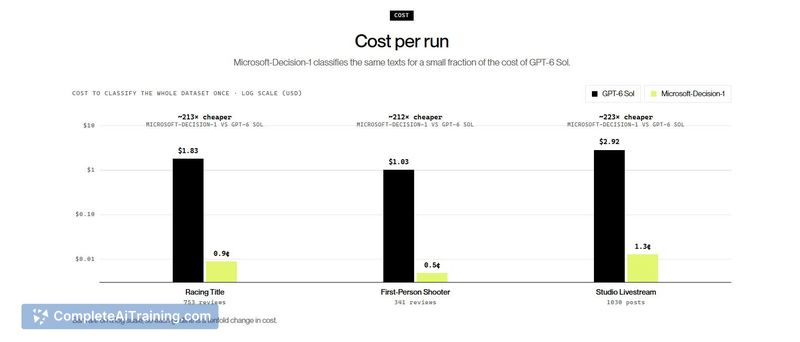
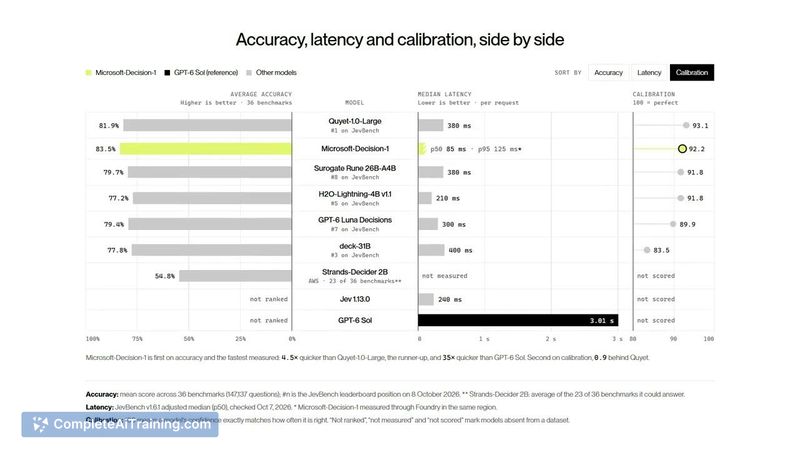
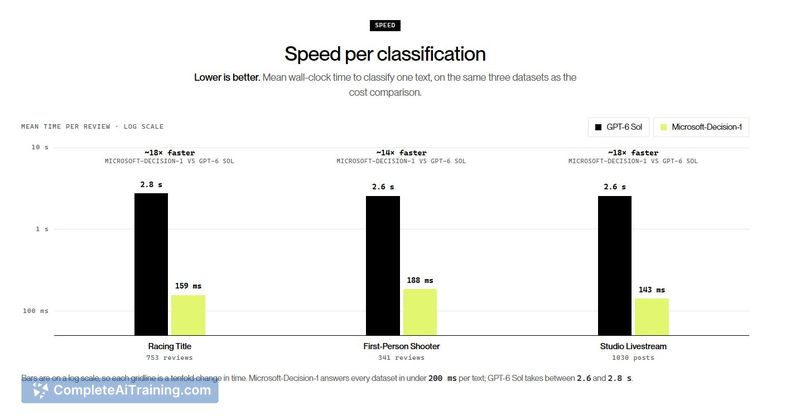
Microsoft-Decision-1 enters a specific niche: replacing general-purpose LLMs for tasks where the answer is always a choice among known options. By removing text generation from the equation, it cuts latency significantly-Microsoft reports about 35x faster median response times than GPT-6 Sol. The trade-off is a narrower scope. This model doesn't chat, reason through novel problems, or generate content; it scores decisions against a predefined set of choices.
Key Features
- Returns calibrated probabilities for yes/no, multiple-choice, and rating options as structured output, eliminating the need to parse generated text.
- Performs rubric-based grading of AI responses and agent actions through a structured API call.
- Post-trained from Qwen3.5-9B, with Microsoft stating plans to rebase the model on other architectures, including Microsoft AI (MAI) and OpenAI models.
- Demonstrates consistent decisions across eight types of input perturbations, changing its output on 1.3% of cases on average and never when option descriptions are paraphrased or options are reversed or shuffled.
- Tested on 5,250 requests across 11 safety benchmarks, refusing harmful behavior while maintaining utility according to Microsoft's published results.
Pricing and Value
Microsoft-Decision-1 is priced at $0.042 per million input tokens, with output tokens free. It is available now in Microsoft Foundry, and OpenRouter access is listed as coming soon. For comparison, Microsoft's internal teams reported running labeling tasks at 200x lower cost than GPT-6 Sol. The cost structure suits high-volume, repetitive decision workloads where per-call pricing on larger models would accumulate quickly.
Pros
- Measured latency is 4.5x faster than the next-fastest model tested and roughly 35x faster than GPT-6 Sol at median, which matters for workflows with many sequential decisions.
- Output is structured probabilities directly, removing a parsing step and reducing the surface for formatting errors in production pipelines.
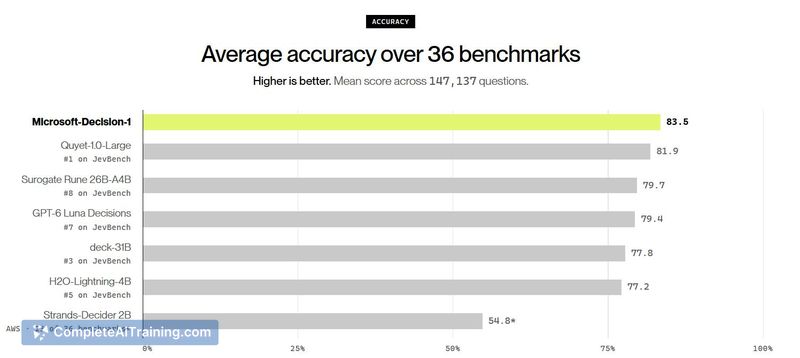
- Microsoft reports the highest accuracy in a 36-benchmark comparison covering nearly 150,000 questions kept blind from training.
- Consistency metrics are unusually detailed: the model doesn't flip decisions when options are paraphrased, reversed, or shuffled.
- Free output tokens mean cost is predictable and tied solely to input volume.
Cons
- The model handles only fixed-option decisions. Workflows requiring open-ended reasoning, explanation, or content generation still need a general-purpose LLM.
- Calibration is measured against a specific test distribution. A user in the launch discussion noted that production traffic drifts, and without built-in drift monitoring, confidently wrong probabilities could go unnoticed.
- It is not well suited for teams whose decision tasks don't fit a predefined option structure or who need the model to articulate the reasoning behind a score.
Microsoft-Decision-1 fits teams running high-volume, structured decision pipelines-routing, content filtering, data labeling, or AI judging-where speed and cost per decision outweigh the flexibility of a general model. Its consistency under input perturbations makes it plausible for guardrail and verification roles where unpredictable flips would break downstream logic. Teams with ambiguous or evolving decision taxonomies, or those who need interpretability alongside the score, will likely keep a general-purpose LLM in the loop.