AI tool
Mistral Medium 3.5
Mistral Medium 3.5 is a 128B merged model for instruction-following, reasoning and coding, with a 256k context window, configurable per-call reasoning, 77.6% on SWE-Bench Verified, and self-hosted on four GPUs.
About Mistral Medium 3.5
Mistral Medium 3.5 is a 128B dense language model that combines instruction-following, reasoning, and coding capabilities in a single set of weights. It offers a very large 256k context window and configurable reasoning effort per request, with open weights available for self-hosted deployment.
Review
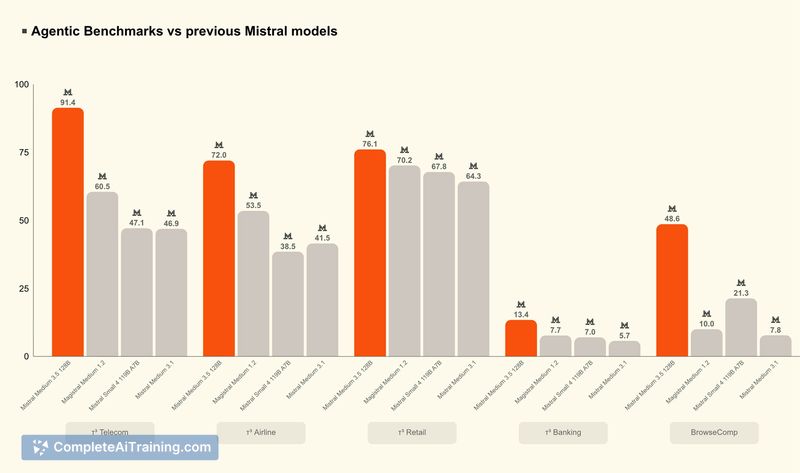
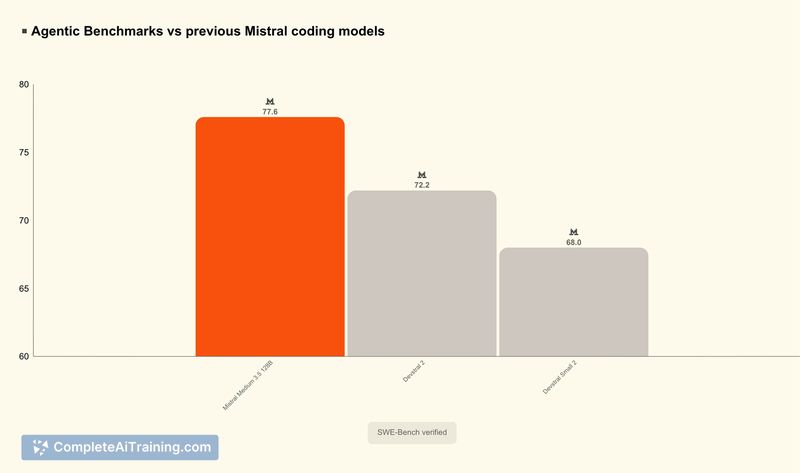

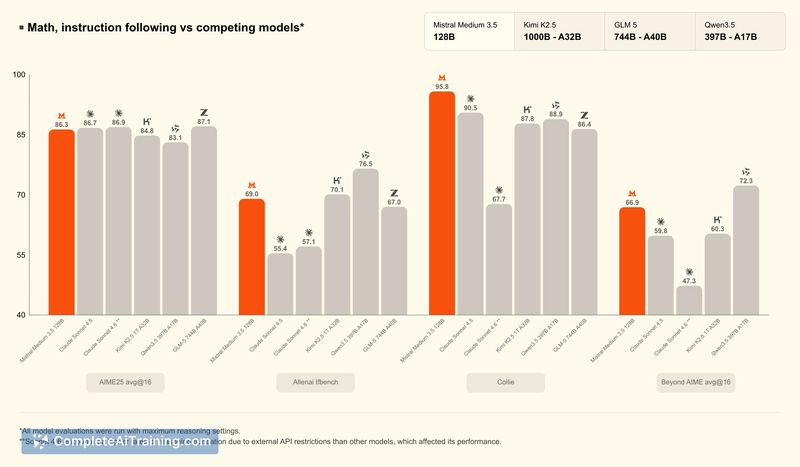
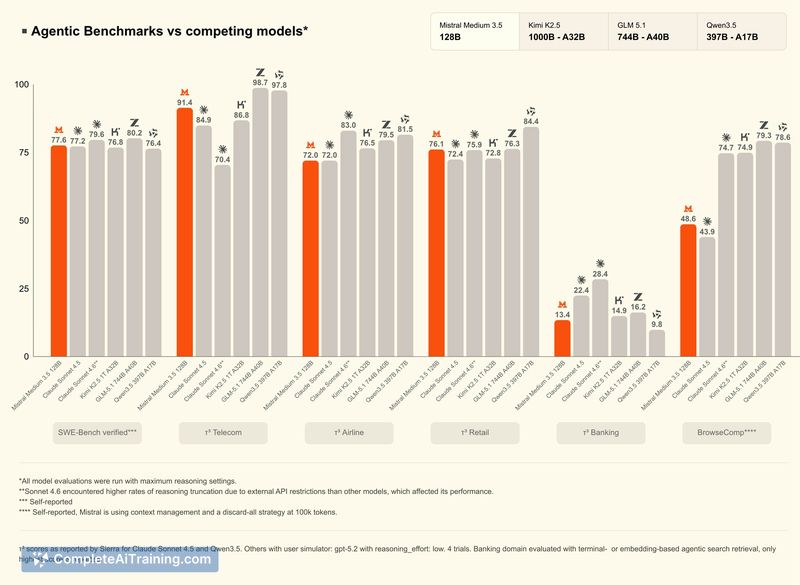
This release aims to provide a high-capability model that can run on modest infrastructure while supporting tasks from quick chat replies to long-horizon coding and reasoning jobs. Public benchmarks report competitive performance, and the model's distribution includes open weights under a permissive license for teams that want to run or tune it on-premises.
Key Features
- 128B dense model that merges instruction-following, coding, and reasoning into one set of weights
- 256k token context window for long documents, codebases, and multi-step workflows
- Configurable reasoning effort per call to trade off latency and depth of computation
- Open weights released under a modified MIT-style license for local use and fine-tuning
- Self-hostable on relatively small GPU setups and provided as containers for common GPU platforms
Pricing and Value
API pricing is offered on a per-token basis (example rates reported at $1.5 per million input tokens and $7.5 per million output tokens). The availability of open weights is a key part of the value proposition: teams that can run the model on their own hardware can avoid ongoing API fees and perform custom fine-tuning or auditing. The configurable reasoning effort helps control cost and latency for mixed workloads by applying deeper compute only when needed.
Pros
- Single model that covers instruction-following, coding, and reasoning workloads, reducing complexity of model selection
- Very large context window useful for long-form code, documents, and chaining multi-step tasks
- Open weights enable on-prem deployment, auditing, and customization
- Configurable reasoning effort provides a practical knob for cost and performance trade-offs
- Can be run on modest GPU counts relative to models of similar capability
Cons
- Self-hosting still requires non-trivial GPU resources and systems engineering to get optimal performance
- Open-weight distribution uses a modified license that teams should review for compatibility with their use case
- Ecosystem and tooling around a new flagship model may lag more established options in some integrations
Overall, this model is well suited for backend and ML engineers or teams that need an open-weight option for agentic pipelines, coding assistants, or on-prem inference where control and customizability matter. It makes particular sense for groups prepared to invest in the infrastructure and integration work required to host and tune a large model.
Jobs Mistral Medium 3.5 suits
We checked Mistral Medium 3.5 against 500+ jobs; these get the most out of it.
Alternatives to Mistral Medium 3.5
Other tools that do the same main job. Our AI compared Mistral Medium 3.5 with similar tools and kept the ones you could use instead.