AI tool
Mozaik
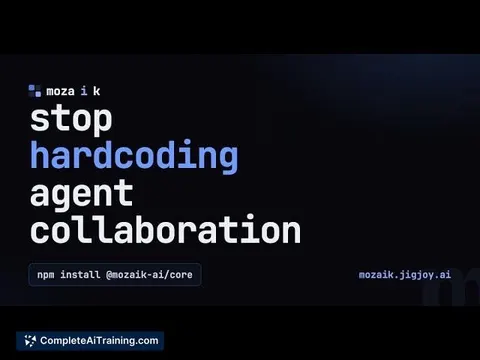
Mozaik enables agent collaboration decided at runtime, removing the need for a hardcoded workflow graph. It is for developers building multi-agent systems where agents self-organize dynamically.
About Mozaik
Mozaik is a TypeScript runtime for self-organizing AI agents. It lets developers create agent teams that decide dynamically how to collaborate during execution, without a predefined workflow graph. Communication runs through semantic events with structured context, and the runtime coordinates concurrent, asynchronous work.
Review
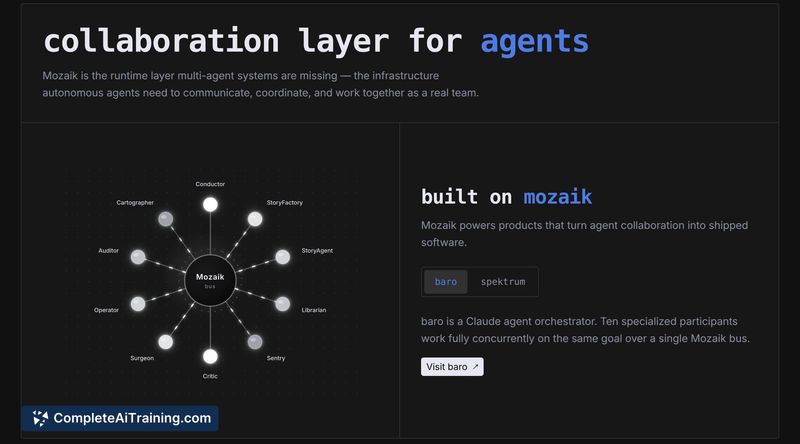
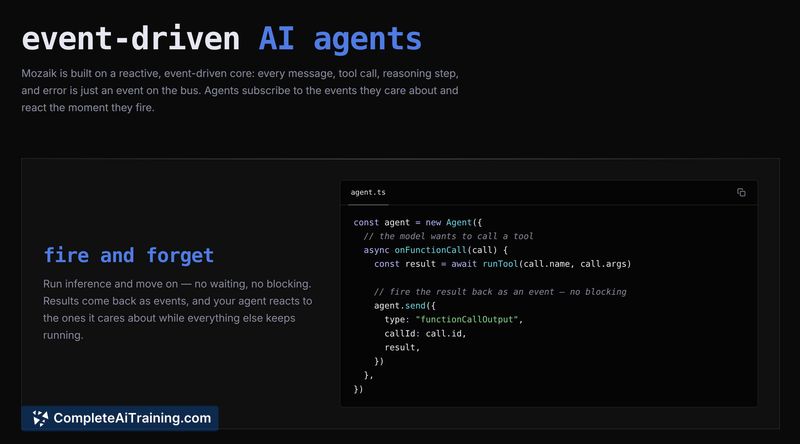
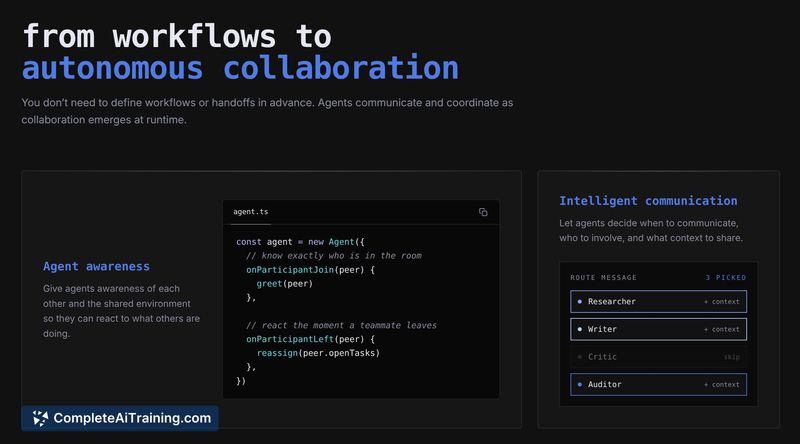
Mozaik enters the agent framework space with a focus on runtime coordination rather than hardcoded workflows. Agents operate asynchronously and react to events, building collaboration patterns on the fly. This shifts complexity from upfront design to runtime dynamics, bringing both flexibility and new engineering questions around cost and control.
Key Features
- Self-organizing agent teams: agents coordinate at runtime, avoiding a fixed DAG.
- Semantic event communication: events carry structured context items (per the OpenResponses spec) wrapped with participant IDs, so agents interpret intent more precisely.
- TypeScript-native runtime: first integration installs a package, then developers define agents as participants connected through a shared environment.
- Pluggable memory and planning: Mozaik provides ports for persisting participant context; developers can wire in their own storage (in-memory, files, vector DB, etc.).
- Concurrent asynchronous execution: agents run non-blocking and handle many parallel processes without polling loops.
Pricing and Value
Mozaik is currently listed as free. The makers have not published a pricing model or future monetization plans. Users can adopt the runtime at no cost during this initial release.
Pros
- Agents coordinate at runtime, removing the need to draw a full workflow graph upfront.
- Structured context items tied to participant IDs reduce guesswork when one agent fires an event and another picks it up.
- Fits into an existing TypeScript project with minimal ceremony: install the package, define a few agents, connect them.
- Asynchronous, non-blocking design allows agents to work concurrently without wasting compute on idle polling.
- Configurable persistence ports give developers flexibility to choose memory backends that survive process restarts.
Cons
- Shared-state conflicts are not resolved automatically; developers need to implement their own coordination logic for now.
- The runtime lacks built-in execution budgets, cost logging, and loop detection - these safeguards are still on the roadmap.
- Not well suited for teams that require deterministic workflow paths and predictable token consumption, because runtime decisions make costs variable and hard to forecast.
Who Mozaik is for
Mozaik fits TypeScript developers experimenting with autonomous agent architectures where emergent collaboration matters more than pre-planned sequences. It serves as a foundation for prototypes and explorations where runtime flexibility is the priority. For production systems that need cost transparency and reliable coordination guardrails, the current early-stage feature set likely falls short.
Jobs Mozaik suits
We checked Mozaik against 500+ jobs; these get the most out of it.
Alternatives to Mozaik
Other tools that do the same main job. Our AI compared Mozaik with similar tools and kept the ones you could use instead.