AI tool
Odyssey 3
Odyssey 3 is a foundation world model that generates interactive environments from text prompts and predicts how they change in real time as users or AI agents act within them. It is intended for researchers and developers working on simulation, r...
About Odyssey 3
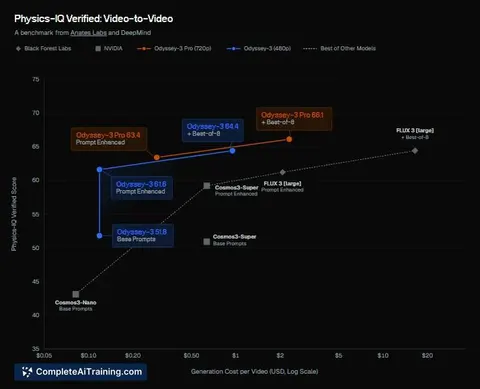
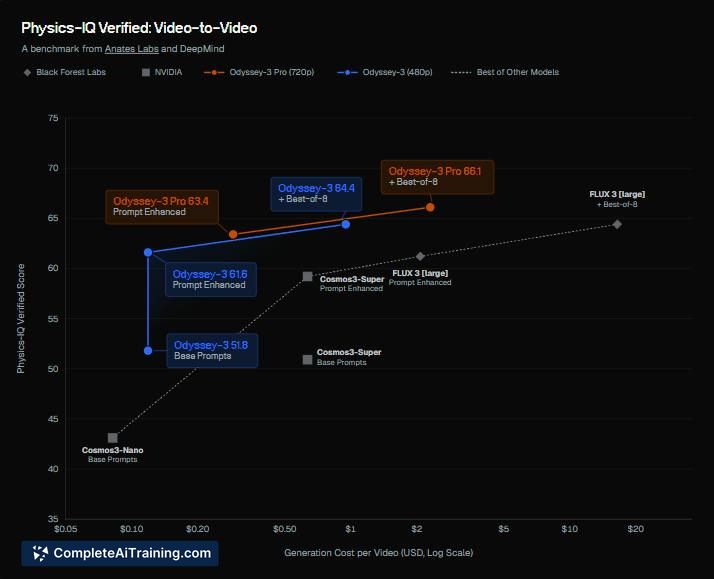
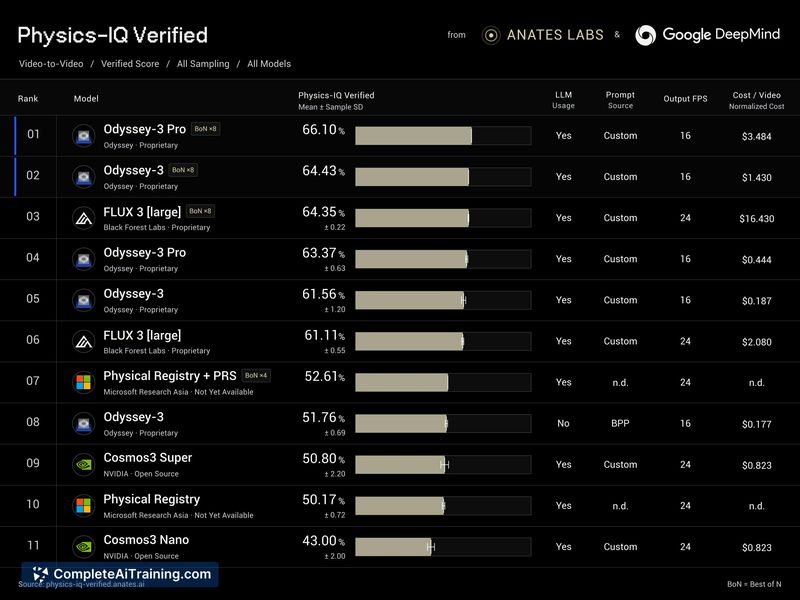
Odyssey 3 is a foundation world model that generates interactive environments from a text prompt. It predicts, in real time, how those environments change as a user or AI agent acts within them. The Pro version reports a Physics-IQ Verified video-to-video score of 66.1 using best-of-8 sampling.
Review
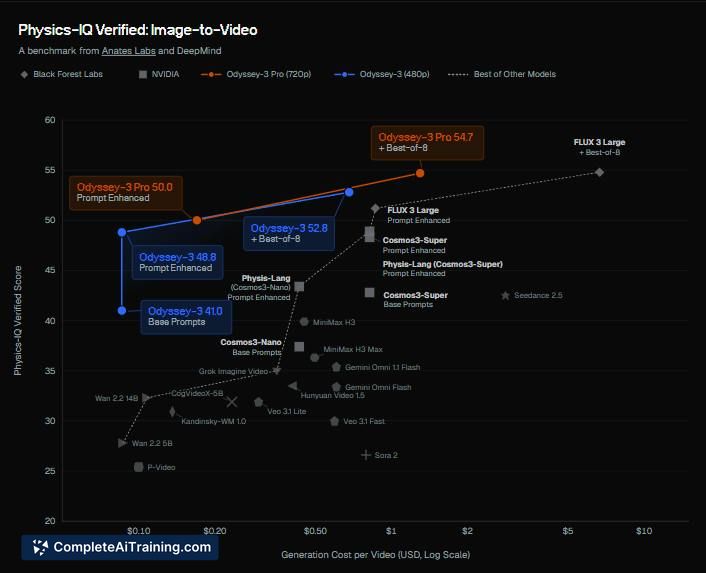
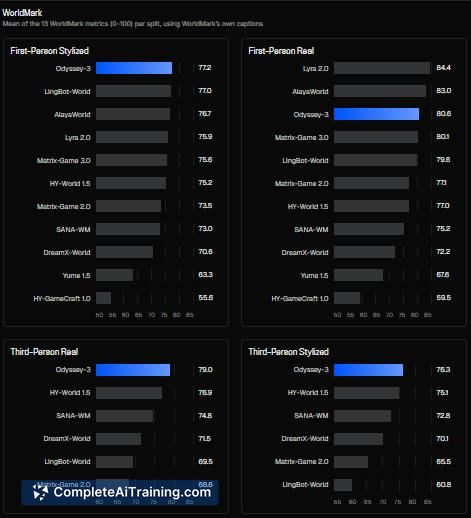
Odyssey 3 takes a different approach to video generation by focusing on physical simulation rather than just visual output. The model reacts to actions and events as they happen, and the same core architecture has been adapted to control physical machines. This review covers what's currently available in the research preview and what the published benchmarks actually measure.
Key Features
- Prompt-to-environment generation. Users type a description and the model produces a navigable 3D scene with first-person and third-person views, plus independent camera movement.
- Real-time interaction. A distilled few-step version of the model reacts to user input and agent actions without pre-rendering, making interactive sessions possible at usable speeds.
- Cross-embodiment adaptation. By training a small action decoder or policy on top of the frozen foundation model, the system has been used to control robot arms, humanoid robots, and a car on real roads.
- Physics-IQ Verified benchmark. The Pro model scores 66.1 on video-to-video and 54.7 on image-to-video in tests covering fluid dynamics, optics, solid mechanics, magnetism, and thermodynamics.
- Agent training support. Early experiments show the model generating multiple camera views of driving scenes and allowing agents to pursue natural-language goals inside the generated world.
Pricing and Value
Odyssey has not yet published pricing details. The research preview at experience.odyssey.systems is available now at no cost. Physical AI developers working on robots, humanoids, cars, or drones can contact Odyssey directly for API access, but the terms and pricing for that access remain undefined.
Pros
- Reports the highest Physics-IQ Verified video-to-video score among published results, with the benchmark covering multiple physical domains.
- The same frozen model backbone transfers to real-world machines-robot arms, humanoids, and a car-without retraining the core world model.
- A distilled version enables real-time interaction, which matters for any use case where latency breaks the simulation loop.
- Recovery behaviors emerged during robot arm tasks that weren't present in the demonstration data, such as re-orienting after a missed grasp.
- Humanoid control policies built on the model kept working under lighting changes that caused tested VLA baselines to fail.
Cons
- The headline benchmark score of 66.1 uses best-of-8 sampling, while real-time use is single-sample by definition. The single-shot score for the distilled model isn't published, which makes direct comparisons to single-sample baselines difficult.
- Details remain thin on whether the visual prediction core was retrained on real sensor data for robot and car control, or if control decisions run directly on video-prediction outputs-a distinction that affects reliability for physical tasks where exact friction, mass, and contact points matter.
- This tool is not well suited for teams that need a production-ready physics simulation with documented single-shot accuracy metrics and transparent pricing. The current release is a research preview, and the adaptation work for robotics required tens of hours of demonstration data plus custom policy training.
Odyssey 3 fits teams exploring generative world models for simulation and embodied AI research, especially those with the resources to train their own action decoders on top of the frozen model. Robotics labs that need a visually grounded simulator and can supply demonstration data may find the cross-embodiment transfer useful. Teams requiring deterministic, numerically precise physics with published single-sample metrics should wait for more detailed benchmarks and pricing before committing.