About Parastore
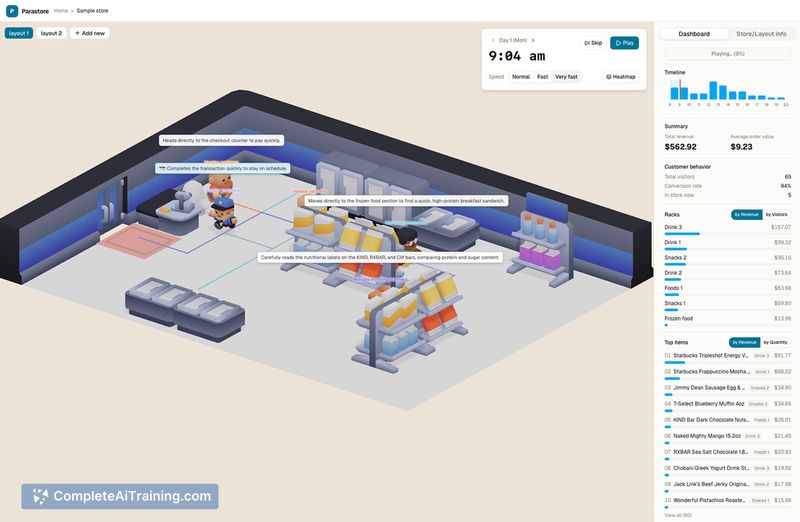
Parastore is an open-source (MIT) retail simulation where LLM-powered synthetic consumers walk through a 3D virtual store, browse shelves, and make purchase decisions. Agents follow one of 12 behavioral patterns with grammar-constrained actions, randomized context (mood, budget, company), and impulse-buy logic based on what they encounter.
Review
Parastore offers an agent-based approach to explore shopper behavior and to test store layouts, merchandising, and product placement without physical trials. The project is implemented with Python/FastAPI and React/Three.js, supports any LLM backend, and provides a simpler open-source pipeline distinct from the proprietary persona engine used for higher-accuracy validation.
Key Features
- 3D virtual store simulation where synthetic consumers walk aisles, inspect items, and make purchases.
- Twelve behavioral patterns with grammar-constrained action scripts and randomized contextual attributes (mood, budget, company).
- Impulse-buy triggers that react to proximity and viewable items during an agent's route.
- LLM-agnostic design so you can plug in different language models as the decision engine.
- Open-source (MIT) codebase built on Python/FastAPI and React/Three.js for customization and extension.
Pricing and Value
The core project is free and released under the MIT license, making it accessible for experimentation, research, and extension. Operational costs arise from LLM usage: each simulation run can invoke the chosen model hundreds of times, so model API fees and compute are the primary expenses. For teams that can accept experimental accuracy from the open-source pipeline, the tool offers strong value for layout testing and agent-behavior research; for production-grade accuracy, additional engineering or commercial models may be needed.
Pros
- Open-source MIT license lowers adoption barriers for developers and researchers.
- Realistic agent features (mood, budget, impulse logic) make simulated shopper journeys more expressive than simple rule-based testers.
- LLM-agnostic and built with common web and Python stacks, which eases integration and customization.
- Validation reported against real POS data shows promising correlation for the proprietary pipeline.
Cons
- The open-source pipeline is a simplified version of the proprietary system and may not match published validation out of the box.
- Simulation runs can be expensive because they call LLMs many times, which adds nontrivial operating cost.
- Early-stage launch means documentation and polish may be limited compared with mature commercial products.
Parastore is best suited for developers, researchers, retail analysts, and product teams who want to prototype store layouts, test agent behaviors, or experiment with agent-based retail simulations. It works well as an extensible research platform, but teams seeking turnkey, high-confidence predictions should plan for additional tuning, model costs, or integration with more advanced persona engines.
Open 'Parastore' Website
Your membership also unlocks: