About Pensieve
Pensieve is a tool that builds a living knowledge graph of an organization by connecting to the tools teams already use. It organizes people, projects, decisions and customer interactions so AI agents start interactions with rich context rather than raw, disconnected data.
Review
This review looks at how Pensieve creates continuous organizational context for AI agents, how it handles integrations and permissions, and where it may fit into a team's workflow. The assessment covers features, pricing, strengths, and limitations based on the product's stated approach and capabilities.
Key Features
- Knowledge graph mapping: ingests and links entities across systems so relationships between people, projects, decisions and customers are explicit.
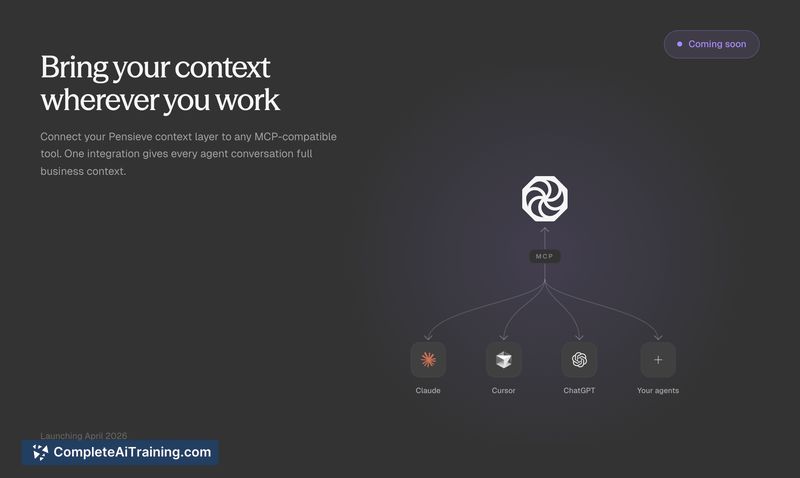
- Connectors to common tools: integrates with sources like Slack, issue trackers, CRMs and file stores to build a unified context layer.
- Bring-your-own inference: works with Anthropic, OpenAI or Google models so teams control which model runs queries and inference.
- Real-time updates: uses subscriptions and background workers to surface new insights as source systems change.
- Permission-aware architecture in progress: supports per-user organizations now and is exploring source-level permission tagging with retrieval-time filtering.
Pricing and Value
Pensieve is offered free to use, with no platform fee and no credit card required; teams supply their own inference provider (Anthropic, OpenAI, Google) which is billed separately. The value proposition is reducing repetitive context-copying and shortening the effective onboarding time for AI agents by keeping a continuously updated organizational map.
That said, adopting Pensieve does carry indirect costs: model inference fees, time to connect multiple data sources, and effort for data governance and access configuration. For teams that already pay for model usage, Pensieve can be a cost-effective way to get higher-quality, context-aware agent outputs without additional platform charges.
Pros
- Makes cross-system relationships explicit through a graph model, improving what agents can reason about.
- Flexible model choice - bring your own inference - so teams keep control of model selection and spend.
- Free to start, which lowers friction for experimentation and early adoption.
- Live updates and a graph-first database (Neo4j) suit scenarios that rely on relationship-centric queries.
- Approach reduces repetitive manual context-passing to agents, saving time for repeated workflows.
Cons
- Permissions and potential information leakage are an open challenge; fine-grained, provable data-layer filtering is still being developed.
- Requires work to connect multiple tools and tune ingestion rules; teams should expect integration and governance effort up front.
- Dependence on external inference providers means ongoing model costs and operational decisions remain with the user.
Overall, Pensieve is a strong fit for product, support, and operations teams that want AI agents to act with persistent company context rather than ad-hoc search results. It's especially useful for smaller teams wanting low-friction experimentation with context-aware agents, and for any group willing to manage integrations and model costs; organizations requiring strict, enterprise-grade access controls should verify the permissions roadmap before committing to sensitive data ingestion.
Open 'Pensieve' Website
Your membership also unlocks: