About Playcall
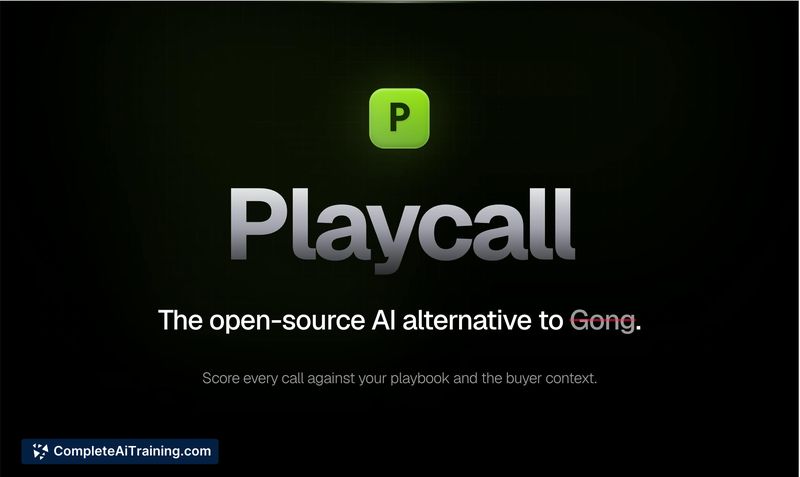
Playcall is an open-source sales call intelligence platform positioned as an alternative to Gong. It scores sales calls against a team's specific sales methodology, such as MEDDPICC, BANT, or SPIN, while incorporating buyer context like company stage and contact role. The tool launched this week and is built for AI-native go-to-market teams.
Review
Playcall tries to answer a specific question that founders and sales managers ask after listening to a call: did the rep say the right thing for this particular buyer? Instead of just summarizing what happened in a conversation, it evaluates the call against a defined playbook. The tool is fresh out of launch, so the feature set reflects what the maker built in the initial release.
Key Features
- Buyer-Aware Scoring: Company stage, contact role, and deal context dynamically shape every scorecard.
- Methodology support: Score against MEDDPICC, BANT, SPIN, or upload a custom playbook and let the AI generate the rubric.
- Outcome-Tied Scoring: Each score links to deal stage, outcome, and pipeline impact, letting managers see which behaviors correlate with closed deals.
- Coaching Drills: Every score comes with a specific, actionable drill for the rep to run next.
- Bring Your Own Key (BYOK): Plug in Claude, GPT, Gemini, or 15+ other LLMs through Vercel's AI SDK.
- Self-Hosting: The code is open source and deployable to your own infrastructure, with one-click deploys via Vercel.
Pricing and Value
Playcall is free and open source. The maker states you can self-host and run it for under $50/month, with LLM usage and data enrichment as the main variable costs. There are no contracts mentioned and no per-seat pricing structure on the product page. The pricing model appears to be: you pay for your own infrastructure and model API calls, not for the software itself.
Pros
- Scoring adapts to buyer context rather than applying a one-size-fits-all rubric, so a discovery call with a Series A startup is not scored like a Fortune 500 vendor evaluation.
- No framework lock-in - teams can score against MEDDPICC, BANT, SPIN, or their own uploaded playbook.
- Self-hostable with no vendor lock-in on the LLM side, since it supports multiple model providers.
- Each score pairs with a coaching drill, turning evaluation into a concrete next action for the rep.
- Built with Supabase for auth, Postgres, and storage, which keeps the stack transparent.
Cons
- Outcome-tied scoring needs a real sample of closed-won and closed-lost deals to produce meaningful correlations; a small team closing a handful of deals a month may find the signal too noisy.
- Automatic call ingestion is not yet built - the maker is asking users whether to connect existing notetakers like Granola, Fathom, or Fireflies, or ship a native Zoom/Meet/Teams bot.
- Not well suited for teams that want a managed, plug-and-play call recording solution without infrastructure setup, since self-hosting requires some technical capability.
Playcall fits best for GTM leaders and RevOps folks who already have a defined sales playbook and want to check whether reps follow it in context. It also suits teams that prefer to keep call data on their own infrastructure. Teams without a clear methodology or without technical resources for self-hosting may find the setup cost outweighs the benefit.
Open 'Playcall' Website
Your membership also unlocks: