About Polyvia
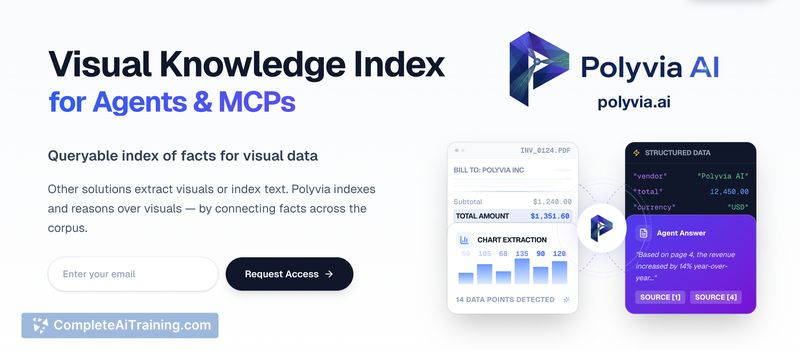
Polyvia is a visual knowledge index that turns charts, slides, diagrams and infographics into a queryable source of truth. It indexes and reasons over visual content across large document collections so agents and teams can retrieve facts with citations rather than rely on text-only search.
Review
Polyvia addresses a clear gap: most enterprise knowledge is stored as images or visual documents that standard text-based agents miss. The platform combines visual extraction, fact disambiguation, and an indexed graph to let multimodal agents and knowledge teams query visuals directly.
Key Features
- VLM-OCR extraction that converts charts, tables, diagrams and infographics into structured visual logic.
- Facts-ontology indexing that disambiguates and connects extracted facts into a graph-based index.
- Agentic visual reasoning that returns answers with audit-ready citations pointing to the original visual and document context.
- Integration options including a REST API and an MCP Server compatible with agents like Claude and Cursor.
- Polyvia Studio for visual search and exploration tailored to research, finance and healthcare teams.
Pricing and Value
Polyvia is currently available in private beta with early access options and a free tier for initial users. The present model emphasizes API and server access for developers and a studio experience for teams; enterprise or usage-based pricing is likely as the product matures. For organizations that rely heavily on visual documents, the platform offers clear value by reducing missed facts and providing traceable citations.
Pros
- Makes visual content queryable and citeable, reducing reliance on manual chart review.
- Combines extraction and graph-style indexing so facts from many documents can be connected.
- Plugs into existing agent workflows via MCP Server or REST API, shortening integration time.
- Studio interface supports non-developers who need visual search and exploration tools.
- Pre-built indexing for larger datasets helps keep query latency reasonable for many use cases.
Cons
- Currently in private beta, so access and production-ready guarantees are limited until wider release.
- Extraction quality depends on visual complexity; highly specialized charts or noisy images may require manual validation.
- Performance and latency for very large or frequently changing corpora can vary and should be benchmarked for each deployment.
Polyvia is best suited for developers building multimodal agents and for knowledge-work teams in research, finance or healthcare who have large volumes of visual documents. Early adopters who need audit-ready citations from visuals and who can participate in beta testing will get the most immediate benefit.
Open 'Polyvia' Website
Your membership also unlocks: