AI tool
Radiq
Radiq ingests signals from Slack, calls and tickets, builds an architecture-grounded knowledge graph, and pushes structured, developer-ready specs to Cursor or Windsurf-automating the customer-to-code handoff so devs get it right first time.
About Radiq
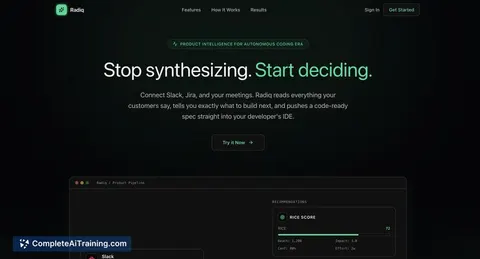
Radiq is a product intelligence tool built for the autonomous coding era that automates the customer-to-code loop. It ingests signals from tools like Slack, Jira, and Confluence, builds a knowledge graph tied to your codebase, and generates structured, developer-ready specs that can be pushed into IDEs via MCP.
Review
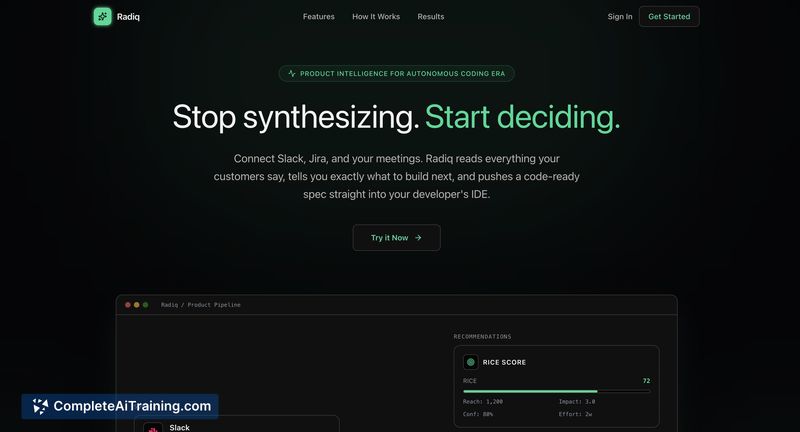
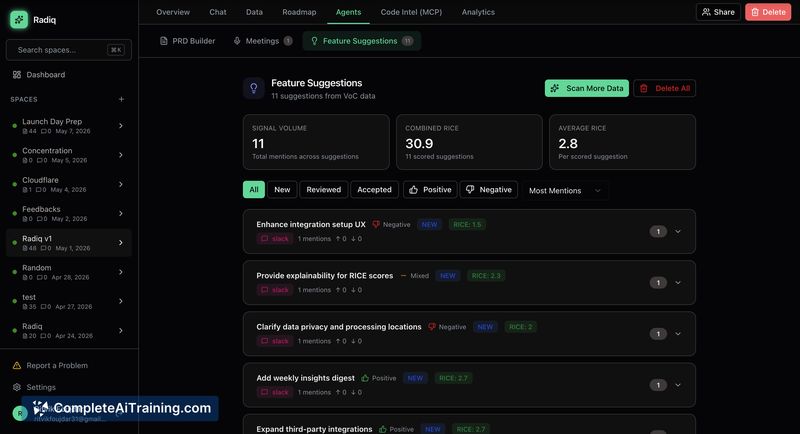
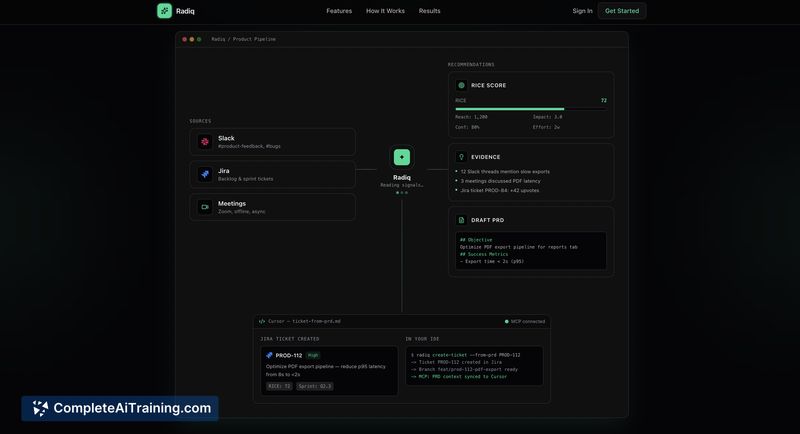
Radiq focuses on closing the handoff gap between product managers and engineering by surfacing decisions, prioritizing them by evidence, and producing executable specs grounded in actual code. Early reports from design partners highlight faster developer onboarding and fewer specification questions, but the product is newly launched and continues to evolve its integrations and workflows.
Key Features
- Knowledge graph that maps customer evidence to code modules and dependencies, using code analysis (ASTs, dependency graphs, feature flags) rather than simple keyword matching.
- Signal ingestion across Slack, Jira, Confluence, meeting notes and other channels to consolidate context into a single source.
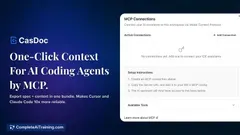
- Structured spec generation that produces developer-ready output and pushes tasks into IDEs (Cursor, VS Code, Windsurf) via MCP.
- Real-time collaboration infrastructure aimed at keeping decisions, prior work, and implementation context connected for teams.
- Operational safeguards such as pattern templates validated by PMs and automatic decay of stale mappings on codebase sync.
Pricing and Value
The public launch notes mention free options and an early design partner program, but detailed pricing tiers are not broadly published. Organizations interested in production use or enterprise integrations should contact the team for pricing and deployment details. The core value proposition is time saved for product teams, fewer back-and-forths with engineering, and more accurate, code-grounded specs that reduce rework.
Pros
- Reduces manual context stitching across multiple tools, cutting time PMs spend preparing specs.
- Specs are grounded in the actual codebase, which helps developers get the right implementation the first time.
- Direct IDE integrations via MCP mean structured tasks can flow straight into developer workflows.
- Knowledge graph approach can produce more accurate mappings than simple retrieval or clustering.
- Early customer feedback indicates measurable improvement in developer speed and handoff quality.
Cons
- Newly launched product; feature set, integrations, and enterprise maturity are still expanding.
- Pricing and support details are not fully public, so procurement may require direct engagement.
- Initial setup and validation with PMs are likely needed to tune mapping templates and ensure accuracy.
Overall, Radiq is a strong fit for product and engineering teams that use distributed collaboration tools and want to reduce the friction of turning customer signals into executable work. It is particularly useful for organizations experimenting with AI coding agents or those that frequently encounter specification rework; teams considering Radiq should plan for an onboarding phase to align mappings and integrations with their codebase and processes.
Jobs Radiq suits
We checked Radiq against 500+ jobs; these get the most out of it.
Alternatives to Radiq
Other tools that do the same main job. Our AI compared Radiq with similar tools and kept the ones you could use instead.