About Struct
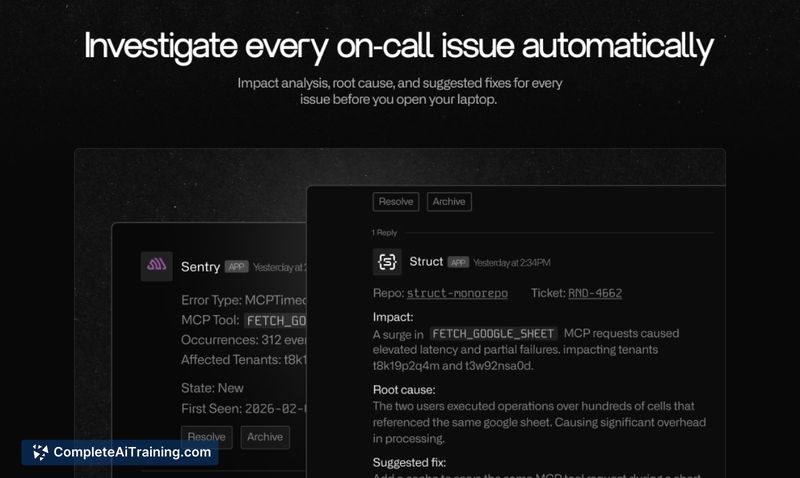
Struct is an AI agent that performs root cause analysis for engineering alerts by synthesizing logs, metrics, traces and code. It integrates with existing observability platforms and collaboration tools to provide fast, contextual summaries and incident reports.
Review
Struct automates the initial investigation workflow for alerts, producing hypotheses, impact summaries, and drafted incident reports with charts, timelines, and relevant commits. It is aimed at teams that want to shorten mean time to triage and give every engineer clearer context for incidents.
Key Features
- Cross-telemetry root cause analysis combining logs, metrics, traces and code to identify likely causes.
- Regression and anomaly correlation that surfaces spikes and patterns tied to alerts.
- Auto-generated incident reports with dynamic charts, timelines and commit histories for faster handoffs.
- Integrations with major observability platforms plus Slack, GitHub, Linear and coding agents for one-click handoffs.
- Quick setup (minutes) and compliance options such as SOC 2 Type II and HIPAA for regulated environments.
Pricing and Value
Struct offers a free self-service tier that lets teams get started without a credit card, with paid plans for higher volume, advanced integrations and enterprise controls. The value proposition is time savings on triage-some customers report large reductions in incident investigation time-and reduced on-call fatigue by surfacing actionable context quickly. For teams with established observability tooling, Struct aims to slot into existing workflows rather than replace them.
Pros
- Speeds up initial triage by pulling relevant telemetry and producing a concise root cause hypothesis.
- Reduces manual cross-referencing across dashboards and logs, which can save engineer hours on-call.
- Wide integration surface enables low-friction adoption into Slack and source control workflows.
- Compliant deployment options and a quick setup path make it accessible to small teams and regulated organizations.
Cons
- Effectiveness is limited by the telemetry and code access it has-uninstrumented services remain hard to analyze.
- Automated hypotheses can be incorrect or incomplete, so human validation is still necessary for complex incidents.
- Some multi-service failures require deep architectural context that may need additional manual investigation.
Struct is well suited for on-call engineers, small teams without dedicated SRE resources, and engineering organizations that want faster, more consistent triage. It makes the most sense when your systems already emit logs/metrics/traces and you want to reduce time spent correlating those signals during incidents.
Open 'Struct' Website
Your membership also unlocks: