AI tool
Tabstack
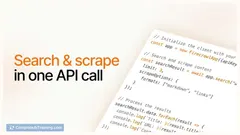
Tabstack: web data + automation API with intelligence in every call. Returns cleaned, structured JSON/Markdown/research or runs browser automation so your product receives ready-to-use data-no scrapers, no pipelines.
About Tabstack
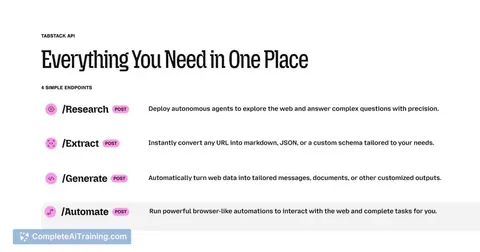
Tabstack is a web data and automation API that returns structured output from web pages based on a schema you provide. It offers endpoints for JSON extraction, markdown extraction, structured generation, multi-source research with citations, and managed browser automation so you don't need to build or maintain a scraper pipeline.
Review

Tabstack focuses on delivering predictable, schema-shaped JSON from URLs so downstream systems can consume data without extra parsing or cleaning. The API includes built-in handling for JavaScript-heavy pages via a managed browser endpoint and a research endpoint that supplies source URLs for cited claims.
Key Features
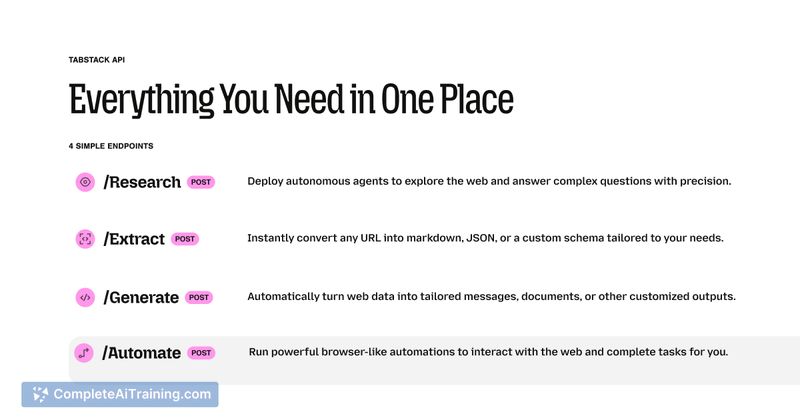
- /extract/json - pass a URL and a schema, receive JSON that matches the requested shape (fields missing from the page come back as null).
- /extract/markdown - convert page content into clean markdown suitable for notes or downstream processing.
- /generate/json - provide custom instructions and receive structured JSON output.
- /research - run multi-source research in one call and get cited answers with source URLs.
- /automate - managed browser agent for interacting with JS-heavy pages, forms, and multi-step flows without running your own browser infrastructure.
Pricing and Value
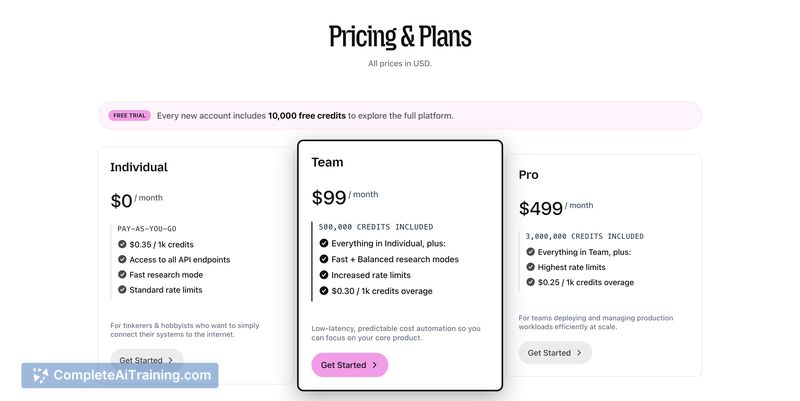
Tabstack lists free options alongside paid usage plans typical for developer-focused APIs. Its value proposition is reducing the engineering work around extraction: you can replace fragile scrapers and orchestration pipelines with single API calls that return cleaned, schema-conformant data and citation metadata. Teams trading off some control over crawling infrastructure for lower maintenance and faster integration are likely to find this cost-effective.
Pros
- Schema-driven output gives predictable JSON formats and reduces downstream parsing work.
- Managed browser automation handles many JavaScript-heavy workflows without hosting browser fleets.
- Research responses include cited page URLs and mapping of claims to sources, which helps verification.
- No in-house scraper maintenance or pipeline orchestration required for many common use cases.
Cons
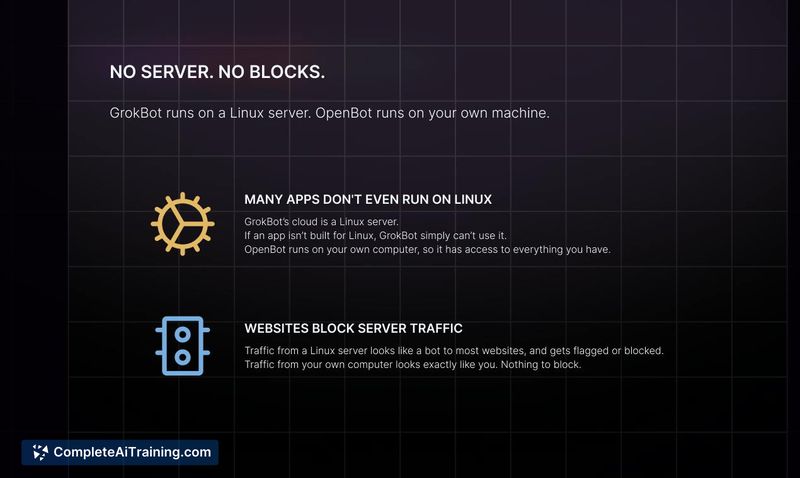
- Sites with advanced bot detection or strict access controls can still block extraction; success is not universal.
- Some complex e-commerce or highly customized layouts may need extra tuning or different approaches to get reliable fields.
- Less suitable if you require full control over crawling infrastructure or want to run persistent, custom crawlers on your own servers.
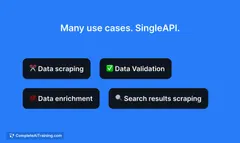
Overall, Tabstack is well suited for developer teams and product teams that need reliable, schema-aligned web data without building a scraper stack. It works best for research, data enrichment, and agent integrations where predictable JSON and citation metadata speed up development; teams that must access sites with very strict defenses or require full crawler control should evaluate fit carefully.
Jobs Tabstack suits
We checked Tabstack against 500+ jobs; these get the most out of it.
Alternatives to Tabstack
Other tools that do the same main job. Our AI compared Tabstack with similar tools and kept the ones you could use instead.