AI tool
Toby
Toby gives you a live mock interview for a specific job. It researches the company, runs you through each round in a video-call room, and provides a scored debrief with improved answers. It is for job candidates who want realistic practice before ...
About Toby
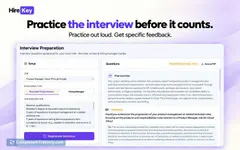
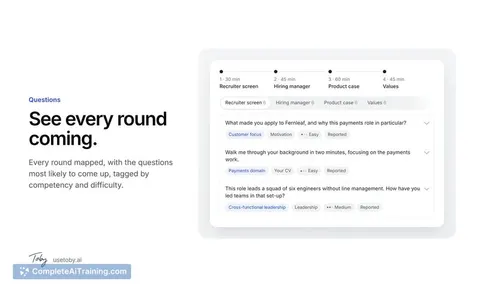
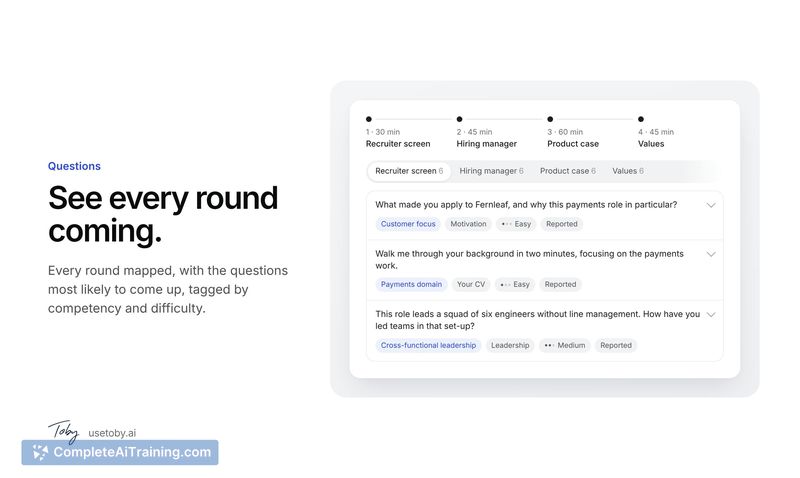
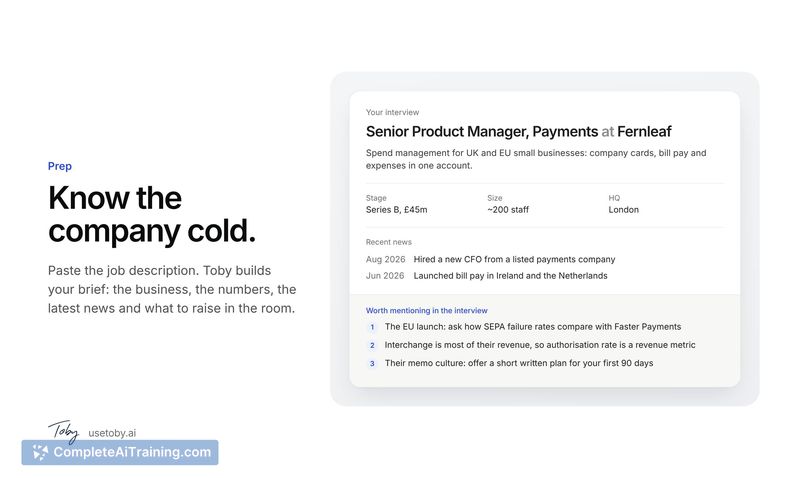
Toby is an AI voice agent that conducts mock job interviews in a video-call format. Users paste a job description, and the tool researches the company, maps out interview rounds, then runs a live practice session on a Meet, Teams, or Zoom-style interface. After the call, Toby produces a scored debrief along with rewritten versions of each answer constructed from what the candidate actually said.
Review
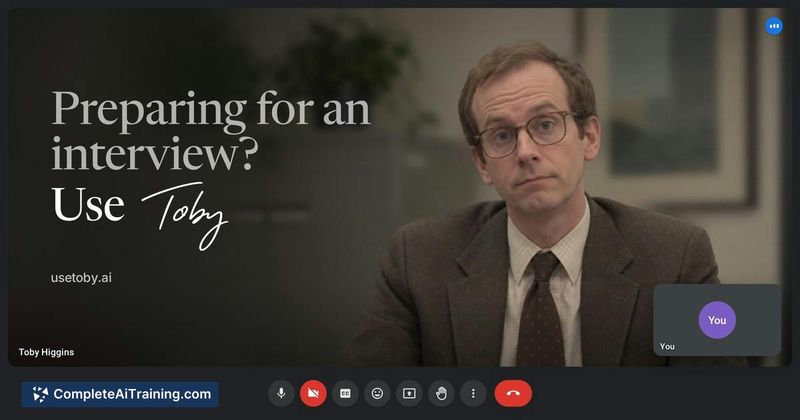
Toby addresses a specific gap in interview preparation: the lack of realistic, interactive practice. Rather than generating static question lists, it simulates the back-and-forth of a live interviewer, complete with interruptions and turn-taking. The tool is built by a solo maker, Rob Kealey, and launched in early access with a straightforward pay-per-use model.
Key Features
- Two interview modes: Real mode runs the session straight through, while Coach mode pauses after each answer to give a note and let you retry.
- Company and role research triggered by pasting a job description, which then informs the question flow across multiple interview rounds.
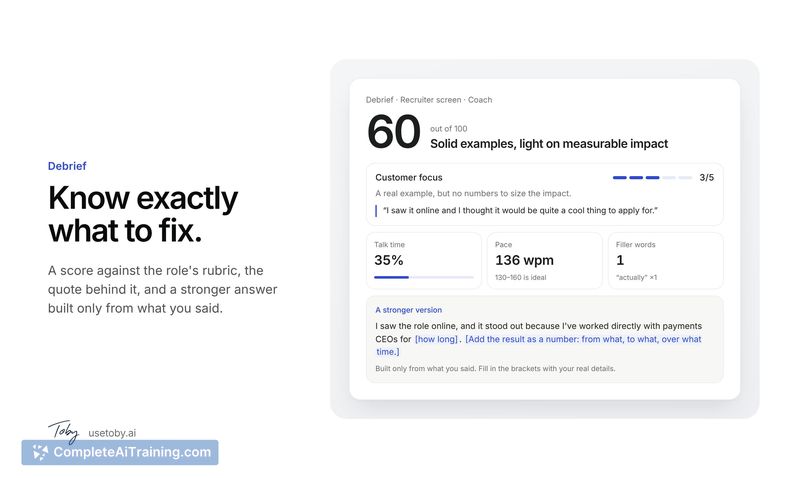
- Post-call debrief with a score mapped to the role's rubric, the specific quote behind each score, pace and filler word analysis, and a stronger version of each answer.
- Interruption handling that lets candidates cut in mid-question, mimicking the dynamics of a conversation with a human interviewer.
- Pay-per-minute pricing with no subscription; briefs and debriefs are included in the per-minute rate.
Pricing and Value
Toby charges 50 pence per minute of call time. The first 5 minutes are free. Briefs and debriefs do not carry a separate charge. There is no subscription tier. The maker notes that the underlying infrastructure costs-specifically Deepgram for transcription, Cartesia Sonic for voice synthesis, and LiveKit for real-time communication-are chosen partly to keep a £5 session economically viable.
Pros
- Transparent, usage-based pricing without recurring commitments.
- Coach mode gives immediate, answer-level feedback and a chance to reattempt, which static question lists cannot do.
- Debrief reports tie scores to exact quotes from the candidate's responses, making the evaluation traceable.
- Interruption capability and low-latency voice response create a conversational feel that differs from scripted practice tools.
- Single-developer build means direct feedback loops with the maker are possible during early access.
Cons
- Pronunciation of specialized terms and company names can be inaccurate, which the maker acknowledges as an active issue.
- Latency still occasionally makes the conversation feel artificial, particularly for users sensitive to pacing irregularities.
- The tool is not well suited for candidates who need structured, curriculum-based interview training rather than open-ended mock sessions.
Toby fits candidates who want to pressure-test their answers in a live, spoken format before actual interviews, especially for roles where a job description is available to guide the simulation. It may also serve hiring managers who want a quick way to experience their own interview process from the candidate's side. Those who prefer written practice or need highly polished, accent-agnostic speech synthesis should watch how the tool's voice and latency handling mature.