About Tonkotsu
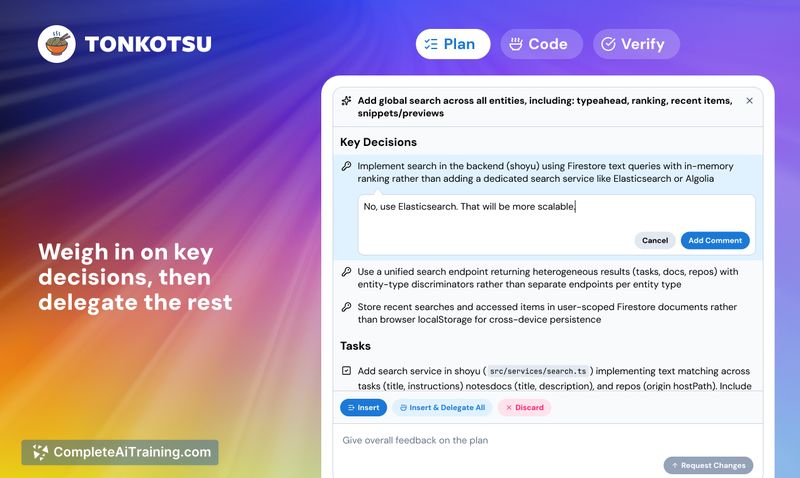
Tonkotsu is a doc-centric interface for managing a team of coding agents from a single document. It focuses on delegation: you define high-level decisions in the doc and let agents handle planning, implementation, and testing. The product is available for free during its early access program.
Review
Tonkotsu offers a clean, focused GUI that treats a document as the primary control surface for agent-driven development. The experience centers on composing instructions and verifying output with built-in test plans and diff reviews, which helps keep human reviewers in control of final commits. For teams experimenting with AI-assisted development, it can reduce the friction of juggling prompts across multiple tools.
Key Features
- Doc-as-control-panel: central document used to assign, monitor, and coordinate agent tasks.
- Agent orchestration: separate agents for planning, coding, and testing with clear handoffs.
- Built-in verification: test plans and diff-based reviews to help guardrail changes before merge.
- Minimal configuration UI: a focused, low-noise interface aimed at reducing setup overhead.
- Context continuity and composability: project state and shared context live in the document for agents and humans to reference.
Pricing and Value
At launch Tonkotsu is offered free during an early access / public beta period, with no keys or billing required. This makes it attractive for teams and individual developers who want to evaluate agent-driven workflows without upfront cost. Long-term pricing is not yet published, so organizations should treat current usage as an opportunity to test fit and workflow impact before any paid plans arrive.
Pros
- Clear, single-pane workflow that reduces the need to switch between prompts and terminals.
- Focus on delegation and review keeps humans in the loop while offloading routine work to agents.
- Built-in testing and diff review provide practical guardrails for automated changes.
- Free early access lowers the barrier for experimenting with agentic development patterns.
Cons
- Still in early access: stability, feature completeness, and long-term pricing are not finalized.
- Effective use requires careful instruction design and attention to context to avoid noisy or incorrect outputs.
- Teams with very custom toolchains may need additional integration work to fit existing processes.
Overall, Tonkotsu is well suited for developers and small teams who want to pilot agent-based workflows from a single document interface, especially for prototyping, refactors, and repetitive implementation tasks. It makes sense for users who are comfortable delegating work to agents but retain final review responsibility, and for organizations that want a low-friction way to evaluate agentic tooling during the free beta period.
Open 'Tonkotsu' Website
Your membership also unlocks: