About Voker
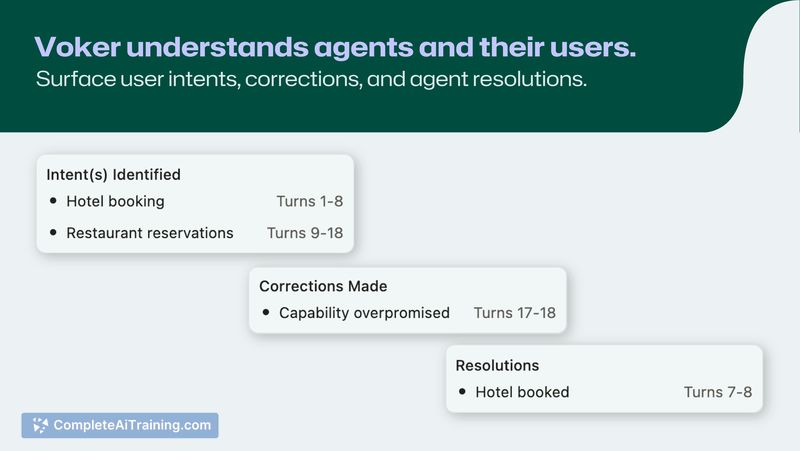
Voker is an Agent Analytics Platform aimed at AI product teams that operate production agents. It collects conversation data via a lightweight, provider-agnostic SDK and provides automated annotations such as intent, correction and resolution detection to help teams monitor agent behavior.
Review
Voker focuses on closing a gap many teams face: observing agent behavior and performance beyond raw logs and occasional manual evaluations. Its automated detection, session reconstructions, and timelines make it easier to spot regressions and recurring failure modes without sifting through individual traces.
Key Features
- Lightweight, provider-agnostic SDK that captures agent inputs, tool calls, and contextual data.
- Automatic annotation of user intents, corrections, and agent resolutions to simplify triage.
- Session reconstruction and queryable timelines for reviewing multi-turn interactions and segmented "session paths."
- Agent performance tracking with version segmentation to compare resolution and correction rates over releases.
- Collection of reasoning/thinking blocks and tool decision metadata so teams can connect decisions to outcomes.
Pricing and Value
There is a free tier that supports up to 2,000 events per month, allowing teams to try the platform with limited traffic. Detailed paid pricing is not listed on the reference page, but the value proposition centers on reducing time spent debugging production agents, surfacing regressions after prompt or tool changes, and giving product teams measurable signals about whether agents are delivering for users. For teams running multiple agents in production, the ability to segment by agent version and intent category can help prioritize fixes and measure impact.
Pros
- Automated annotations reduce manual labeling and make common failure patterns easy to spot.
- Captures reasoning blocks and tool usage, which helps bridge the gap between opaque logs and human-readable diagnostics.
- Version-based segmentation and metrics (e.g., resolution and correction rates) support post-deploy monitoring and regression detection.
- Provider-agnostic SDK makes it straightforward to add analytics without being locked to a single model or tool stack.
- Free tier is useful for early experimentation and validating instrumentation choices.
Cons
- Handoff between multiple agents is currently treated as a simple resolution in many cases, making it hard to distinguish intentional routing from "passing the buck."
- Some UI and display elements for reasoning visualization are still under development, so debugging workflows that rely on detailed reasoning diffs may need additional tooling for now.
- Highly domain-specific vocabulary may require sending supplemental context or feedback so the automatic annotations align with niche terminology.
Voker is best suited for AI product teams, agent engineers, and product managers who run production agents and need concrete metrics and timelines to prioritize work. It provides practical observability for multi-turn interactions and versioned experiments, though teams with complex multi-agent orchestration or very specialized domain language should plan for some additional setup and future feature work.
Open 'Voker' Website
Your membership also unlocks: