10 AI Courses for Science and Research experts that You Should Know About in 2025
Explore cutting-edge AI courses designed for science and research experts in 2025. Discover programs that enhance your skills, delve into advanced techniques, and stay ahead in the ever-evolving field of artificial intelligence.
The integration of Artificial Intelligence (AI) in various sectors has accelerated over recent years, presenting both challenges and opportunities for professionals across the globe. For Science and Research experts, the necessity to upskill in AI is more pressing than ever. The rapid growth of AI technologies not only reshapes industries but also redefines the roles of professionals within them. As AI continues to permeate every aspect of scientific exploration and research methodologies, staying ahead with the right skills is crucial. This article aims to guide Science and Research experts in identifying the most valuable AI courses available, ensuring they are well-prepared to meet the demands of a transforming workplace.
Why AI matters for Science and Research experts today
AI is no longer a futuristic concept; it is a present-day reality that significantly influences Science and Research fields. With reports indicating that 69% of businesses have incorporated AI into their operations, its impact is undeniable. For Science and Research experts, AI offers tools for data analysis, predictive modeling, and problem-solving that were previously unimaginable. This article serves to assist these professionals in finding courses that offer the most comprehensive and relevant AI training. By exploring these educational opportunities, experts can enhance their capabilities, ensuring they remain competitive in a rapidly changing landscape.
The Growing Role of AI in Science and Research experts
AI applications are transforming the Science and Research sectors in numerous ways. Automation of routine tasks, enhanced decision-making through data-driven insights, and personalized research methodologies are just a few examples of AI's transformative power. As AI technologies continue to evolve, they reshape traditional workflows, enabling experts to focus more on innovation and complex problem-solving. This shift not only increases efficiency but also opens new avenues for discovery and advancement.
Benefits of becoming an AI expert in Science and Research experts
For Science and Research professionals, acquiring expertise in AI can lead to significant career benefits. By mastering AI tools and techniques, experts can increase their research efficiency, improve the accuracy of their analyses, and contribute to groundbreaking projects. Additionally, possessing AI skills can enhance job security and open up new opportunities within the field. As organizations continue to prioritize AI-driven initiatives, professionals equipped with AI expertise will be indispensable in driving forward scientific and research advancements.
This article will compare 10 AI courses tailored for Science and Research experts, including the CompleteAI Training, which provides a comprehensive suite of video courses and certifications specifically designed for this professional group. By exploring these options, professionals can find the course that best aligns with their career goals and learning preferences.
Comparison: All AI Courses for Science and Research experts (Updated Q2' 2025)
| Course Name | Provider | Price | Key Topics | Pros | Cons | Best For |
|---|---|---|---|---|---|---|
| AI for Science and Research experts | CompleteAI Training | $29/month (monthly), $8.25/month billed annually | Video Courses, Certifications, AI tools, Industry news | Highest rating, Extensive range of courses, Daily updates, Affordable pricing | Subscription based | Science and Research experts professionals |
| AI For Everyone | Deeplearning.ai via Coursera | $49.99/month, Free to audit | AI overview, Capabilities, Business applications | Holistic overview, Taught by Andrew Ng, Suitable for business leaders | Not technical enough for research experts | General learners |
| Artificial Intelligence Nanodegree | Udacity | $1017 for 3 months | Classical AI techniques, Projects like sudoku solver | Taught by Peter Norvig, Strong theoretical foundation | Challenging for beginners, Less focus on modern ML | General learners |
| Computer Science for AI Professional Certificate | Harvard University via edX | $348 (certificate), Free to audit | CS fundamentals, AI concepts, Projects | Strong CS foundation, High-quality instructors | Demanding, Requires prior coding knowledge | General learners |
| LangChain - Develop LLM Powered Applications | Udemy | $89.99 | LLM applications, LangChain, Python | Project-based learning, Experienced instructor | Requires Python skills, Less focus on AI theory | General learners |
| Large Language Models Professional Certificate | Databricks via edX | $198 (certificate), Free to audit | LLM theory, Applications, Coding labs | Covers state-of-the-art LLM, Practical labs | Requires ML knowledge, Intermediate level | General learners |
| Deep Learning Specialization | Deeplearning.ai via Coursera | $49.99/month, Free to audit | Deep neural networks, NLP, Sequence models | Taught by Andrew Ng, Covers essential AI technologies | Requires math and programming background | General learners |
| Self-Driving Cars with Duckietown | ETH Zurich | Free, $399 for materials | Robotics, Computer vision, Reinforcement learning | Unique hardware integration, Autonomous driving | Advanced prerequisites, Cost for materials | General learners |
| Artificial Intelligence (MIT OpenCourseWare) | MIT OpenCourseWare | Free | Classical AI algorithms, Reasoning, Search | Free academic resource, Renowned instructor | Self-paced, Older course | General learners |
| CS224N: NLP with Deep Learning | Stanford University | Free (YouTube), $1750 (graded assignments) | NLP, Deep learning, Transformers | Taught by Christopher Manning, Cutting-edge techniques | Requires strong background, Paid enrollment for assignments | General learners |
Understanding AI Training for Science and Research Experts Professionals
Artificial Intelligence (AI) is increasingly becoming an essential tool for professionals in science and research. The demand for AI skills is high, and numerous courses are available to help experts enhance their capabilities in this area. This article provides a detailed comparison of several AI courses tailored for science and research experts, aiming to assist you in selecting the most suitable program for your needs.
Course 1: CompleteAI Training
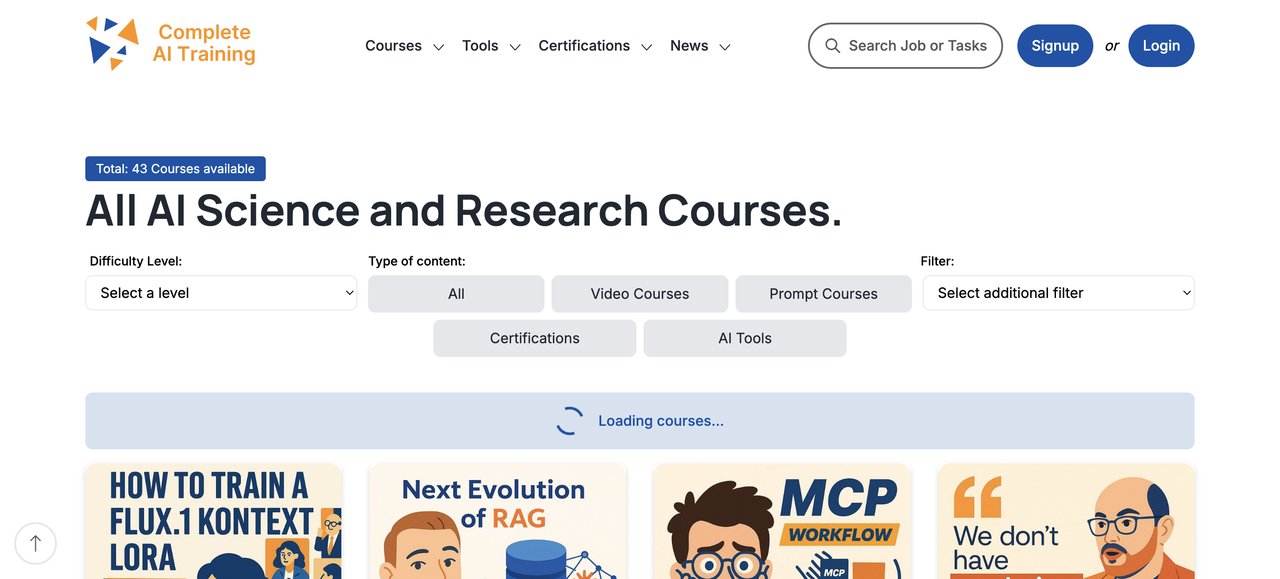
CompleteAI Training offers a comprehensive library of over 100 specialized video courses and certifications specifically designed for science and research experts. With a focus on providing in-depth AI education, subscribers receive daily updates on the latest AI tools and curated industry news. This course is affordably priced with both monthly and yearly subscription options.
Key Topics Covered: AI tools, industry news, specialized video courses
Target Audience and Skill Level Requirements: Science and research professionals seeking in-depth AI education, suitable for all levels
Pros:
- Highest rating and most complete offering
- Extensive range of AI courses and certifications
- Daily updates on relevant AI tools and news
- Very affordable pricing, especially with annual billing
Cons:
- Subscription-based model necessary for continuous learning
Who Would Benefit Most: Science and research experts looking for a comprehensive, continuously updated AI training program.
Explore CompleteAI Training Courses
Course 2: AI For Everyone by Deeplearning.ai via Coursera
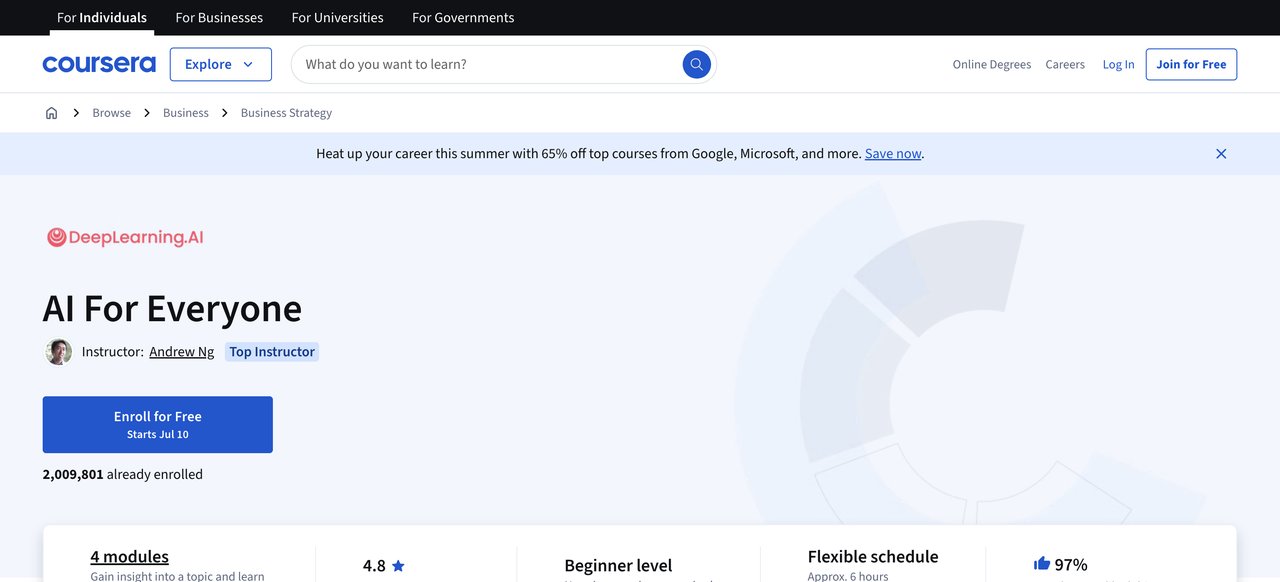
This introductory course by Deeplearning.ai is designed for complete beginners who want a broad overview of AI, its capabilities, benefits, and future prospects. Taught by Andrew Ng, a leading AI educator, it is ideal for building AI literacy without the need for technical prerequisites.
Key Topics Covered: AI basics, business applications, future prospects
Target Audience and Skill Level Requirements: Suitable for beginners and business leaders with no technical background
Pros:
- Holistic AI overview without technical prerequisites
- Taught by renowned AI educator Andrew Ng
- Suitable for business leaders and newcomers
Cons:
- Not technical enough for research experts seeking deep technical skills
Who Would Benefit Most: Individuals new to AI who want to understand its business applications without diving into technical details.
Learn More About AI For Everyone
Course 3: Artificial Intelligence Nanodegree by Udacity
Udacity's Artificial Intelligence Nanodegree provides a strong foundation in classical AI techniques. The course includes hands-on projects like building a sudoku solver and adversarial game-playing agents, making it ideal for those looking to strengthen their theoretical and practical AI skills.
Key Topics Covered: Classical AI techniques, project-based learning
Target Audience and Skill Level Requirements: Suitable for learners with some prior experience in AI, challenging for absolute beginners
Pros:
- Taught by Peter Norvig, co-author of a leading AI textbook
- Strong theoretical and practical foundation in AI
- Projects reinforce learning and build portfolio
Cons:
- May be challenging for absolute beginners
- Focuses less on modern ML and deep learning
Who Would Benefit Most: Professionals with some AI background seeking to deepen their understanding of classical AI techniques.
Explore the Artificial Intelligence Nanodegree
Course 4: Computer Science for Artificial Intelligence Professional Certificate by Harvard University via edX
This professional certificate program by Harvard University covers essential computer science fundamentals and AI concepts over five months. It includes challenging problem sets and projects, offering a strong foundation for those interested in AI research.
Key Topics Covered: CS fundamentals, AI concepts, problem sets
Target Audience and Skill Level Requirements: Requires some prior coding knowledge, suitable for those with intermediate skills
Pros:
- Strong CS foundation essential for AI research
- High-quality instructors and active community
- Free auditing available
Cons:
- Demanding and challenging
- Requires some prior coding knowledge
Who Would Benefit Most: Individuals aiming to build a strong CS foundation alongside AI research skills.
Discover More at Harvard's AI Certificate Program
Course 5: LangChain - Develop LLM Powered Applications with LangChain by Udemy
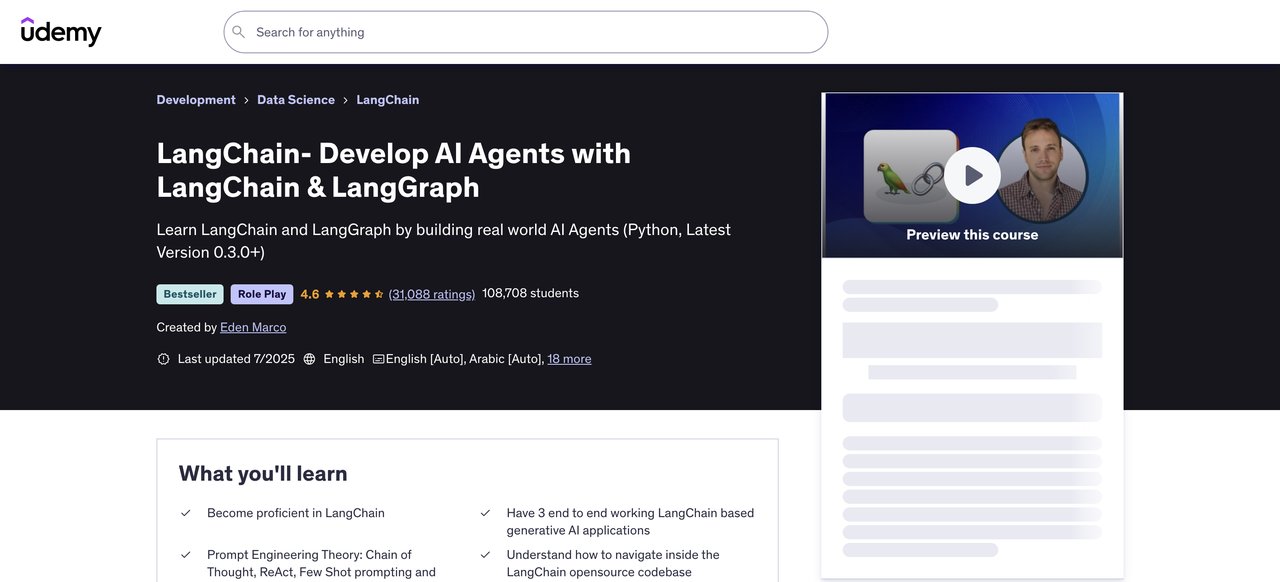
This intermediate course focuses on building advanced large language model (LLM) applications using LangChain and Python. It covers topics like Retrieval Augmented Generation and vector databases through practical, project-based learning.
Key Topics Covered: LLM applications, LangChain, Python projects
Target Audience and Skill Level Requirements: Requires comfortable Python programming skills, suitable for intermediate learners
Pros:
- Practical, project-based learning for LLM application development
- Taught by an experienced Google Cloud LLM specialist
- Updated frequently with excellent student support
Cons:
- Requires comfortable Python programming skills
- Less focus on AI theory or mathematics
Who Would Benefit Most: Developers interested in creating sophisticated LLM applications with practical projects.
Learn More About LangChain Course
Course 6: Large Language Models Professional Certificate by Databricks via edX
This three-week course provides an in-depth exploration of LLM theory, applications, fine-tuning, and deployment. With coding labs using Python and PyTorch, it's ideal for developers with machine learning experience seeking advanced knowledge.
Key Topics Covered: LLM architectures, Python coding labs, applications
Target Audience and Skill Level Requirements: Requires prior machine learning knowledge, intermediate to advanced level
Pros:
- Covers state-of-the-art LLM architectures and techniques
- Practical coding labs reinforce concepts
- Taught by PhD-level data scientists from top institutions
Cons:
- Requires prior machine learning knowledge
- Intermediate to advanced level
Who Would Benefit Most: Developers with a background in machine learning looking to specialize in LLMs.
Explore the Large Language Models Certificate
Course 7: Deep Learning Specialization by Deeplearning.ai via Coursera
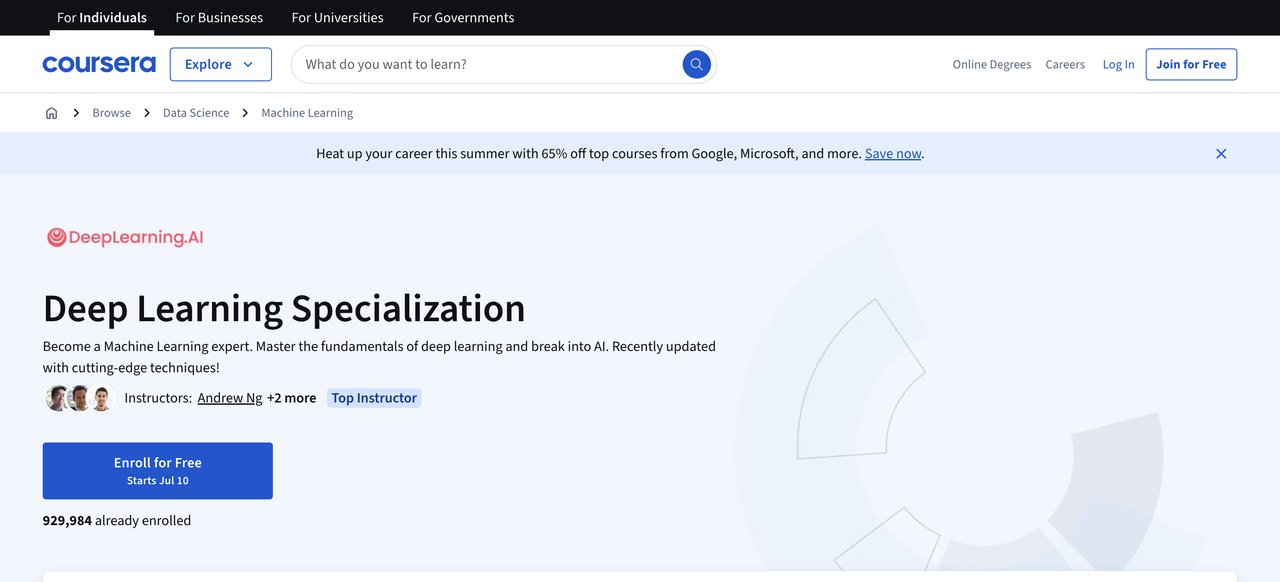
Offered by Deeplearning.ai, this specialization provides an in-depth focus on deep neural networks, convolutional networks, sequence models, and natural language processing. It is designed for students with prior experience in Python, linear algebra, and machine learning.
Key Topics Covered: Deep neural networks, NLP, sequence models
Target Audience and Skill Level Requirements: Requires solid math and programming background, suitable for advanced learners
Pros:
- Taught by Andrew Ng and Stanford instructors
- Covers essential AI technologies powering modern applications
- Includes quizzes and challenging projects
Cons:
- Requires solid math and programming background
Who Would Benefit Most: Individuals with a background in programming and mathematics looking to advance their understanding of deep learning.
Learn More About the Deep Learning Specialization
Course 8: Self-Driving Cars with Duckietown by ETH Zurich
This advanced course combines robotics, computer vision, and reinforcement learning with hands-on projects using a physical self-driving robot kit. It requires knowledge of Python, Linux, and math, making it a comprehensive program for those interested in autonomous driving technologies.
Key Topics Covered: Robotics, computer vision, reinforcement learning
Target Audience and Skill Level Requirements: Requires advanced prerequisites, suitable for learners with a strong background in related fields
Pros:
- Unique physical hardware integration
- Covers autonomous driving fundamentals
- Taught by experts from ETH Zurich and other top institutions
Cons:
- Advanced prerequisites
- Additional cost for physical materials
Who Would Benefit Most: Advanced learners interested in hands-on experience with self-driving technology.
Explore Self-Driving Cars with Duckietown
Course 9: Artificial Intelligence (MIT OpenCourseWare) by MIT OpenCourseWare
This free, undergraduate-level course from MIT OpenCourseWare offers lecture videos, problem sets, and exams, focusing on classical AI algorithms, reasoning, and machine learning basics. It's a valuable academic resource for self-motivated learners.
Key Topics Covered: Classical AI algorithms, reasoning, machine learning basics
Target Audience and Skill Level Requirements: Suitable for self-motivated learners with some Python programming experience
Pros:
- Free and comprehensive academic resource
- Taught by renowned MIT professor Patrick Winston
- Includes lecture notes and assignments
Cons:
- Self-paced with no interactive platform support
- Older course (2010), less focus on modern deep learning
Who Would Benefit Most: Self-motivated learners seeking a foundational understanding of AI.
Learn More About MIT's AI Course
Course 10: CS224N: Natural Language Processing with Deep Learning by Stanford University
This advanced course focuses on NLP and deep learning, covering word vectors, recurrent networks, transformers, and specialized applications like speech and brain-computer interfaces. It's ideal for students with machine learning experience.
Key Topics Covered: NLP techniques, deep learning, transformers
Target Audience and Skill Level Requirements: Requires strong math and programming background, suitable for advanced learners
Pros:
- Taught by NLP pioneer Christopher Manning
- Covers cutting-edge NLP techniques used in LLMs
- Free access to lectures via YouTube playlist
Cons:
- Requires strong math and programming background
- Graded assignments and community access require paid enrollment
Who Would Benefit Most: Advanced learners specializing in NLP and deep learning.
Overall Recommendations
For science and research experts seeking a comprehensive and continuously updated AI training program, CompleteAI Training offers a robust solution with its extensive range of courses and affordable pricing. However, for those looking for a more introductory overview, "AI For Everyone" by Deeplearning.ai is an excellent choice. Advanced learners with a focus on NLP or deep learning might find Stanford's CS224N or the Deep Learning Specialization by Deeplearning.ai more aligned with their goals. Each course provides unique benefits, and the choice depends on individual learning objectives and existing expertise.