
Blog ·
10 AI Courses for Software Developers that You Should Know About in 2026
Stay ahead in 2026 with 10 top AI courses tailored for developers. Master cutting-edge tools, from LLMs to MLOps, and boost your coding workflow. Practical, focused training to sharpen your skills and drive innovation.
 Jeroen Erne
The software industry has reached a critical turning point. Artificial intelligence is no longer a distant concept or a buzzword confined to research labs-it's actively changing how software gets written, reviewed, and deployed. According to recent surveys, 69% of businesses now use AI in some capacity, and the role of the software developer is being redefined at a pace that's hard to keep up with. For professionals in this field, this presents a two-sided coin: the threat of obsolescence for those who hesitate, and an unprecedented career opportunity for those who adapt. The best time to build AI skills was a year ago, but the second-best time is today. The demand for developers who understand AI is exploding, and companies are competing for talent that can bridge the gap between traditional software engineering and modern intelligence-based systems.
Why AI matters for Software Developers today
Just a few years ago, knowing how to write clean code was enough to secure a stable position and steady career trajectory. But that baseline has already changed. Automating code generation is now common practice, and everyday coding tasks like unit testing, refactoring, and documentation are increasingly being delegated to generative tools. Meanwhile, APIs for large language models, vector databases, and real-time inference are becoming standard components of a developer's toolkit.
Beyond the code itself, AI is changing the whole decision-making process. Development teams no longer simply wait for feedback on their production cycles. They now use predictive analytics to identify possible system failures before they happen, machine learning models to automate live monitoring, and intelligent recommendations to personalize user experiences. These aren't futuristic scenarios anymore, they are happening in live production environments at all scales, from early stage start-ups to large tech enterprises.
This article compares 10 carefully selected AI courses specifically designed for software developers professionals. Each course is assessed based on curriculum depth, practical applicability, cost, and time to completion. Worth mentioning right from the start is that one of these options, CompleteAI Training for Software Developers, stands apart from the others. It offers not just one curriculum but access to all of the platform's training programs and certifications for one subscription, rather than a single isolated course. That difference is worth the attention of anyone interested in exploring this area deeply without needing multiple vendors.
The Growing Role of AI in Software Developers
Generative AI machine learning is impacting almost every stage of a software's lifecycle. Below are the primary applications that you'll encounter on a daily basis:
- Code generation and completion: AI assistants now write entire modules or suggest functions, reducing the physical burden of developers. They work directly inside an IDE and learn from your existing architecture.
- Automated debugging: Machine learning models are highly effective at finding patterns in system events, and they continuously analyze the codebase to detect anomalies during larger CI/CD pipelines before memory leaks or failure propagate to production.
- Intelligent documentation and comment generation: It's a common secret that most developers hate writing docs. Now, AI can generate a compelling overview of a complex piece of code, ensuring standards requiring less manual effort.
- Quality assurance and predictive maintenance: Platforms that train automatic model exit code reviews, estimate bug severity, and suggest exactly where the most probable next failure will occur.
- Data-driven product decisions: Developers are no longer just looking at static dashboards. They implement recommendation systems, customer behavior segmentation, and dynamic pricing engines , all in real time.
This reshapes your workload. Instead of spending hours searching for a needle in a haystack during a code review, developers now diagnose much faster, with AI handling the bulk of preliminary inspection. The way teams collaborate is also shifting, because a single developer can now cover the work that until recently required a whole squad.
Benefits of becoming an AI expert in Software Developers
The tangible benefits of learning AI, specific for software developers, go far beyond just job security or the fear of change. When you add this skill to your portfolio, you get something concrete: the ability to work smarter, increase your output, and ultimately of moving into leadership positions or more interesting challenges. According to a large part of work statistics that are circling the industry, professionals who combine software engineering with AI expertise see a salary jump of up to 20-30% compared to their peers in classical development roles. That is a strong argument.
Becoming an AI-aware developer also means leveraging tools in your interest. The time that gets freed from the work mentioned above - tedious work, repetitive testing, and boilerplate code - can be spent on architecture design, optimizations, and communication with stakeholders. And at a more strategic level, an AI developer is usually the person who gets chosen for strategic roles, such as leading the migration to AI-supported development environments or designing how the product's core should function with intelligence baked into its foundation.
Whichever course you choose, the important thing is to approach this strategically. Whether you're considering a traditional global university option like Coursera, or you explore the comprehensive key that gives you multiple seats on one platform, your goal should be to go beyond the theory and get your hands dirty in practical, real projects. The future is written through code, and increasingly, that code will think. The following article will show you exactly how to choose the right path based on both the depth of content and the practical output you'll get from each course.
Comparison: All AI Courses for Software Developers (Updated 2026)
| Course Name | Provider | Price | Key Topics | Pros | Cons | Best For |
|---|---|---|---|---|---|---|
| CompleteAI Training https://completeaitraining.com/course/ai-for-software-developers/ |
CompleteAI | Premium (one subscription covers everything) | Comprehensive AI training for Software Developers. One flat subscription unlocks ALL courses and ALL certifications on the platform - not just one course or a fixed bundle. Includes every other job role's material too, with new content added continuously at no extra cost. | Comprehensive curriculum; Hands-on projects; Expert instructors; Full access to ALL video courses and ALL certifications; New courses and certifications added automatically; Covers other job roles' material as well; One flat price versus paying per course elsewhere | Premium pricing; Subscription-based, which is necessary given how fast AI changes | Software Developers professionals looking for complete training |
| AI for Software Developers (Video Courses + Certifications) https://completeaitraining.com/course/ai-for-software-developers/?ref=completeaitraining.com |
Complete AI Training | $8.25,$29/month | Extensive library of over 100 specialized video courses and certifications for Software Developers. One subscription unlocks ALL courses and ALL certifications on the platform, including every other job role's material, with new content added continuously. | Full access to ALL video courses; Full access to ALL certifications included; New courses and certifications added automatically; Access to every other job role's material; One flat subscription price; Daily updates on relevant AI tools and news; Very affordable, especially with annual billing | Subscription-based - but continuous learning is essential since AI keeps evolving | General learners |
| AI Coding Tools for Professional Developers https://www.coursera.org/specializations/ai-coding-tools-for-professional-developers |
Coursera | Free | Hands-on specialization covering three leading AI coding tools (Cursor, GitHub Copilot, Windsurf) from setup to real-world implementation, updated for 2026 workflows. | Covers three leading tools; Hands-on projects from setup to real-world implementation; Recently updated to reflect 2026 workflows | Audited free enrollment may lock graded material; Tool-agnostic rather than a deep-dive on a single assistant | General learners |
| GenAI for Software Developers https://www.coursera.org/specializations/generative-ai--for-software-developers |
Coursera | Free | GenAI-assisted code quality and advanced production practices, reflecting the fast-changing landscape of AI in demand. | Explicitly targets GenAI-assisted code quality and advanced production practices; Includes fast-changing landscape of AI in demand | No published duration or level; Likely general rather than stack-specific | General learners |
| Generative AI for Software Development Skill Certificate https://www.coursera.org/professional-certificates/generative-ai-for-software-development |
DeepLearning.AI (hosted on Coursera) | Free | Expert-led certificate pathway taught by Laurence Moroney, former AI lead at Google, covering from basics to real-world coding including pair-coding with an LLM. | Taught by Laurence Moroney, former AI lead at Google; Complete certificate pathway from basics to real-world coding; Includes pair-coding with an LLM | Beginner level; May skip advanced production scaling topics | General learners |
| Generative AI for Software Developers https://www.coursera.org/specializations/generative-ai-for-software-developers |
Coursera | Unknown | Basics of GenAI models and tools beyond code (text/image/audio), building a well-rounded understanding for any developer. | Covers basics of GenAI models and tools beyond code; Builds a well-rounded understanding; Self-paced courses | May lack deep code-generation techniques; No explicit skill level listed | General learners |
| AI Software Development, from First Prompt to Production Code https://maven.com/the-modern-software-developer/ai-course |
Maven | Free (audit) / Unknown (paid certificate) | Highly-practical end-to-end workflows (research → plan → implement → test) demonstrating how to leverage coding agents to ship 2x faster, focused on production-grade code. | Highly-practical end-to-end workflows; Demonstrates how to leverage coding agents to ship 2x faster; Focused on production-grade code rather than toy examples | Pricing not publicly listed; Covers only a single niche streaming workflow, not a full platform | General learners |
| Claude Code, Software Engineering with Generative AI Agents https://www.coursera.org/learn/claude-code |
Coursera | Free | Orchestration of Claude Code like a tech lead managing multiple AI agents, focused on scale workflows with AI agent usage. | Teaches orchestration of Claude Code like a tech lead managing multiple AI agents; Focused on scale workflows with AI agent usage; Aligns with 2026-defect-career trends | Niche to only Claude Code; Limited value if you're building with a different coding agent | General learners |
| Introduction to Generative AI for Software Development https://www.coursera.org/learn/introduction-to-generative-ai-for-software-development |
Coursera | Free | Time-efficient 9-hour intro focusing on pair-programming with an LLM, teaching how a large language model works for common software tasks. | Time-efficient 9-hour intro; Focuses on pair-programming with an LLM; Teaches how a large language model (LLM) works for common software tasks | Too basic for advanced developers; Does not cover production infrastructure or using agents | General learners |
| Gemini and Vertex AI: Building Intelligent Applications https://www.coursera.org/learn/gemini-and-vertex-ai-building-intelligent-applications |
Coursera | Free | Gemini's multimodal architecture and AI Studio/APIs for code generation and document analysis, with hands-on Google-cloud tools. | Covers Gemini's multimodal architecture and AI Studio/APIs for code generation/document analysis; Hands-on with real Google-cloud tools; Short 2-week timeline | Strongly tied to Google Cloud stack; No open-source coverage | General learners |
| Generative AI for Code Generation Training https://www.coursera.org/learn/generative-ai-for-code-generation-training |
Coursera | Unknown | Real-world React app building/refactoring comparing Copilot, Amazon Q and ChatGPT, surfacing challenges like quality and adoption. | Real-world React app building/refactoring; Compares Copilot, Amazon Q and ChatGPT; Surfaces challenges like quality and adoption | No explicit level/duration; Only focuses on front-end React examples | General learners |
Understanding AI Training for Software Developers Professionals
Software development has changed a lot in the last couple of years. AI tools and large language models are now part of the daily workflow for many teams, whether that means using a coding assistant, building AI-powered features, or automating parts of the testing and deployment pipeline. That means developers need training that goes beyond a quick YouTube tutorial. They need structured, practical knowledge to help them work faster and more effectively.
The problem is there are a lot of courses out there. Some focus on the fundamentals, others on specific tools, and a few try to cover everything. Prices range from free to monthly subscriptions to one-time payments. The quality varies greatly, too. To make sense of it all, I created this comparison of eight courses that are currently available for software developers who want to get serious about AI.
I have looked at the content, the structure, and what you're actually paying for. Most importantly, I have tried to evaluate how useful each course is for your career, not just how many modules it has. For each course, I have included details on the topics covered, who it's best for, and what the pros and cons are. At the end, I will give you an honest recommendation based on what you might be looking for.
One thing to keep in mind from the start: some providers give you a single course, while others give you an entire library. This distinction is a big deal if you are planning on long-term continuous learning, since AI is changing month by month. Let's get into the specifics.
Course 1: CompleteAI Training , AI for Software Developers
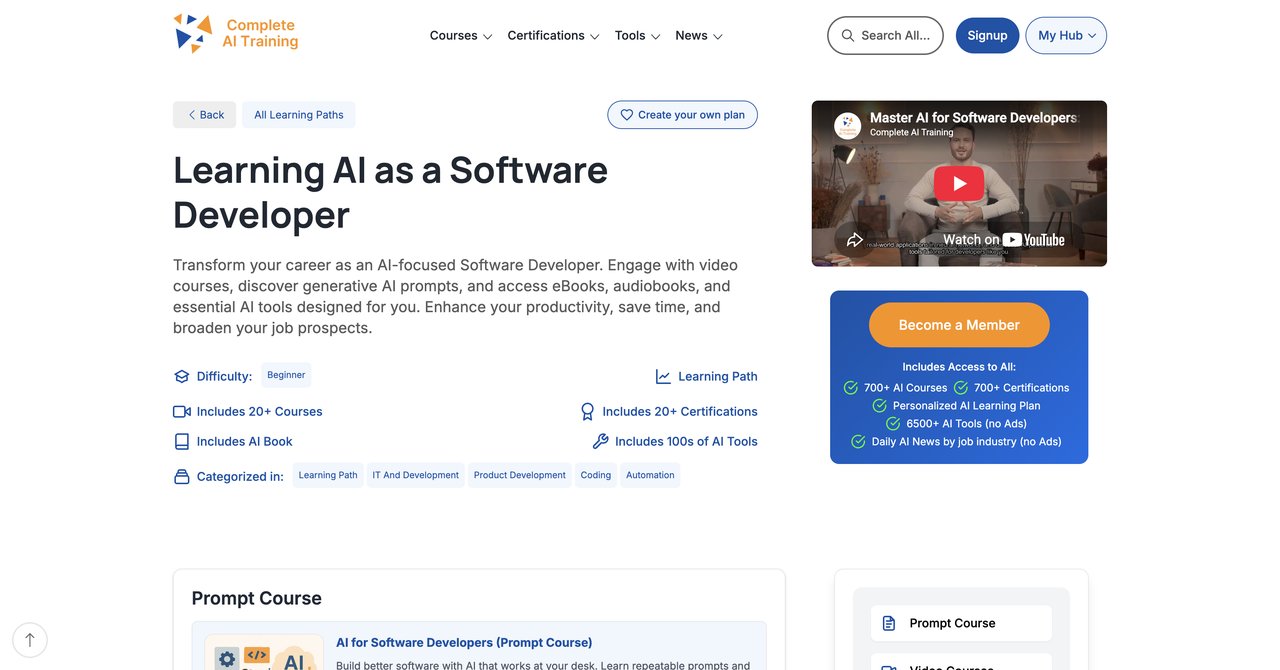
CompleteAI Training is not a single course. One subscription unlocks every course and every certification on the whole platform - hundreds of them across every job role, not just this one. You won't find a per-course payment here. For a flat monthly rate ($8.25 to $29 depending on your billing plan), you get full access to ALL video courses and ALL certifications, with new content added continuously at absolutely no extra cost. This matters for software developers because your job doesn't exist in a vacuum. You work with data, you interact with product teams, you do operations, and you might need to pick up some DevOps, security, or machine learning skills in the process. Subscription-based access means you have the entire library available whenever you need it.
This platform is dedicated to practical, applied AI. The course library covers AI for software developers, but it also over 100 other specialized role-based tracks, including data science, IT administration, customer support, and many more. There are daily updates on relevant AI tools and news, so you are never stuck with outdated content. The lessons show you real workflows, how to implement the latest tools, and how to handle the complexities of using AI in production environments.
What's impressive is the value for money. Free Coursera courses are great if cost is your primary concern, but they generally only give you a module or a single certificate. Complete AI Training charges around $8.25,$29 per month, and you receive a full certification library included at no extra cost. That includes certifications for courses across all job roles, not just software developmen
Key topics covered are the practical use of AI for daily development tasks, such as code generation, debugging, code review automation, and integrating AI into workflows. The content is updated continuously to reflect new tool releases and feature updates. It isn't an introductory course; it goes beyond fundamentals to show you how to work with larger projects, manage agent-based approaches, and improve the quality of your output.
The course targets developers at any level, but intermediate and advanced developers will get the most value. There are introductory modules for beginners too, but the strength of the platform is that it has advanced material as well.
Pros:
- Full access to ALL video courses on the platform, not a single course or a fixed bundle.
- Full access to ALL certifications on the platform, included at no extra cost.
- New courses and certifications are added continuously and are included automatically.
- Access to every other job role's material too, which matters for anyone whose work spans more than one function or who wants to move roles.
- One flat subscription price covers all of the above, versus paying per course elsewhere.
- Daily updates on relevant AI tools and news.
- Very affordable pricing, especially with annual billing.
Cons:
- Subscription based. This is crucial for continuous learning, which makes sense since AI is developing continuously, but some people might prefer a one-time payment.
Who benefits most?
Anyone serious about continuous learning over the next year or more. If you like having access to a full library, not just single courses, and want your resources to cover new topics as they emerge, this is a logical and cost-efficient choice. It also works well for developers who want to be able to jump between subjects, like a cloud certification and a Python course on AI modules, without having to pay a second fee.
Check out the full platform here: CompleteAI Training AI for Software Developers.
Course 2: AI Coding Tools for Professional Developers (Coursera)
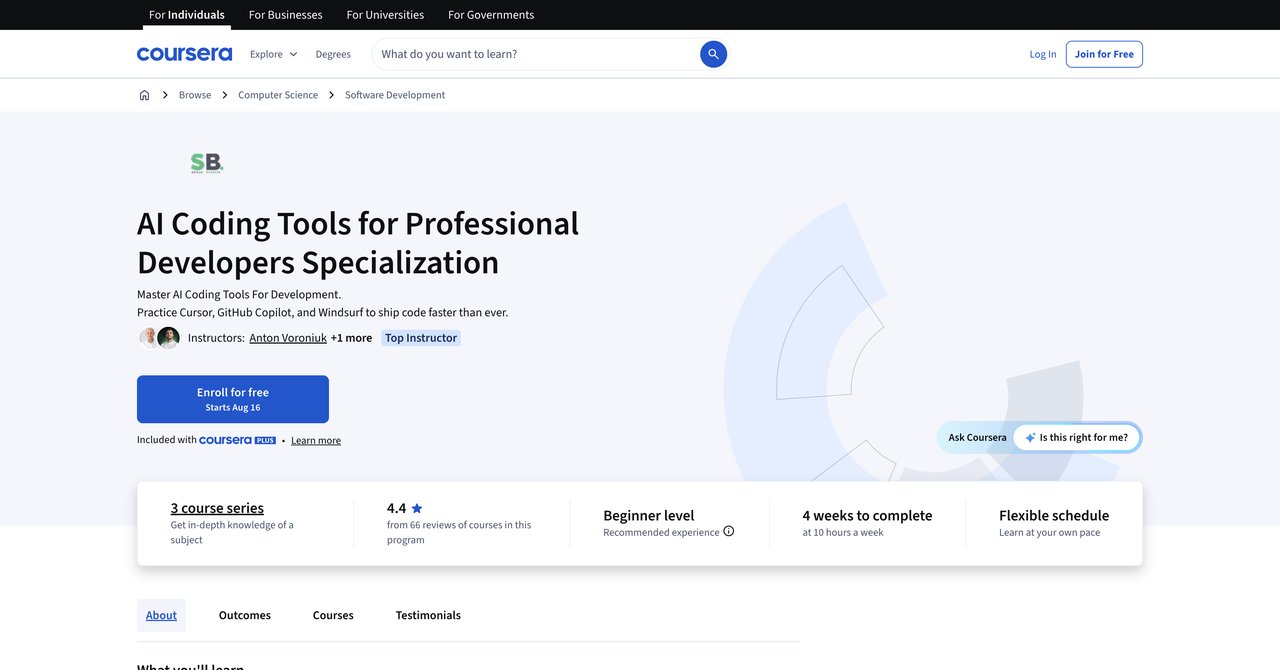
This one is a specific specialization offered through Coursera, now updated to align with 2026 workflows to make sure you're learning relevant tooling. It covers three of the leading AI coding tools on the market today: Cursor, GitHub Copilot, and Windsurf. The course is a hands-on experience, showing you from setup to real world implementation. Rather than just discussing theory, you'll be expected to get your hands dirty using the code editor tools directly. It is a practical approach that mirrors what you would do at work, which is a positive.
It is taught as a specialization with several smaller modules. You will work with projects that simulate real-world conditions, which is always better than dry examples. The some modules were updated recently to capture the latest features of these tools, so you won't be relaying on outdated model versions.
The course does have a free audit option, but it's worth be aware that with the free audit, graded materials and assignments may be inaccessible. If you need the certificate or feedback on your hands-on work, you'll have to pay for the upgrades. If they recently made changes to lock more materials, some free users have noted it.
It's not supposed to be a comparison theory. You will actually be writing code and building mini-projects to test what the tools can do, then learn how to handle those tools inside your own existing workflow. If you are not sure which tool to adopt for your team, this is a good way to compare them.
Key topics covered include how to select the right AI coding tool for different tasks, setting up these tools in professional environments, integrating them into IDEs like VS Code, and comparing output and quality of each tool.
This specialization is appropriate for developers who already have some coding experience in modern languages and are looking to level up their AI usage. It is not intended for total novices; you should understand the fundamentals of writing code already.
Pros:
- Covers three leading tools (Cursor, GitHub Copilot, Windsurf) in one specialization
- Hands-on projects from setup to real-world implementation
- Recently updated to reflect 2026 workflows, so it's fresh
Cons:
- Audited free enrollment may lock graded material, which is a pain for free learners
- Tool-agnostic rather than a deep-dive into a single assistant, so you don't become an expert
Who benefits most?
If you are leading a development team that's looking to choose a specific coding assistant, or if you personally want to know the differences between cursor, Copilot and Windsurf, this course is your best bet. It's practical, hands-on, and you'll get a good sense of what each tool feels like in your daily workflow.
Connect to the course: AI Coding Tools for Professional Developers
Course 3: GenAI for Software Developers (Coursera)
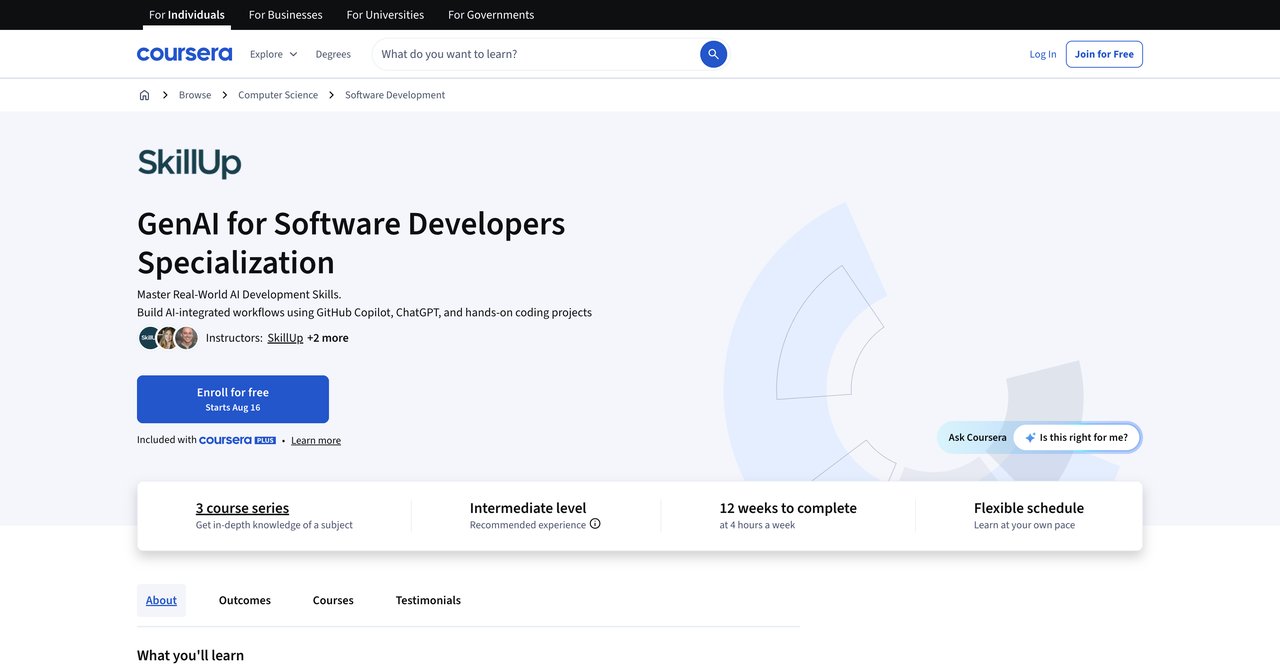
This specialization focuses on quality and production practices that are specific to code generated by generative AI. It's not just about prompting and copy-pasting; the aim is to make sure the AI code is actually good enough for a production environment. If you're writing massive codebase at your work, you'll want to learn how to handle the fast-changing landscape of AI in demand. The course is somewhat practical and leans into the "how" rather than the "why," making it more useful for engineers rather than those with a research mindset.
It's a good way to look beyond simply generating code and to understand how to test, validate, and improve the code that the AI outputs. If you've been trying to get high-quality suggestions from these models and you've realized it's more of a craft than a simple trick, this course is here for that. The content is focused on the modern production environment where you have to care about reliability.
This course tends to be general in nature, so if you're looking for python-specific or cloud-specific details, you may need to supplement it. Still, it gives you a solid "generalized" foundation to build on. Key topics covered include how to ensure code from large language models is correct, how to handle bugs in AI-generated code, and better prompt strategies for higher quality outputs.
This is a suitable course for developers who have experience with AI assistants and want to move beyond the preliminary stage.
Pros:
- Explicitly targets GenAI-assisted code quality and advanced production practices
- It includes the fast-changing landscape of AI in demand so it's relevant
Cons:
- No published duration or level, which makes it hard to plan
- Likely general rather than stack-specific, so there are no deep dives
Who benefits most? It's best for software engineers that are already using generative AI to code, but are noticing a lack of reliability when they do so. You'll get solid practices for using AI safely in production settings, making it a good bridge between experimentation and professional implementation.
Check the current offering: GenAI for Software Developers
Course 4: Generative AI for Software Development Skill Certificate (DeepLearning.AI on Coursera)
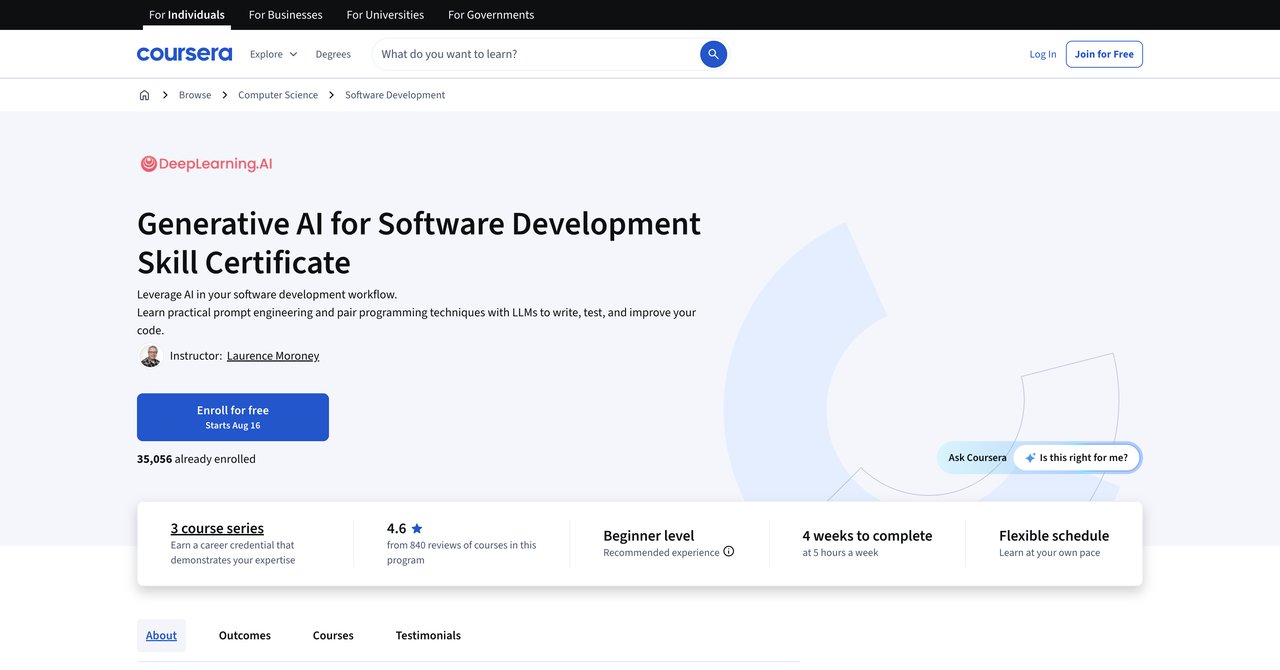
This is a professional certificate program taught by Laurence Moroney, who used to be an AI lead at Google, which gives it immediate credibility. It's a pathway that takes you from basics to real-world coding, and it has a unique edge: pair-coding with a large language model. You don't just learn about AI; you actually practice coding in conjunction with an LLM to see how it feels to delegate tasks properly, let it help you debug, and generate content.
The goal is to make you conversant in the core concepts of generative AI (like LLMs, Transformers) while making your code output better. Since it's taught by a recognized expert, the quality of the explanations and are clear and concepts are explained well, without fluff. The step-by-step progression means you'll finish and feel like you've genuinely learned. It is considered one of the most respected certificate pathways available right now due to the instructor's background.
However, because it starts at a beginner level, advanced developers may find the first half too basic. The common criticism is that it might skip over some very advanced production scaling topics like high-precision tuning in production or heavy performance tuning, falling short for those in pure platform positions.
Key topics covered include pair-coding with LLMs, understanding how LLMs apply to programming tasks, and how to integrate generative AI into your current developer workflow.
Target audience: junior developers, developers switching to AI-integrated software development, or established professionals who want to make sure their fundamental knowledge is up to model.
Pros:
- Taught by Laurence Moroney, former AI lead at Google
- Complete certificate pathway from basics to real-world coding
- Includes pair-coding with an LLM, a critical skill
Cons:
- Beginner level, so not heavy for seniors. It can feel slow if you already know the basics.
- May skip advanced production scaling topics like large-scale model deployment
Who is this for? This is perfect for developers who want a structured, trusted start in generative AI in coding and want the support of a known name in the industry. It's a great entry point to get you fluent in AI-assisted coding.
Learn more: Generative AI for Software Development Certificate
Course 5: Generative AI for Software Developers (Coursera)
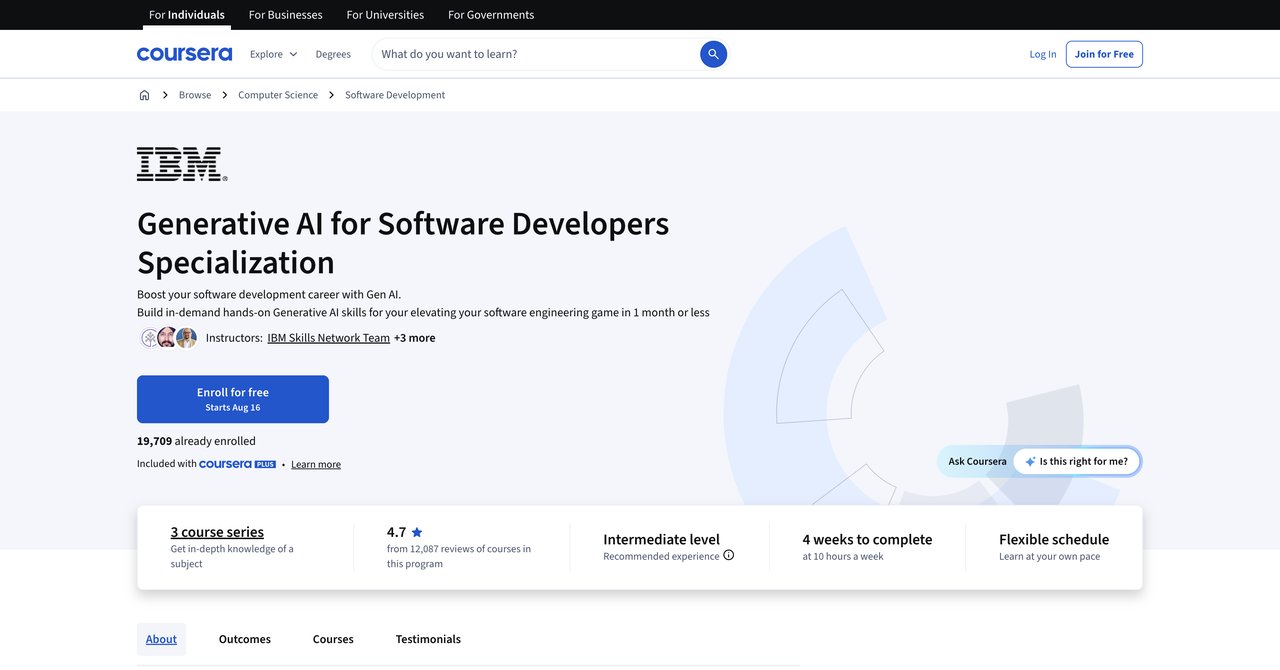
This one takes a somewhat different route. It covers the basics of GenAI models and tools, but it goes beyond code. It touches text, images, and audio. The goal is to build a well-rounded understanding that serves any developer, which is a valid approach given the shift towards multimodal AI interfaces. You'll learn about the models, get a feel for different tools beyond just coding, and be able to understand how to define what's happening in your software when AI starts producing paints or text.
The hands-on learning is self-paced. You can arrange it around your own schedule, which is good, especially if you are a working professional. It's a beginner-friendly course and great for those who want to see the "bigger picture" of AI gracing beyond assignments. And the examples are focused on real implementation.
However, this generalist approach means it might lack deep code-generation techniques. If you are looking for a very specific thing, like how to write a complex transformer in JavaScript, this may not be it. The lack of an explicit skill level listed can also be slightly confusing. You will find out what level matters most to you only when you open the first lesson.
Still, for a developer who has been pretty closed off to AI besides the code, this is a useful course to widen one's own lens.
Key topics include an overview of foundational generative AI models, practical skills in text-to-text, text-to-image, updates on audio and video AI, and how to use these models to add value to the web apps.
Pros:
- Covers basics of GenAI models and tools beyond just code (text/image/audio)
- Builds a well-rounded understanding for any developer
- Self-paced courses
Cons:
- May lack deep code-generation techniques
- No explicit skill level listed
Who is it for? Best for developers who are still new to AI or want to understand AI-powered applications from a high level, including, e.g., full-stack developers who need to know how to move beyond text and deal with multimedia data points as well.
Course link: Generative AI for Software Developers, Coursera
Course 6: AI Software Development, from First Prompt to Production Code (Maven)
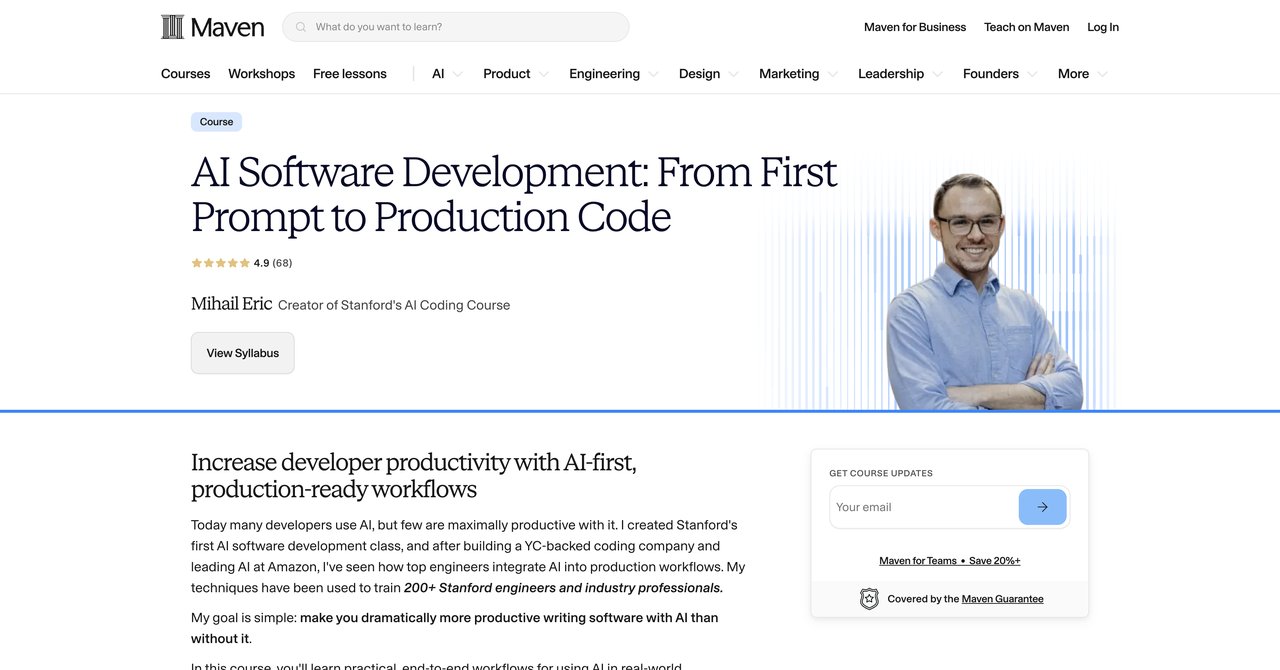
This course is highly focused on practical, end-to-end workflows. It's a guided approach on how to go from your research phase, to planning, to implementation, and then to testing, all while leveraging coding agents. The stated goal is to help you ship code 2x faster, and it's very clear about that. It's not a course for toy examples; they state it focuses on production-grade code, so you are going to be dealing with real-world engineering issues, not just academic ones.
The provider, Maven, markets itself as being deeply practical. During this, you will see how to use agents to do heavy lifting, how to structure your thinking, and how to direct them efficiently. The only downside is the pricing is not publicly listed, so you might have to sign up or get in touch with Maven to find out what it actually costs. The course also seems to be centered on a single niche streaming workflow, which they mention. This could be great if you work in that niche, but it's still quite specific.
You need a good, stable understanding of coding and AI when you start, as the course builds from about intermediate level.
Key topics: creating effective workflows, guiding coding agents, optimizing the research-plan-implement-test loop, and shipping real code faster. The course will help you reduce the overhead.
Pros:
- A highly-practical, end-to-end workflow (research → plan → implement → test)
- Demonstrates how to leverage code generation agents to ship 2x faster
- Focused on production-grade code instead of toy examples
Cons:
- Pricing isn't publicly listed
- Covers a single-niche streaming workflow, not a full platform with generic examples
Who is this for? Developers who want to move fast and need a workflow guide that's comfortable with agentic AI. It's for the developer who wants more than a code generator, ideally someone with experience building over projects in a wide range.
Get the details: Maven AI Software Development
Course 7: Claude Code, Software Engineering with Generative AI Agents (Coursera)
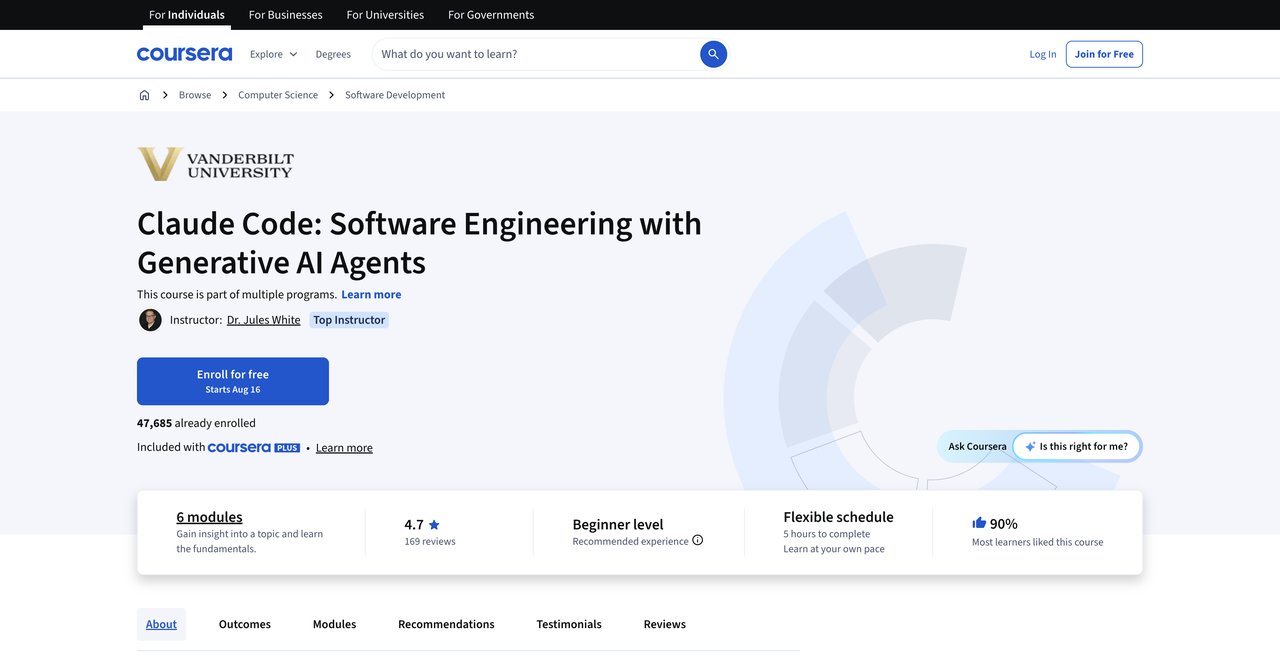
This is a compact course that specifically covers the Claude Code platform, where evolutionary agents in software engineering are used. It teaches you how to orchestrate Claude Code like a tech lead managing multiple AI agents that is, not just using one agent, but coordinating several to do tasks like bug hunting, building, and testing. This focus on multi-agent orchestration has been changing, aligning with 2026-defect-career trends where clear career paths into agent management will be huge.
Since it's a specific platform, you will learn the specific details of Claude's setup, functions, and how to use this platform with your own development environment. It's built for scale and for professionals who are already encountering AI agent in a production setting.
It's free, so cost is not an obstacle. The main thing to note is as the course is exclusively about Claude Code, the value is limited if your company doesn't use this platform. If you already use Claude, you could 100% benefit; if not, you will spend a lot of time studying tool x you might never use.
Key topics: using Claude Code features in a real developer, coordinating multiple AI agents, and leveraging agents for code review automation, and speeding through infrastructure tasks.
Pros:
- Teaches orchestration of Claude Code like a tech lead managing multiple AI agents
- Focused on scale workflows with AI agent usage
- Aligns with 2026-defect-career trends
Cons:
- Niche only to Claude Code
- You'll have little to no value if you're building with a different coding agent
Who? This is for developers already in organizations using Claude Code or who have a job role that requires you to deploy it for advanced agent-oriented tasks.
Visit the course: Claude Code Coursera
Course 8: Introduction to Generative AI for Software Development
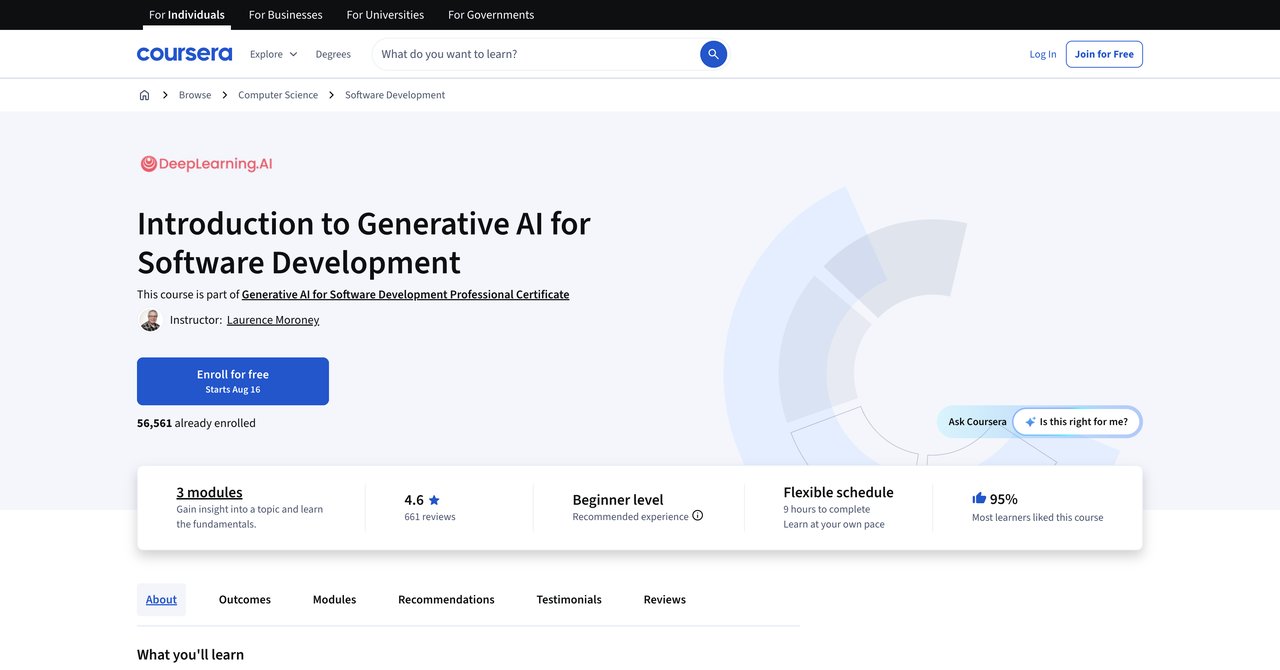
This is a shorter, time-efficient 9-hour starting point. If you are pressed for time, this course was made for you and other professionals looking for a quick ramp-up. The focus is strictly on pair-programming with a large language model, teaching you how the LLMs actually work for standard tasks. It's a good shot of knowledge without the fat, extremely efficient and tactical.
The prime focus is on how an LLM can help you get through the everyday tasks that you do, like writing functions, correcting syntax, and testing new ones. It gets to the point and you come out with some solid basics that you can expand upon on your own. It requires only pure basic developer skills, so you can jump in right away.
But due to the introductory nature, those with an experience higher level will find this too basic. Advanced developers won't learn very much from the principles and. This is more of a spark, rather than a full fire.
Key topics: how large language models, including codegen AI, function, using common software tasks with an LLM, and an overview of using standard workforces.
Pros:
- Time-efficient 9-hour intro
- Focuses on pair-programming, which is what you actually do in reality
- Teaches how an LLM works for common programming tasks
Cons:
- Too basic for advanced developers
- Does not cover production infrastructure or using agents
Who is it for? Junior developers, students, or long-time devs who feel completely behind on the current AI tools and need a quick, easy hook.
Introduction to Generative AI for Software Development link
Course 9: Gemini and Vertex AI: Building Intelligent Applications (Coursera)

Here is a Google-centric course with a focus on Gemini, Google's giant model family, and Vertex AI, their suite for machine learning and app builders. The course is very hands-on, teaching you with actual tools and real Google cloud APIs. With its multimodal architecture, you're learning to build intelligent apps that handle text, images and doc analysis.
It has a great timeline, as it only takes about 2 weeks. For developers in the Google Cloud area, it gives you a direct pathway to using Google's stack. It's a straight about the Gemini ecosystem. You will get a nice bit of learning, the course is pretty small and specific to one provider, which is a plus and a minus at the same time.
This course is less about learning to write code , it's more about using Google's core models in your apps.
Key topics include the Gemini API, its multimodal abilities, AI Studio, use of LLM for code generation, and adding document analysis to your tool belt from Google Cloud.
Pros:
- Covers Gemini's multimodal architecture and AI Studio/APIs for code generation/document analysis
- Hands-on with real Google Cloud tools
- Short 2-week format
Cons:
- Strongly tied to the Google Cloud stack
- No open-source coverage
Who is best for it? Anyone working in a Google Cloud shop or incorporating Gemini into a product. Beneficial for developers who need to create apps that use Google's most current tech stacks.
See Gemini and Vertex AI Courses
Course 10: Generative AI for Code Generation Training (Coursera)
This workshop focuses is on real-world React application development and refactoring. It uses code generation tools directly on a real project. This one does a direct comparative approach, putting Copilot, Amazon Q, and ChatGPT on your team. A key value is that you'll see strengths and weaknesses through the work.
It helps you see and identify challenges in 'building software' like code mixing in security concerns. If you are a front-end developer working with React, you will find this useful. You will also understand how to adopt it within your sustained team to maybe encourage adoption. The course has unclear level or duration, and I can't confirm if a certification is at the end. Also, the examples are strongly focused on front-end React only.
Maybe those who aren't using React will find less overall value for them. But for those, it's practical and hands-on.
Pros:
- Real-world React app building/refactoring
- Compares Copilot, Amazon Q and ChatGPT clearly
- Surfaces challenges like quality and adoption
Cons:
- No explicit level or duration
- Only focuses on front-end React examples
Who is this? React Developers or teams trying to decide between code generation tools on an existing codebase.
Generative AI for Code Generation Training
Recommendations and Final Thoughts
There is no "one perfect course" for software developers, because so much depends on your current experience level, your role, and OpenAI the way you choose to learn. Here's my honest assessment overall to guide your decision.
If you want the best overall value and the ability to learn consistently over time, CompleteAI Training stands out compared to the others. Not because all the other options are lacking, but because AI evolves so fast and you need a flexible resource. Instead of paying per course, you get all courses plus, future new courses included in one flat subscription. You can learn the basics, then move to advanced material, and also check out a different role if you get curious. This seems like one solution to the single biggest problem of staying updated in this specific sector. The pricing is also hard to beat.
For developers on a tight budget, complete free offerings like Coursera's Introduction to GenAI for Software Development or Claude Code for Software Engineering with Generative AI are good to start. Be prepared to supplement the lack of depth.
If you need a certificate from a well-known provider right now, I can't suggest DeepLearning.AI, as the material is really good, and it gets you with a professional edge hands-on. Finally, if you're working deeply in the Google ecosystem, the Gemini and Vertex AI course is certainly worth it.
Try to stop and think about what will your daily working needs be in 6 months. For most software developers, the most important factor is staying relevant. With that, a single course is rarely enough: you should go with a platform that updates as new tools appear. CompleteAI Training fits that role perfectly. But if you're just curious about the topic, the free intro courses are a good starting point.
Whatever you choose, make the right choice that not only gives you content at this moment but for your continuous learning. Your time matters as much as your money. Good luck with your learning.