
Blog ·
11 Essential AI Courses for Network Engineers in 2026
Future-proof your network career with 11 curated AI courses covering automation, predictive analytics, and intelligent troubleshooting. Learn practical skills and essential tools to excel in the AI-driven networking world.
 Jeroen Erne
The rapid expansion of artificial intelligence is reshaping industries at a pace that feels almost relentless. For network engineers, this shift is both a challenge and an opportunity. The tools, protocols, and workflows you mastered a few years ago are being augmented-and in some cases replaced-by AI-driven systems that can predict failures, automate configurations, and optimize traffic in real time. The question is no longer whether AI will affect your career, but how quickly you can adapt to it. Upskilling in this area isn't just a nice-to-have anymore; it's becoming a core requirement for staying relevant in a field that is evolving faster than most certification programs can keep up with.
If you're a network engineer who hasn't yet explored AI, you might feel a bit behind. But you're not alone. Many professionals in your position are just starting to look at how machine learning, automation, and intelligent analytics fit into their daily responsibilities. The good news is that there are now dozens of courses specifically designed for people like you-engineers who understand routing, switching, and security but need to build a bridge to AI concepts without starting from scratch.
Why AI matters for Network Engineers today
The numbers tell a compelling story. According to recent surveys, roughly 69% of businesses are already using AI in some capacity, and that figure continues to climb each year. In networking specifically, AI is being used to automate routine maintenance tasks, detect anomalies in traffic patterns, and even self-heal network issues before they impact users. This isn't science fiction-it's happening right now in enterprise environments, data centers, and service provider networks.
What does that mean for you? It means that the skills you've built over years of troubleshooting and configuring networks are still valuable, but they're being complemented by new tools that require a different kind of knowledge. Understanding how AI models work, how to feed them the right data, and how to interpret their outputs is becoming a differentiator in hiring decisions. Companies are actively looking for engineers who can bridge the gap between traditional networking and AI-driven operations.
This article is here to help you cut through the noise. We've reviewed and compared 12 AI courses aimed specifically at network engineers, ranging from vendor-neutral introductions to deep technical bootcamps. Whether you're looking for a quick overview or a comprehensive certification path, you'll find options that fit your experience level and career goals.
The Growing Role of AI in Network Engineers
AI is not just a buzzword in networking; it's being deployed in concrete, measurable ways. Here are some of the most common applications you'll encounter:
- Automated network operations: AI can handle routine tasks like configuration backups, firmware updates, and even initial troubleshooting, freeing up engineers to focus on more complex issues.
- Predictive analytics: By analyzing historical traffic data, AI models can forecast when a link might fail or when bandwidth demand will spike, allowing for proactive adjustments.
- Intelligent traffic routing: Machine learning algorithms can dynamically adjust routing paths based on real-time conditions, improving performance and reducing congestion.
- Security threat detection: AI-powered systems can spot unusual patterns that might indicate a breach, often faster than a human analyst could.
- Network optimization: AI can continuously monitor performance metrics and recommend or implement changes to improve efficiency, whether that's in a campus LAN or a multi-cloud WAN.
These applications are changing the day-to-day work of network engineers. Instead of spending hours manually configuring devices or sifting through logs, you might find yourself designing the rules that an AI system uses to make decisions, or validating the outputs of an automated tool. That shift requires a new skill set-one that combines traditional networking knowledge with a working understanding of AI principles.
Benefits of becoming an AI expert in Network Engineers
Investing time in AI training pays off in several tangible ways. First, there's the salary factor. Roles that combine networking expertise with AI skills often command higher compensation because they're harder to fill. You're not just a network engineer anymore; you're someone who can design intelligent systems that reduce operational overhead and improve reliability. That's a value proposition that hiring managers notice.
Second, there's job security. Automation is often feared as a threat to networking jobs, but the reality is more nuanced. While some routine tasks are being automated, the need for people who understand how to design, deploy, and manage these AI systems is growing. By positioning yourself as someone who can work alongside AI tools-rather than being replaced by them-you make yourself indispensable.
Finally, there's the intellectual challenge. Networking has always been a field that rewards continuous learning, and AI adds a fresh layer of complexity that can keep the work interesting. Whether you're building predictive models for capacity planning or using natural language processing to automate ticketing systems, there's a lot of room to grow and specialize.
If you're ready to take the next step, the courses we've reviewed below cover everything from foundational concepts to hands-on labs. One standout option is CompleteAI Training's AI for Network Engineers, which not only covers the essentials but also gives you access to all courses and all certifications on the platform-so you're not limited to a single track. Whether you choose that or one of the other excellent programs, the important thing is to start building your AI skills now, before the gap between those who understand AI and those who don't becomes even wider.
Comparison: All AI Courses for Network Engineers (Updated 2026)
| Course Name | Provider | Price | Key Topics | Pros | Cons | Best For |
|---|---|---|---|---|---|---|
| CompleteAI Training - AI for Network Engineers | CompleteAI | Premium (one flat subscription covers ALL courses and ALL certifications) | Comprehensive AI curriculum covering everything from fundamentals to advanced networking AI applications. Includes hands-on projects across multiple domains, not just a single course. | Comprehensive curriculum, Hands-on projects, Expert instructors, Full access to ALL video courses and ALL certifications on the platform (not just one course), New content added continuously, Access to every other job role's material too | Premium pricing, Subscription-based rather than one-time purchase | Network Engineers professionals looking for complete training; those who want everything included in one flat price |
| AI for Network Engineers (Subscription) | Complete AI Training | $29/month or $8.25/month (billed annually) | Full access to ALL video courses and ALL certifications on the platform. New material added continuously. Covers every job role, not just network engineering. | Full access to ALL video courses on the platform, not a single course or a fixed bundle; Full access to ALL certifications at no extra cost; New courses added automatically; Access to every other job role's material; One flat subscription covers everything vs paying per course elsewhere | Subscription-based may be a barrier for those preferring one-time purchases; Continuous learning required as AI develops quickly | General learners who want broad access to multiple AI topics and certifications |
| AI-NE , AI for Network Engineers | Firefly | $2,900 USD | AI/ML fundamentals, prompt engineering, infrastructure design for AI workloads, practical AI applications for network monitoring, configuration, troubleshooting, and compliance | Hands-on labs for monitoring, configuration, troubleshooting, and compliance; Covers AI/ML fundamentals plus prompt engineering; Includes infrastructure design for AI workloads | Expensive; Requires live attendance on specific dates | General learners |
| AI for Network Administrators: Monitoring, Automation, and Troubleshooting | Qualora | $49.00 | AI workflows for network administration, safety, compliance, ethical guidelines, AI-driven automation and troubleshooting | Low-cost, self-paced; Focuses on AI workflows for network administration; Includes safety, compliance, and ethical guidelines | Short duration; limited hands-on lab work | General learners |
| AI for Network Engineers v1.0 (AINE) | Tandem Solution | $2,900.00 | AI-driven automation, monitoring, prompt engineering, infrastructure design for AI workloads | Instructor-led with hands-on labs; Covers AI-driven automation, monitoring, and prompt engineering; Includes infrastructure design for AI workloads | High cost; scheduled dates may be limited | General learners |
| AI+ Network | ProTrain College | $495.00 | AI with SDN, NFV, and cybersecurity; automation; real-time network optimization; AI for cybersecurity | Covers automation, SDN, NFV, and AI for cybersecurity; includes real-time network optimization; moderate price | Less focus on hands-on labs; may require additional self-study | General learners |
| Cisco CCDE AI v3.1 Practical/Lab and Written Training | Orhan Ergun | $29.08/month (subscription) | 20 modules, 244 lectures, 17 quizzes, lab preparation for Cisco CCDE exam, AI for networking and networking for AI | Comprehensive and self-paced; includes 17 quizzes and lab prep for Cisco CCDE exam; covers both AI for networking and networking for AI | Monthly subscription may add up; advanced level may be challenging for beginners | General learners |
| AI for Network Engineers (Live Event) | O'Reilly | Subscription or per-event fee | TensorFlow, PyTorch, network-specific AI platforms, anomaly detection, predictive maintenance, NLP for logs | Hands-on with TensorFlow, PyTorch, and network-specific AI platforms; covers anomaly detection, predictive maintenance, and NLP for logs; practical enterprise focus | Requires O'Reilly subscription or event fee; limited to live event schedule | General learners |
| AI Techniques for Networking | LinkedIn Learning | Subscription (LinkedIn Learning) | Root cause analysis, predictive analytics, dynamic resource allocation in network management | Short and focused; covers root cause analysis, predictive analytics, and dynamic resource allocation; beginner-friendly | Brief; not updated recently (2024); limited depth | General learners |
| Master Network Automation with Python for Network Engineers | Udemy | Varies (often discounted, ~$20-$100) | Python automation with napalm and Ansible for multi-vendor networks; 23.5 hours of content, starts from scratch | Hands-on labs with napalm and Ansible; starts from scratch; multi-vendor support; boosts job prospects | Not AI-specific; focuses on Python automation rather than AI/ML | General learners |
| Programming For Network Engineers Training With Labs Devasc | Udemy | Varies (often discounted) | Python network programming with hands-on labs, preparation for DevNet Associate (DevASC) certification using real devices | Python network programming with labs; prepares for DevNet Associate (DevASC); uses real devices | Not AI-focused; limited to programming basics | General learners |
| Network Automation with Python and Ansible: Live Course | PM Networking | ₹19,999 (approx. $240 USD) | Network-specific automation training with Python and Ansible, real-world labs, resume building, job assistance | Network-specific automation with Python and Ansible; real-world labs; resume building and job assistance; lifetime access | Not AI-specific; may be region-focused (India) | General learners |
Understanding AI Training for Network Engineers Professionals
Network engineering is changing fast. AI now handles things like predictive troubleshooting, automated configs, and traffic analysis that used to take hours of manual work. For professionals in this field, learning how to apply AI isn't optional anymore-it's becoming a core part of the job. But the training market is crowded, and courses range from cheap Udemy deals to expensive instructor-led bootcamps. Some focus purely on Python automation, while others dig into machine learning for network monitoring. The right choice depends on your budget, your current skill level, and what you actually want to achieve in your career.
This comparison breaks down the main options available right now. We'll look at what each course actually covers, who it's for, and what you're really getting for your money. Some of these are one-off purchases, some are subscriptions, and a few are live events with fixed schedules. Let's get into it.
Course 1: CompleteAI Training , AI for Network Engineers
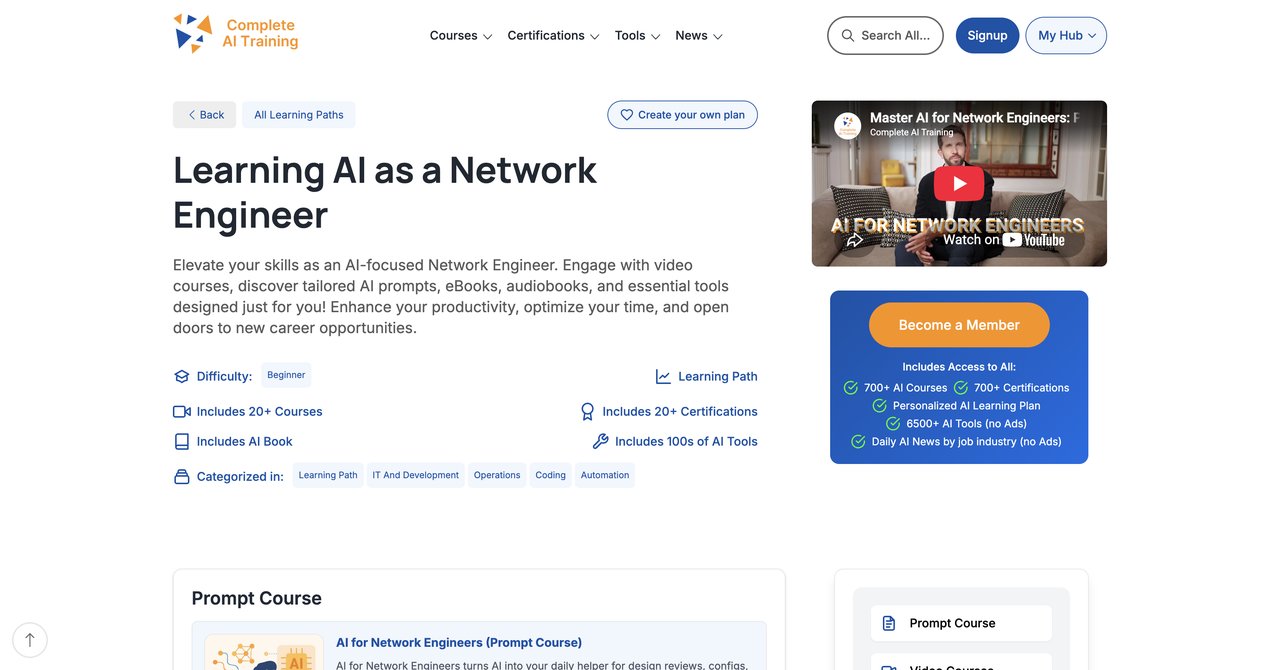
CompleteAI Training is different from every other entry on this list. You're not buying one course. The subscription unlocks every video course and every certification on the entire platform-hundreds of them, across all job roles, not just network engineering. This is the key differentiator. Other providers charge per course, and if you want a certificate, you pay extra. Here, one flat monthly fee covers everything, including the certs.
The AI for Network Engineers content itself is comprehensive. It covers AI fundamentals, practical applications for network monitoring, automation workflows, and troubleshooting with machine learning. But the real value is the scale. Because you get access to all job role materials, you can cross-train into adjacent areas like cybersecurity or cloud. If your work spans multiple functions, or if you're thinking about moving roles in the future, that flexibility matters.
New courses and certifications are added continuously, and they're included automatically. You don't have to re-purchase or upgrade. The subscription is $29/month, or $8.25/month if you pay annually. That's significantly less than what you'd pay for a single instructor-led course elsewhere.
Key topics covered: AI/ML fundamentals for networking, AI-driven network monitoring, automation with AI, troubleshooting, prompt engineering, and certification prep across multiple job roles.
Target audience and skill level: Network engineers at any level, from beginners to advanced. The platform has material for all skill levels, and because you get everything, you can start where you're comfortable and move up.
Pros:
- Full access to ALL video courses on the platform, not a single course or a fixed bundle
- Full access to ALL certifications on the platform, included at no extra cost
- New courses and certifications are added continuously and included automatically
- Access to every other job role's material, useful for multi-function work or role changes
- One flat subscription price covers all of the above, versus paying per course elsewhere
Cons:
- Subscription-based, which may be a barrier for those preferring one-time purchases
- Continuous learning required as AI develops rapidly
Who would benefit most: Network engineers who want maximum value for their money and like having a full library of resources at their fingertips. It's also great for people who aren't 100% sure what specialization they want-you can sample everything without paying extra.
Visit CompleteAI Training for AI for Network Engineers →
Course 2: AI-NE , AI for Network Engineers by Firefly
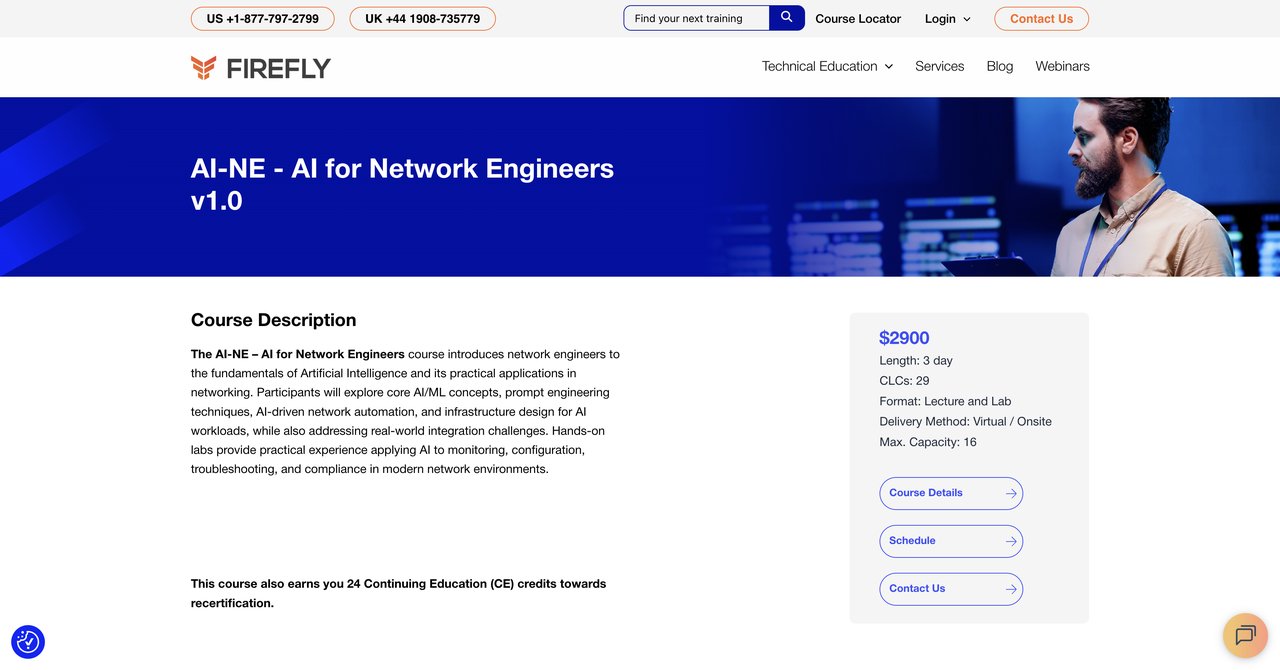
Firefly's AI-NE is a three-day instructor-led course that costs $2,900. It's a premium option that focuses on practical AI applications for network monitoring, configuration, troubleshooting, and compliance. The course covers AI/ML fundamentals, prompt engineering, and infrastructure design for AI workloads. If you're looking for hands-on labs and direct interaction with an instructor, this delivers that.
The price tag is steep, no question. But you're paying for live instruction and a structured schedule. For some professionals, that structure is worth the money-especially if you learn better in a classroom setting. The labs are designed around real-world scenarios, so you're not just watching slides. You're actually configuring networks and troubleshooting issues with AI tools.
The infrastructure design component is a nice bonus. It's not just about using AI-it's about designing networks that can support AI workloads, which is a specialized skill in itself.
Key topics covered: AI/ML fundamentals, prompt engineering, network monitoring with AI, configuration automation, troubleshooting, compliance, infrastructure design for AI workloads.
Target audience and skill level: Intermediate to senior network engineers who need hands-on experience and prefer live instruction. Some familiarity with networking concepts is assumed.
Pros:
- Hands-on labs for monitoring, configuration, troubleshooting, and compliance
- Covers AI/ML fundamentals plus prompt engineering
- Includes infrastructure design for AI workloads
Cons:
- Expensive
- Requires live attendance on specific dates
Who would benefit most: Professionals who learn best in a live, instructor-led environment and need a fast, intensive immersion. Also good for companies that want to train a team and have the budget for it.
Visit Firefly AI-NE course page →
Course 3: AI for Network Administrators by Qualora
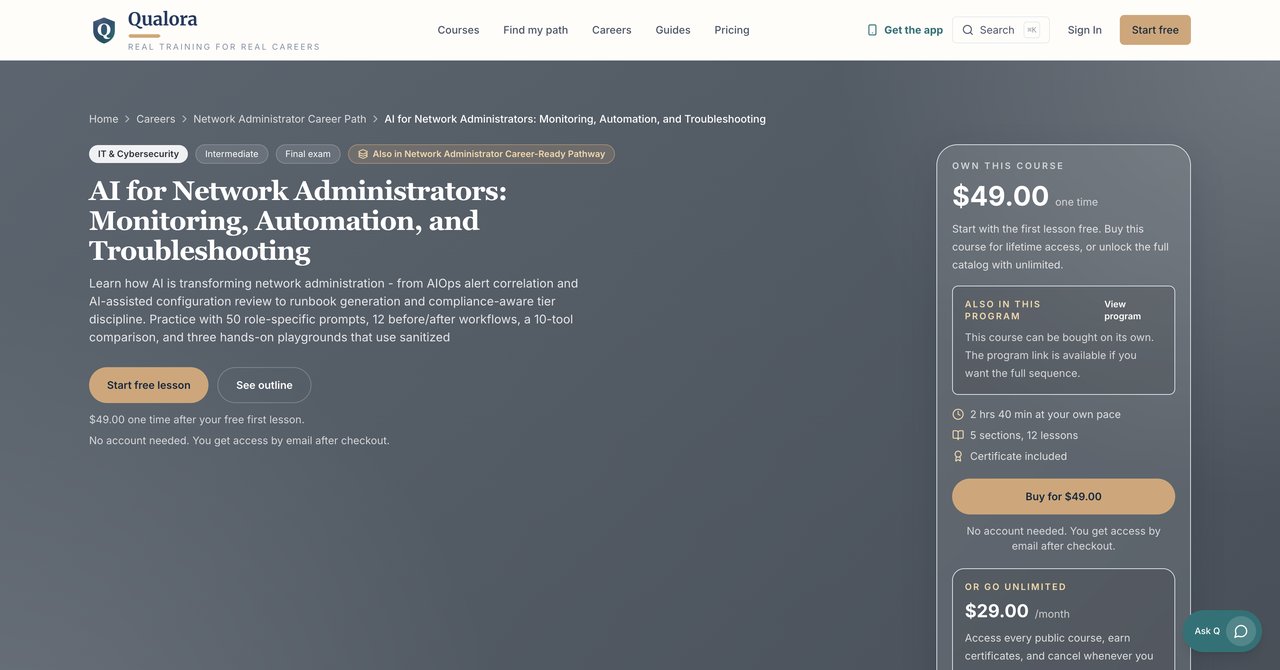
Qualora's course is a budget-friendly option at $49. It's self-paced and focuses on AI workflows for network administration. The content covers AI-driven automation and troubleshooting, but it also includes something many other courses skip: safety, compliance, and ethical guidelines. That's a useful addition, especially if you work in a regulated industry.
The low price makes it an attractive entry point. If you're just starting to explore AI in networking and don't want to commit hundreds or thousands of dollars, this is a reasonable first step. The self-paced format means you can work through it on your own schedule.
That said, it's short. Don't expect the depth of a multi-week course or an intensive bootcamp. The hands-on lab work is also limited, so if you need lots of practical exercises, this might not be enough on its own.
Key topics covered: AI workflows for network administration, AI-driven automation, troubleshooting, safety, compliance, ethical guidelines.
Target audience and skill level: Network administrators and junior engineers who want a low-cost introduction to AI. No advanced prerequisites.
Pros:
- Low-cost
- Self-paced
- Focuses on AI workflows for network administration
- Includes safety, compliance, and ethical guidelines
Cons:
- Short duration
- Limited hands-on lab work
Who would benefit most: Beginners or those on a tight budget who want to understand the basics of AI in network administration without a big investment.
Visit Qualora AI for Network Administrators →
Course 4: AI for Network Engineers v1.0 (AINE) by Tandem Solution
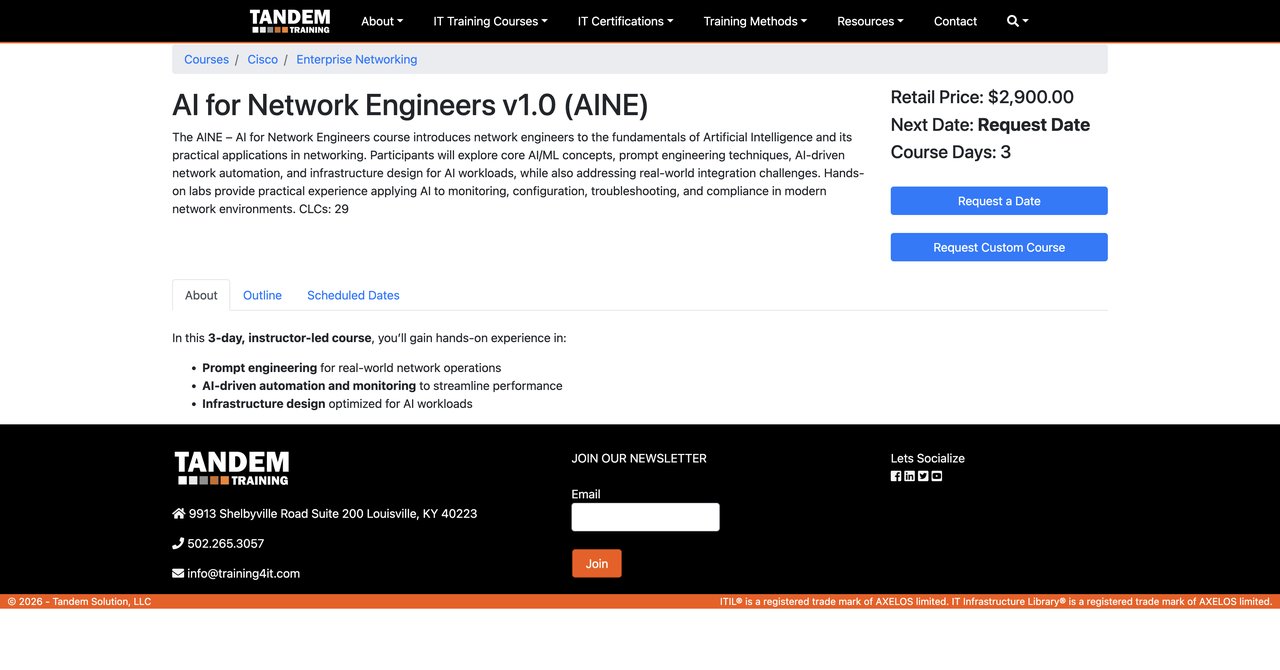
Tandem Solution's AINE course is another instructor-led option at $2,900. It covers AI-driven automation, monitoring, and prompt engineering, with hands-on labs throughout. Like Firefly's offering, it also includes infrastructure design for AI workloads. The focus is on practical skills you can apply immediately in your job.
The instructor-led format is a plus for those who value real-time feedback and the ability to ask questions. The hands-on labs are a core part of the experience, so you're not just passively absorbing information. You're working through scenarios that mirror what you'd face in production networks.
The cost is high, and the scheduled dates may be limited depending on where you are. If you need flexibility in timing, this could be a problem. But if you can commit to the schedule, the depth of instruction is solid.
Key topics covered: AI-driven automation, monitoring, prompt engineering, infrastructure design for AI workloads, hands-on labs.
Target audience and skill level: Network engineers with some experience who want a structured, instructor-led experience. Intermediate level is probably the sweet spot.
Pros:
- Instructor-led with hands-on labs
- Covers AI-driven automation, monitoring, and prompt engineering
- Includes infrastructure design for AI workloads
Cons:
- High cost
- Scheduled dates may be limited
Who would benefit most: Professionals who need a structured learning environment and have the budget for a premium course. Also suitable for teams looking for group training.
Visit Tandem Solution AINE course →
Course 5: AI+ Network by ProTrain College
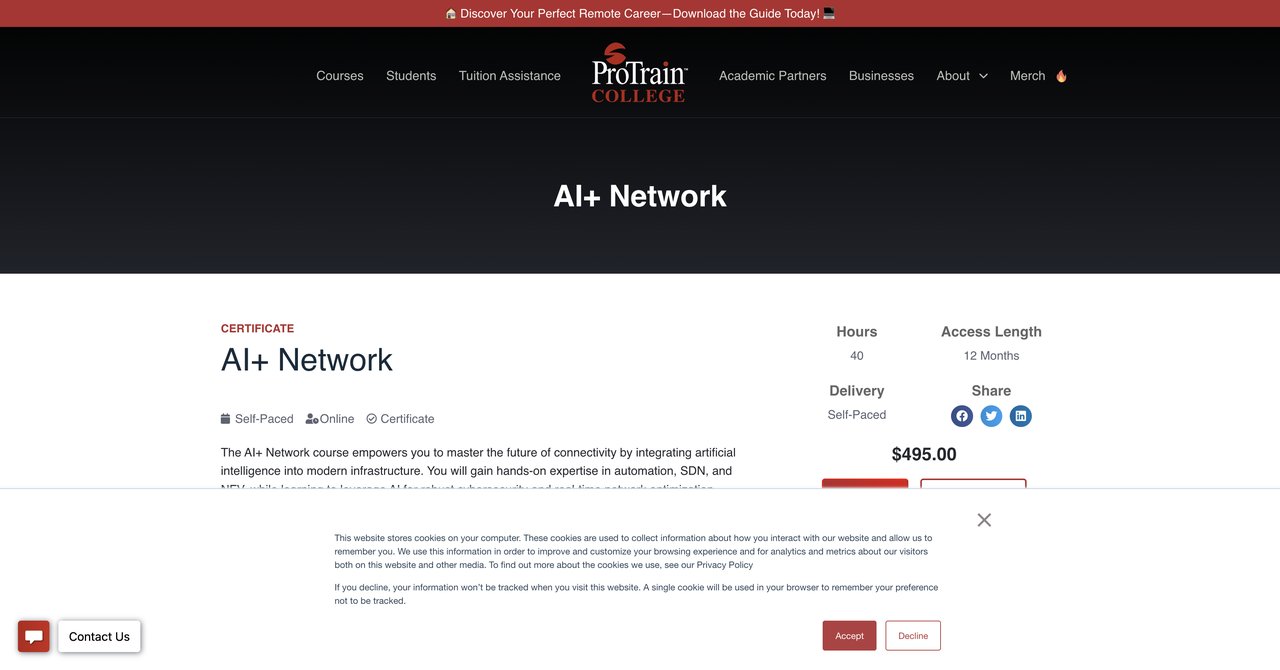
ProTrain College takes a slightly different angle. Their AI+ Network course blends AI with SDN, NFV, and cybersecurity. It covers automation, real-time network optimization, and AI for security applications. At $495, it sits in the middle of the price range-not as cheap as Qualora, not as expensive as Firefly or Tandem.
The integration of cybersecurity is a differentiator. If you're interested in the security side of networking, this course gives you a broader perspective than pure AI-for-networking courses. The real-time network optimization content is also practical, especially if you're dealing with performance-sensitive environments.
The trade-off is that hands-on labs are less emphasized. You might need to supplement with additional self-study or practice on your own equipment. The course is more theoretical in places, which could be a drawback if you learn by doing.
Key topics covered: AI with SDN and NFV, automation, real-time network optimization, AI for cybersecurity.
Target audience and skill level: Network engineers interested in the intersection of AI, networking, and security. Intermediate level recommended.
Pros:
- Covers automation, SDN, NFV, and AI for cybersecurity
- Includes real-time network optimization
- Moderate price
Cons:
- Less focus on hands-on labs
- May require additional self-study
Who would benefit most: Engineers who want a broad overview that includes security and software-defined networking, and who are comfortable with a more theoretical approach.
Visit ProTrain AI+ Network course →
Course 6: Cisco CCDE AI v3.1 Practical/Lab and Written Training by Orhan Ergun
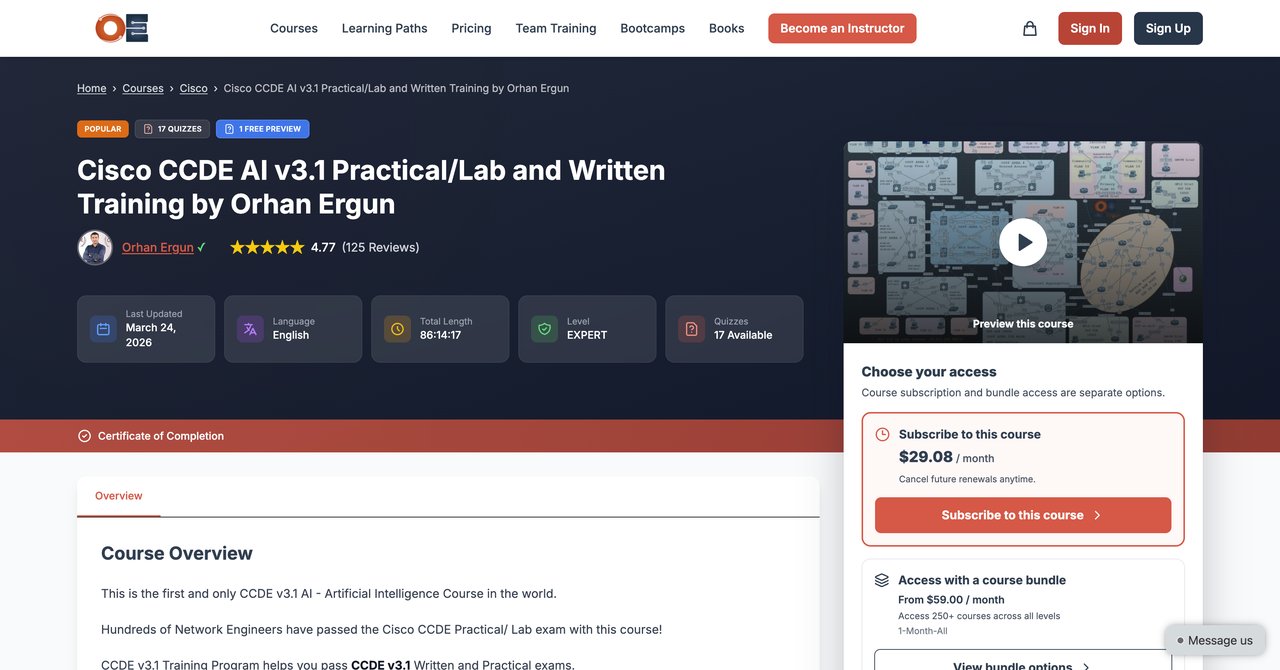
Orhan Ergun's course is specifically designed for the Cisco CCDE exam. It's a comprehensive, self-paced program with 20 modules and 244 lectures, including 17 quizzes and lab preparation. The content covers both AI for networking and networking for AI, which gives you a two-way understanding of how these fields intersect.
At $29.08/month, it's a subscription model. If you're serious about passing the CCDE exam, this is a deep resource. The quiz and lab prep components are valuable for exam readiness. The self-paced format is flexible, but you'll need discipline to work through 244 lectures on your own.
The advanced level means it's not for beginners. You should have solid networking knowledge before attempting this. The monthly subscription can also add up if you don't finish within a few months, so factor that into your budget.
Key topics covered: Cisco CCDE exam preparation, AI for networking, networking for AI, 17 quizzes, lab preparation, 20 modules.
Target audience and skill level: Advanced network engineers preparing for the Cisco CCDE certification. Not suitable for beginners.
Pros:
- Comprehensive and self-paced
- Includes 17 quizzes and lab prep for Cisco CCDE exam
- Covers both AI for networking and networking for AI
Cons:
- Monthly subscription may add up
- Advanced level may be challenging for beginners
Who would benefit most: Experienced engineers targeting the Cisco CCDE certification who want a thorough, exam-focused study resource.
Visit Orhan Ergun CCDE AI course →
Course 7: AI for Network Engineers (Live Event) by O'Reilly
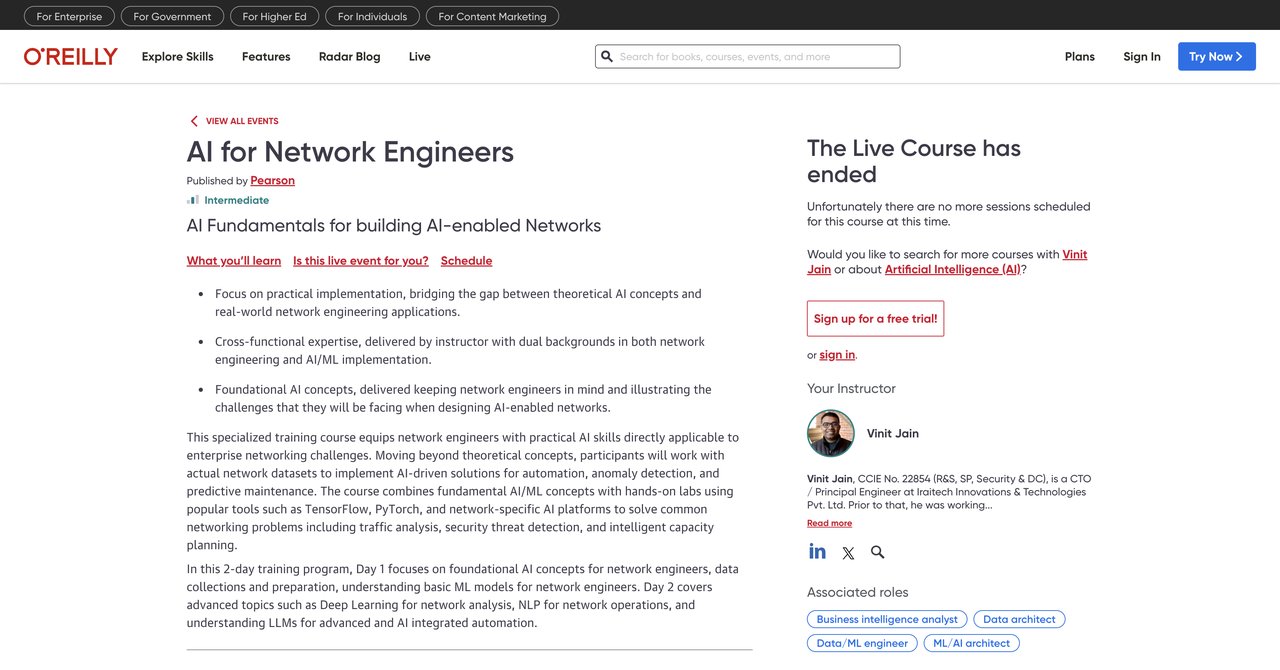
O'Reilly's live event takes a hands-on approach using TensorFlow, PyTorch, and network-specific AI platforms. The content covers anomaly detection, predictive maintenance, and NLP for logs. The enterprise focus makes it relevant for professionals working in larger organizations.
Access requires either an O'Reilly subscription or paying a per-event fee. If you already have an O'Reilly subscription, this is a good way to use it. The live event format means you get real-time interaction, but it also means you're tied to a specific schedule.
The use of TensorFlow and PyTorch is notable-these are industry-standard tools, and getting hands-on experience with them is valuable. The NLP for logs component is particularly useful for engineers dealing with massive amounts of log data.
Key topics covered: Anomaly detection, predictive maintenance, NLP for logs, TensorFlow, PyTorch, network-specific AI platforms.
Target audience and skill level: Network engineers with some programming background, especially Python. Intermediate to advanced level.
Pros:
- Hands-on with TensorFlow, PyTorch, and network-specific AI platforms
- Covers anomaly detection, predictive maintenance, and NLP for logs
- Practical enterprise focus
Cons:
- Requires O'Reilly subscription or event fee
- Limited to live event schedule
Who would benefit most: Engineers who already use O'Reilly or want practical experience with ML frameworks applied to networking problems.
Visit O'Reilly AI for Network Engineers event →
Course 8: AI Techniques for Networking by LinkedIn Learning
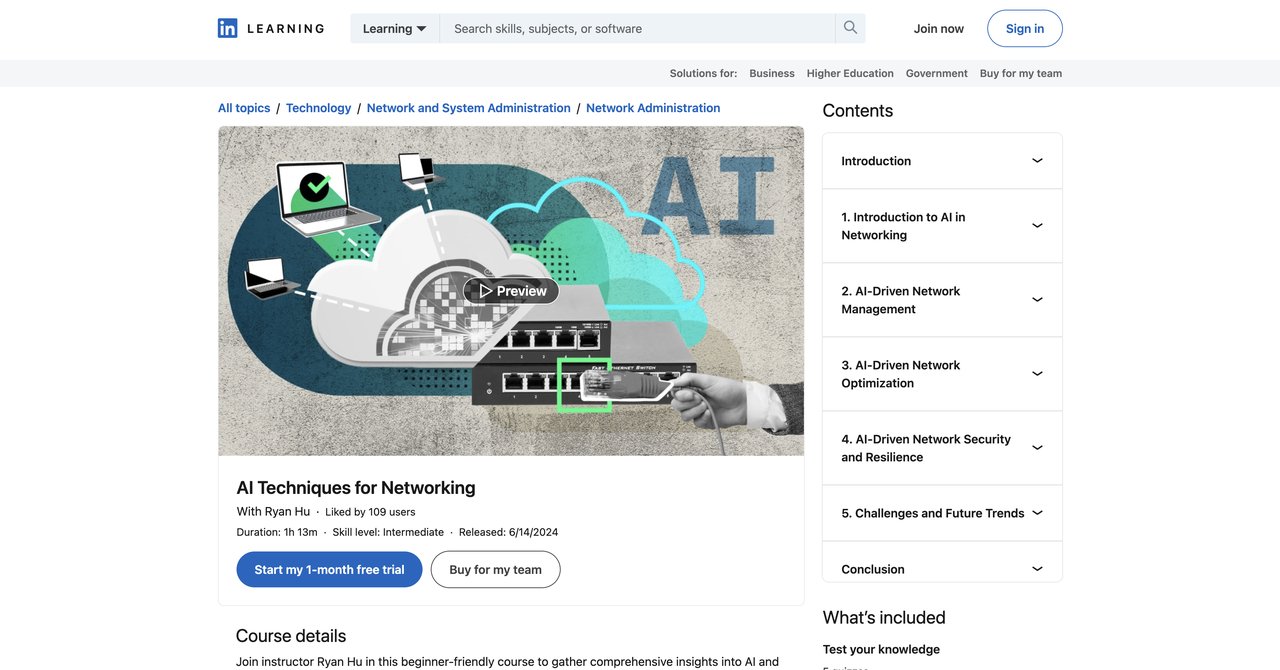
LinkedIn Learning's course is a short, focused introduction to AI techniques for network management. It covers root cause analysis, predictive analytics, and dynamic resource allocation. It's beginner-friendly, which makes it accessible if you're new to the topic.
The course is part of a LinkedIn Learning subscription, so if you already have one, there's no additional cost. The short format means you can complete it in a few hours, which is great for a quick overview. But it also means the depth is limited.
A notable drawback is that the content hasn't been updated recently-it's from 2024. In a field that moves as fast as AI, that's a concern. The fundamentals haven't changed, but you won't get the latest developments or tools.
Key topics covered: Root cause analysis, predictive analytics, dynamic resource allocation.
Target audience and skill level: Beginners who want a quick, low-commitment introduction. No prerequisites.
Pros:
- Short and focused
- Covers root cause analysis, predictive analytics, and dynamic resource allocation
- Beginner-friendly
Cons:
- Brief
- Not updated recently (2024)
- Limited depth
Who would benefit most: Those with a LinkedIn Learning subscription who want a quick primer before committing to a more comprehensive course.
Visit LinkedIn Learning AI Techniques for Networking →
Course 9: Master Network Automation with Python for Network Engineers by Udemy
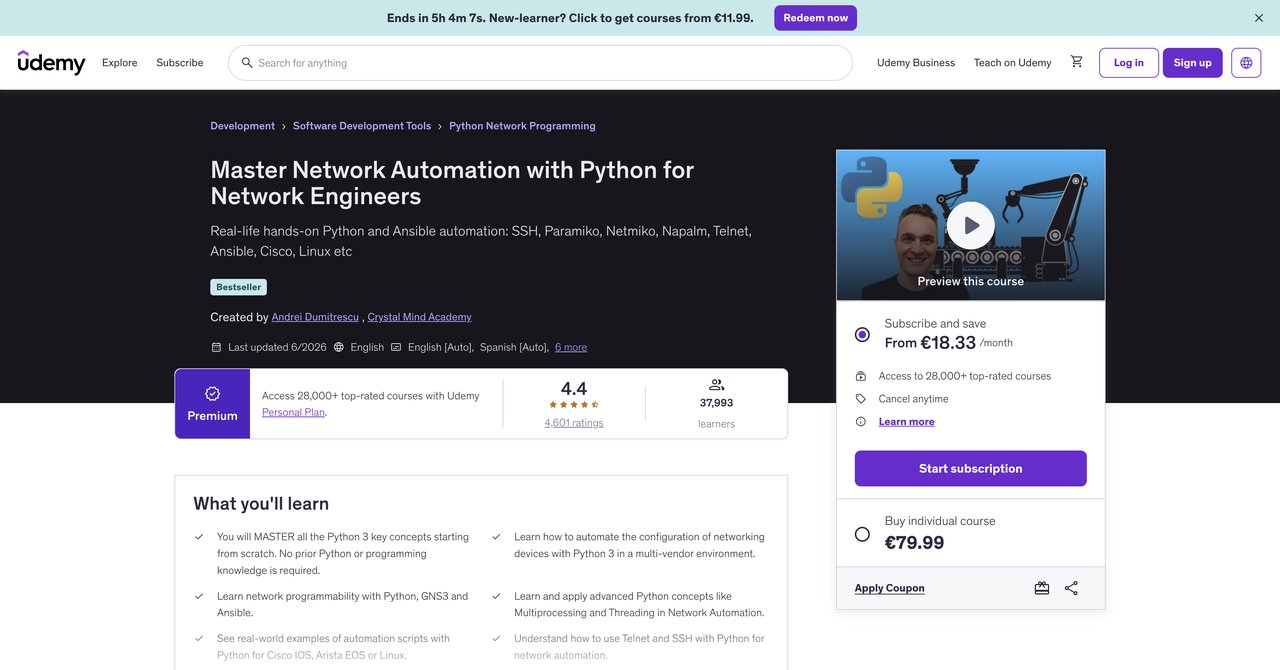
This Udemy course is a popular option for learning Python automation with napalm and Ansible. It's not AI-specific, but it's a strong foundation for automation, which is a prerequisite for many AI applications. The course starts from scratch, so no prior programming experience is needed. It includes 23.5 hours of content.
The price varies-Udemy frequently discounts courses, so you can often pick this up for $20,$100. That's excellent value for the amount of content. The multi-vendor support means you'll learn skills that apply across different network equipment brands.
Because it's not AI-focused, you'll need to connect the dots yourself. The automation skills are directly relevant, though. If you're looking to automate repetitive tasks and improve your job prospects, this is a solid choice.
Key topics covered: Python automation, napalm, Ansible, multi-vendor networks, starting from scratch.
Target audience and skill level: Network engineers with no programming experience who want to learn automation. Beginner friendly.
Pros:
- Hands-on labs with napalm and Ansible
- Starts from scratch
- Multi-vendor support
- Boosts job prospects
Cons:
- Not AI-specific
- Focuses on Python automation rather than AI/ML
Who would benefit most: Engineers who need to build automation skills as a stepping stone to AI and ML applications.
Visit Udemy Master Network Automation course →
Course 10: Programming For Network Engineers Training With Labs Devasc by Udemy
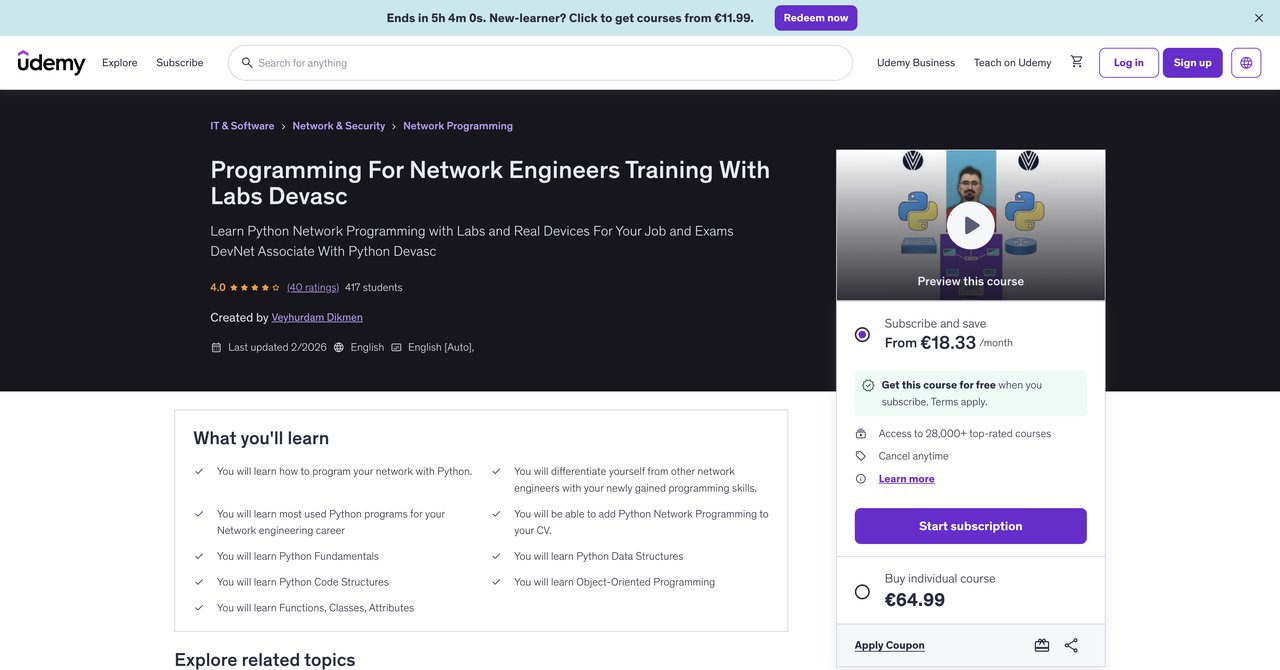
Another Udemy option, this course focuses on Python network programming with hands-on labs. It's designed to prepare you for the DevNet Associate (DevASC) certification, and it uses real devices in the labs. The certification focus is a strong point if you're looking to validate your skills.
Like the other Udemy course, pricing is variable and often discounted. The content is practical-you're working with actual network devices, not just simulations. That's a big plus for building real-world confidence.
The main limitation is that it's not AI-focused. It's about programming and automation fundamentals. If you already have those skills, this course won't add much AI-specific value. But if you're preparing for DevASC and want a solid programming foundation, it does the job.
Key topics covered: Python network programming, hands-on labs, DevNet Associate (DevASC) preparation, real devices.
Target audience and skill level: Network engineers preparing for DevASC certification or wanting to learn network programming. Beginner to intermediate.
Pros:
- Python network programming with labs
- Prepares for DevNet Associate (DevASC)
- Uses real devices
Cons:
- Not AI-focused
- Limited to programming basics
Who would benefit most: Engineers targeting the DevASC certification who need hands-on programming practice.
Visit Udemy Devasc Programming course →
Course 11: Network Automation with Python and Ansible: Live Course by PM Networking
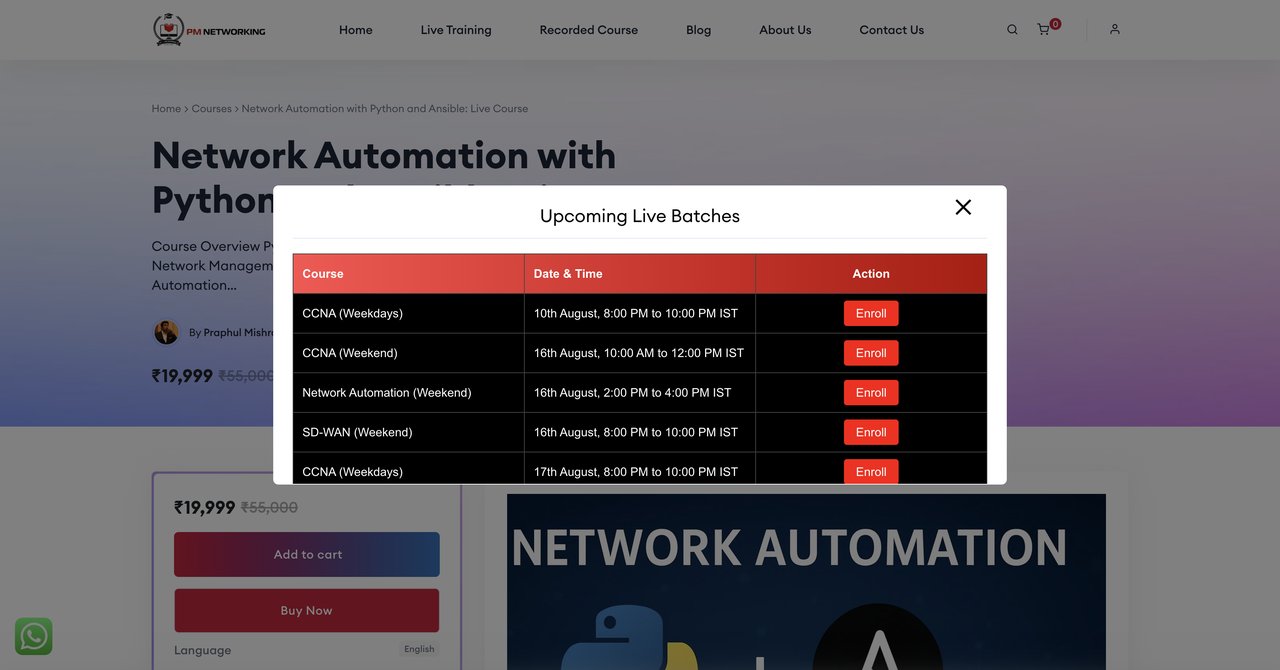
PM Networking's live course covers Python and Ansible automation for networks. It's priced at ₹19,999, which is roughly $240 USD. The course includes real-world labs, resume building, and job assistance. Lifetime access is included, which is a nice bonus.
The job assistance component is unusual and valuable. If you're looking to make a career move, having someone help with your resume and job search is a tangible benefit. The live format means you can ask questions in real-time.
The main caveat is that it's not AI-specific. It's about automation, which is a foundation for AI but not AI itself. Also, the course seems to be region-focused on India, so if you're elsewhere, the timing and job assistance may be less relevant.
Key topics covered: Python automation, Ansible, real-world labs, resume building, job assistance.
Target audience and skill level: Network engineers in India or those comfortable with that time zone. Beginner to intermediate.
Pros:
- Network-specific automation with Python and Ansible
- Real-world labs
- Resume building and job assistance
- Lifetime access
Cons:
- Not AI-specific
- May be region-focused (India)
Who would benefit most: Engineers in India or nearby regions who want automation skills plus career support.
Final Recommendations: Which Course Should You Pick?
There's no single best course-it depends on your situation. Here's a breakdown to help you decide.
For maximum value and flexibility: CompleteAI Training is hard to beat. At $8.25/month billed annually, you get every course and every certification on the platform. If you're even slightly interested in multiple areas of AI or networking, the subscription pays for itself quickly. The all-access model means you're not locked into one topic. The downside is the subscription model-if you prefer owning a course outright, this isn't for you.
For a structured, instructor-led experience: Firefly and Tandem Solution both offer solid $2,900 courses with hands-on labs. They're expensive, but you get live instruction and immediate feedback. If your company is paying, these are strong choices. Between the two, Firefly has a slight edge on compliance coverage, while Tandem is more focused on automation and prompt engineering.
For a budget-friendly introduction: Qualora's $49 course is the cheapest dedicated AI-for-network-admin option. It's short, but it covers the essentials and includes safety and compliance guidelines. LinkedIn Learning is also cheap if you have a subscription, but the content is dated.
For certification seekers: Orhan Ergun's CCDE course is the go-to if you're targeting that Cisco cert. It's deep and comprehensive, but it's advanced. For DevASC, the Udemy course by PM Networking is a practical choice with real device labs.
For automation foundations: The Udemy Python courses are excellent value, especially when discounted. They're not AI-specific, but you can't do AI without automation skills. The PM Networking course adds career support, which is unique.
For enterprise professionals: O'Reilly's live event is worth considering if you already have a subscription. The TensorFlow and PyTorch hands-on work is directly applicable to enterprise environments.
In summary, if you want the most comprehensive coverage for the lowest ongoing cost, CompleteAI Training offers the best overall value. If you need live instruction and have a budget, Firefly or Tandem are solid. If you're just starting and want to test the waters cheaply, Qualora is a fine entry point. And if you're pursuing a specific certification, choose the course aligned with that cert. The right choice really comes down to your budget, your learning style, and your career goals.