
Blog ·
12 AI Courses for Vice Presidents of Operations that You Should Know About in 2026
Discover the 12 essential AI courses tailored for VPs of Operations in 2026—master strategic implementation, boost efficiency, and lead digital transformation with cutting-edge skills.
 Jeroen Erne

The numbers are startling, and they should grab your attention. Artificial intelligence is no longer a distant tech trend or a buzzword confined to IT departments. It is actively reshaping how operations run at the highest level. For Vice Presidents of Operations, the pressure is mounting. You are being asked to optimize more, predict more, and automate more, all while keeping costs in check and quality high. The tools to do this are available, but the skills to deploy them effectively are not a given. A gap has formed between what AI can do and what leadership teams know how to ask for. That gap is where career momentum goes to die, or, for the proactive professional, where it gets supercharged. Upskilling in AI is no longer a "someday maybe" item on a professional development plan. It is a requirement for staying relevant and driving real organizational results. The decisions you make today about where and how you invest your learning time will directly influence your value and the performance of your teams in the near future.
Why AI matters for Vice Presidents of Operations today
The pressure to do more with less is not new, but the mechanisms to achieve it have changed dramatically. Recent data shows that 69% of businesses are now using AI in some capacity, and that number keeps climbing. This isn't just about chatbots or content generation. For operations, AI directly impacts supply chain forecasting, workforce allocation, and even complex process automation. Voting for the right tools and leading the teams that use them starts with a clear understanding of the technology's real-world applications. Without this knowledge, decision-making falls back on intuition, which is no longer sufficient when your competitors are guided by sharp, data-driven insights. You can check the job boards, too; many senior operations roles now list AI literacy as a desired or required qualification. And the pace of change is quick. We are not talking about annual updates; we are talking about monthly shifts in what is possible for automation and analysis. This article helps you cut past the 12 distinct AI courses in this guide, giving you a path to sort through your specific situation, whether you need to start from scratch or already have some basics down. The goal is to help you choose a course that gives you the highest return on the time you spend, in seeing what will change your work, there's little room for static skills.
The Growing Role of AI in Vice Presidents of Operations
Look around at the core activities in any well-run operations department, and you will see where AI inputs are starting to matter. It goes well beyond rudimentary automation. For instance, AI plays a serious role in bringing predictive maintenance, allowing production equipment to actively flag issues before a failure happens, saving you thousands in downtime. It matters in demand forecasting, where algorithms study complex historical data to help you manage inventory levels with what might be a better balance than you can get from spreadsheets. Advanced analytics support procurement and vendor negotiations. Resource scheduling? AI can process constraints and optimize the use of your talent and equipment.
Perhaps most importantly, AI influences the qualitative side of the work flow. It helps you identify bottlenecks through automation, removes repetitive manual tasks, and gives your managers freedom to focus on tasks that need a human judgment call. A Vice President of Operations who understands the specific files where AI applies is ceding advantage. The task is changing. Instead of managing just people and processes, you're now managing the intersection of humans and intelligent software that makes those processes run smarter. The role is more complex, but it is also a higher-leverage position. Understanding how to direct your data collection and shape your technology purchases is part of the new operating system.
Benefits of becoming an AI expert in Vice Presidents of Operations
Investing time in AI knowledge changes how you lead. For one, it builds a strong base for strategic conversations. When you can push back on unrealistic requests from senior leadership or steer your technical team toward a more practical solution, you gain credibility. Ethics come into play also. When you can lead a native conversation about process automation that sets realistic expectations for employees, you build trust. AI prevents mistakes in approvals or lifecycle forecasts that can save you from spending six figures on the wrong platform. Cost control is a direct skill, and when you know what's actually happening inside a system, you can estimate better and invest more wisely.
Being comfortable brings an AI expert aboard the advantage of bringing artificial intelligence out of the "tech" category and into the business-powered decision. That is what your role calls for. In this guide, we'll compare 12 AI courses in this field to help you find the right answer. Among the options is the CompleteAI Training for Vice Presidents of Operations, which stands out because enrollment gives you access to ALL courses AND ALL certifications on the platform, not just a single path. You will also look at options from MIT, Microsoft, and other specialized training providers.
- which we shall review in detail. Each has its own style and focus, so the right match depends on your experience level and where you want to build your foundation. The goal here is to give you a clear picture so you can make the choice that moves your operations, and your career, forward.
Comparison: All AI Courses for Vice Presidents of Operations (Updated 2026)
| Course Name | Provider | Price | Key Topics | Pros | Cons | Best For |
|---|---|---|---|---|---|---|
| CompleteAI Training | CompleteAI | Premium (one subscription covers everything) | Full access to ALL video courses and ALL certifications on the platform-hundreds of them, across every job role, not just this one. New courses and certifications are added continuously and included automatically. Covers AI strategy, hands-on projects, operational workflow automation, and more. Access to every other job role's material too. | Comprehensive curriculum; one flat subscription unlocks every course and every certification; new content added automatically; access to all other job roles' material; hands-on projects; expert instructors; daily updates on relevant AI tools and news; very affordable, especially with annual billing | Subscription-based-continuous learning is necessary as AI evolves | Vice Presidents of Operations looking for complete, ongoing training across all AI topics |
| AI for Vice Presidents of Operations (Video Courses + Certifications) | Complete AI Training | $29/month or $8.25/month billed annually | Full access to ALL video courses and ALL certifications on the platform-not a single course or fixed bundle. Includes every job role's material, so you can explore beyond operations. Covers AI strategy, operational applications, tools, and more. | Highest rating / most complete offering; full access to all courses and certifications; new content added continuously; access to other job roles' materials; one flat price covers everything; very affordable with annual billing | Subscription-based; continuous learning required as AI changes quickly | General learners seeking maximum value and flexibility |
| Microsoft AI Transformation Leader Professional Certificate | Microsoft / Coursera | Subscription (Coursera Plus or monthly) | Enterprise AI strategy, governance, total cost of ownership (TCO), risk-value mapping, four executive-ready projects (roadmap, investment recommendation, governance charter, deployment strategy) | Executive-level focus on enterprise AI strategy; covers governance, TCO, and risk-value; includes practical executive projects | Requires experience leading cross-functional initiatives; not hands-on technical training | General learners in executive roles |
| AI for Operations Management | Udemy | Paid (one-time purchase, often discounted) | Practical use of ChatGPT and Google Gemini for operations; data-driven decision-making in operational contexts; accessible for non-technical leaders | Hands-on with consumer AI tools; easy to follow for non-technical leaders; practical focus | Focuses on consumer AI tools rather than enterprise platforms; limited depth on strategic transformation | General learners, operations managers, and non-technical professionals |
| AI Academy | AI for Operations | SmarterX AI Academy | Not specified | Frameworks for prioritizing AI opportunities; building custom AI assistants; AI-powered research; designed for operations practitioners and leaders | Specifically for operations; practical, hands-on skills; frameworks that help prioritize AI opportunities | Provider is a specialist, less established than major platforms; pricing not publicly listed | General learners, especially operations practitioners and leaders |
| AI Applications for Human,AI Teaming in Operations | Emory University Goizueta Business School | Not specified (executive education pricing) | Live case simulation; rapid design sprint; redesigning operational workflows for human,AI collaboration; practical, non-technical approach | Live simulation and design sprint; focuses on practical workflow redesign; non-technical | Short duration; limited to specific processes like demand forecasting or customer support triage | General learners in operations leadership |
| Leading the AI-Driven Organization | MIT Sloan Executive Education | $12,900 | AI management, leadership insights for teams and organizations, strategic decision-making | Elite MIT faculty; designed for strategic decision-makers; strong leadership focus | Very high tuition; in-person commitment may be tough for busy VPs | General learners, senior executives |
| AI Adoption: Driving Business Value and Impact | MIT Sloan Executive Education | $3,850 | Mapping AI to business challenges; overcoming adoption barriers; co-creation practices to amplify human capability | Strong business value focus; practical adoption strategies; emphasizes human-AI collaboration | Requires strategic decision-making authority; not hands-on technical training | General learners, leaders with strategic authority |
| AI Automation Bootcamp for Operations Leaders | Maven (Linda Mutricy) | Not specified | Building AI-powered tools, workflow automations, and autonomous AI agents; no prior coding knowledge required | Hands-on, learn-by-doing; practical tool-building; accessible without coding skills | Specialist instructor, not a major platform; limited duration for deep strategic coverage | General learners, operations leaders |
| Certified AI for Operations and Process Improvement Professional (CAIOPI) | Tonex Training | Not specified | Operational excellence, bottleneck identification, workflow improvement, intelligent automation readiness, root cause analysis | Certification validates practical AI knowledge; covers key operational improvement areas; includes root cause analysis | Specialist provider with less brand recognition; pricing and duration not publicly listed | General learners, professionals seeking certification |
| AI Wise for Operations Managers | AI Wise Training | $297 (track only) or $397 (Core + track bundle) | Operations, plant, production, logistics, and supply chain management; regulatory and safety compliance; data governance; accountability frameworks; certification exam included | Role-specific for operations managers; covers compliance and governance; includes certification exam and lifetime access | Requires AI Wise Core credential (additional cost); self-paced micro-learning may lack depth for senior leaders | General learners, operations and supply chain managers |
| AI in Operations Management Transforming Business Operations | Udemy | Paid (one-time purchase, often discounted) | AI-driven methods for operations; data-driven decision-making; accessible for anyone in operations | Comprehensive coverage of AI methods; enhances data-driven decisions; supports all operations roles | Not specifically part of executive leadership; overlaps with other Udemy operations AI courses | General learners, operations professionals |
| AI Wise Core Credential | AI Wise Training | Included in $397 bundle (standalone pricing not specified) | Foundational AI literacy; required prerequisite for the Operations Manager track; lifetime access and updates included | Foundational AI literacy; works as a prerequisite; lifetime access | Standalone price not clearly listed; basic level may not challenge experienced VPs | General learners seeking AI literacy |
Understanding AI Training for Vice Presidents of Operations Professionals
Operations leaders are under constant pressure to improve efficiency, reduce costs, and make data-driven decisions faster than ever. With AI seemingly everywhere, it is tempting to jump into the first training that pops up in a search. But the right course for a Vice President of Operations is not necessarily the same one that works for a team lead or an IT manager. The stakes are higher, the scope is broader, and the time is limited.
This comparison looks at AI training options available to VPs of Operations in 2025. Some are serious academic offerings from MIT or Emory. Others are practical bootcamps or self-paced video libraries. There is even an all-access platform model that challenges the traditional one-course-at-a-time approach. We take a hard look at what each of these options actually delivers, how much it costs, where it falls short, and who should consider it.
Course 1: CompleteAI Training
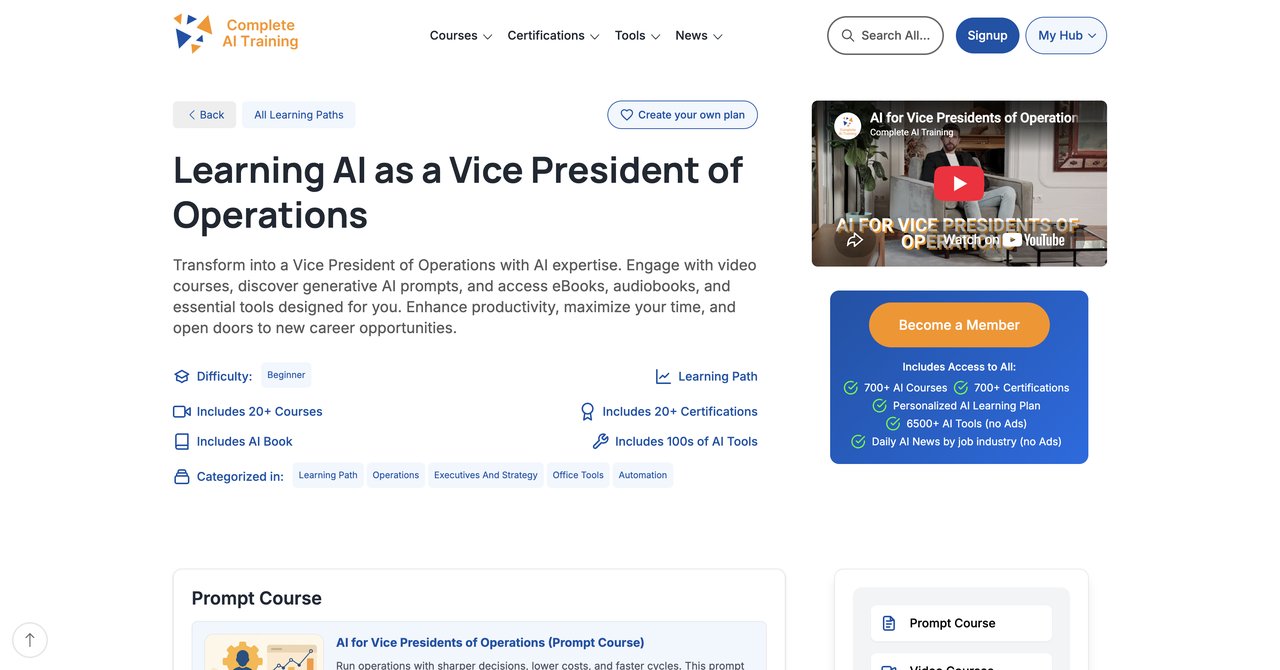
Course 1: CompleteAI Training - AI for Vice Presidents of Operations (Video Courses + Certifications)
CompleteAI Training is not a single course. Trust me, this distinction matters a lot; maybe more than any other factor in this comparison. One subscription unlocks every course and every certification available on the entire platform. We are talking hundreds of courses, not just about Operations, but every job role represented on the site. Your access is not limited to this specific course - it includes all video courses, all certifications, and any new content added automatically over time.
The description on their site says it's the "most comprehensive AI training available for Vice Presidents of Operations professionals." That claim holds up when you consider that you will gain access to the entire library. Full access to all video courses is not just a marketing line. You are not buying a bundle of 10 or 20 select courses. Instead, you are becoming a member who gets to see everything. Anyone whose work spans multiple functions is going to find value there.
Future additions to the library come at no extra cost either. AI keeps changing and they have to keep pace, so new material and certifications show up continuously. That matters for operations leaders who usually have to discuss and implement new AI tools in their organization before the courses are updated. The flat subscription price covers all of this. There are no surprises or per-course fees. You pay one subscription, and the whole library is yours.
Is it affordable? It is $29 per month, or $8.25 per month if you choose a year plan. Yes, there are other platforms with lower prices, but rarely with this diversity. So you can compare it to the price of a couple of business books and decide for yourself.
Key Topics Covered:
The main course focuses on AI for Vice Presidents of Operations, but other courses in the library cover things like, but not limited to, supply chain analytics, process improvement, process automation, leadership and more. Because the subscription includes everything, the effective curriculum covers much more than operations-though AI operations remains the core requirement.
Target Audience:
This is designed for operations leaders-Vice Presidents, Directors, and Heads of Operations-but the breadth of the library makes it one of the few training options useful for cross-functional and multi-disciplinary leadership teams. There's no strict prerequisite, no need to code.
Pros:
- Highest rating / most complete offering of all training options
- Full access to ALL video courses on the platform, not a single course or a fixed bundle
- Full access to ALL certifications on the platform, included at no extra cost
- New courses and certifications are added continuously and are included automatically
- Access to every other job role's material too, which matters for anyone whose work spans more than one function or who wants to move roles
- One flat subscription price covers all of the above, versus paying per course elsewhere
- Daily updates on relevant AI tools and news
- Price: $29/month or $8.25/month billed annually
Cons:
- Subscription-based. For continuous learners, this is good. But if you want one-time access to a single topic, a one-time purchase might seem more predictable. However, with AI moving this is the best way to keep up
Would benefit most: Operations VPs who need cross-functional coverage and want to stay current without renewing licenses and deals with several different vendors, or paying hundreds of dollars per course.
Check the official CompleteAI Training page to look at current offerings.
Course 2: Microsoft AI Transformation Leader Professional Certificate (Coursera)

Course 2: Microsoft AI Transformation Leader Professional Certificate by Microsoft / Coursera
This isn't a quick intro. The Microsoft program, hosted on Coursera, has an executive-level focus on enterprise AI strategy. The topics keep things at a strategic altitude: governance, total cost of ownership, and risk-value mapping. Plus, you do four executive-ready projects: a roadmap, investment recommendation, governance charter, and deployment strategy.
It's one of the most complete enterprise AI syllabus available in the market for those who already have a base. One thing to keep in mind - it requires experience leading cross-functional initiatives. And if you want hands-on coding, this would be the wrong platform. It does not provide technical training.
Key Topics:
Strategy, governance, TCO, risk mapping, execution, and AI leadership at enterprise level.
Target Audience & Skill Level:
For senior leaders who already know how to manage projects across functional areas. No coding needed. But they expect you have led enterprise initiatives where strategy and general presence counts.
Pros:
- Executive-level focus and enterprise perspective
- Strong on governance, TCO, and financial alignment
- Includes a solid set of 4 executive-ready projects for portfolio
Cons:
- Requires experience leading cross-functional initiatives
- Not hands-on technical training
Who benefits: Executives in businesses that will run substantial pilot projects. You are already steering AI rollouts but need a structured way to plan the full transformation and governance structure. However, check the costs - Coursera subscription can add up, and this course is not part of their free material.
Microsoft AI Transformation Leader on Coursera
Course 3: AI for Operations Management on Udemy
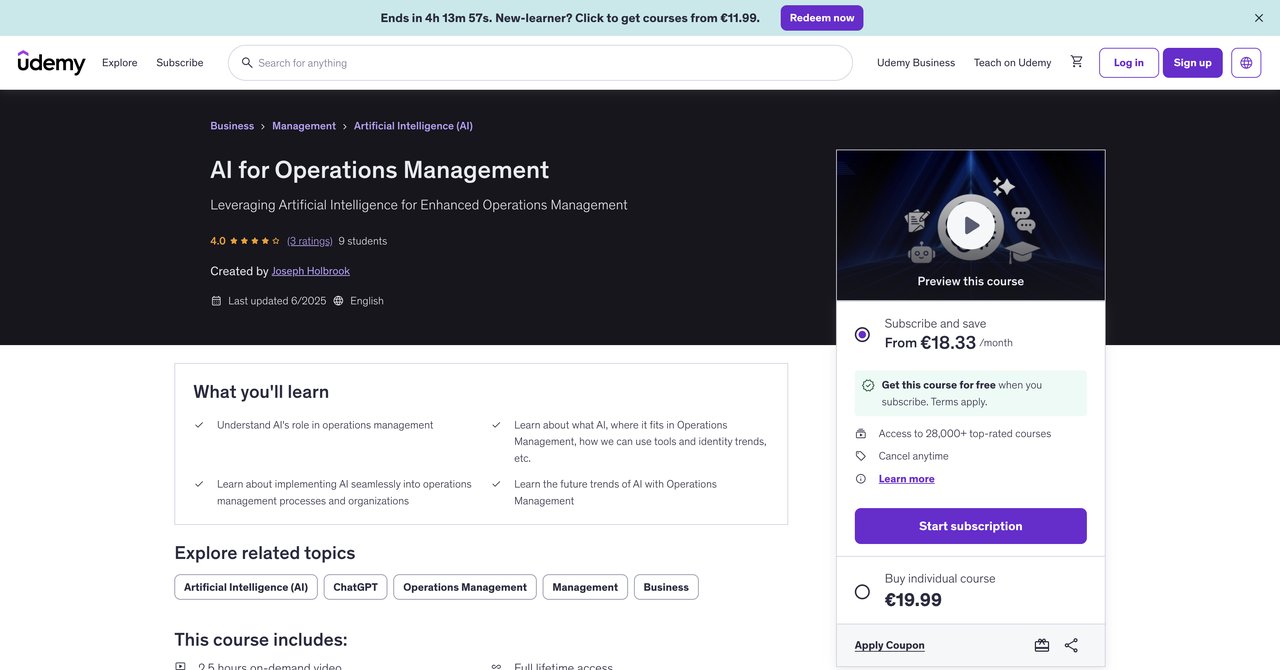
Course 3: AI for Operations Management - Udemy
This course gives practical, hands-on work with ChatGPT and Google Gemini for operations. It really focuses on the data-driven decisions that you can make with consumer-grade AI tools. It's aimed at those who are not code-savvy, and that is good. But the use is deliberately practical.
The biggest advantage this has over more complex fellows is that it's basic. That is also a weakness, from a VP standpoint. The course shows what AI can do at a workgroup level. But the strategic quality is limited, and it won't cover high-end transformation.
Key Topics:
Using ChatGPT and Google Gemini for daily operation management, data analysis in daily operations, and decision-making.
Target Audience: Non-technical users in middle and senior positions. Those who have not yet integrated AI tools into process chain.
Pros:
- Practical and hands-on with ChatGPT and Gemini
- Covers data-driven decision-making, accessible to non-technical users
- A strong introduction
Cons:
- Focuses on consumer AI tools rather than enterprise platforms
- Limited depth on strategic transformation
Who would benefit: If you're new to using GenAI and haven't used ChatGPT yet, this will help you see how AI in daily tasks. But if you're already using AI tools for a year or more, this course will probably be too basic. Often on sale on Udemy, but the price is usually less than $30 when discounted.
Course 4: AI Academy , AI for Operations by SmarterX
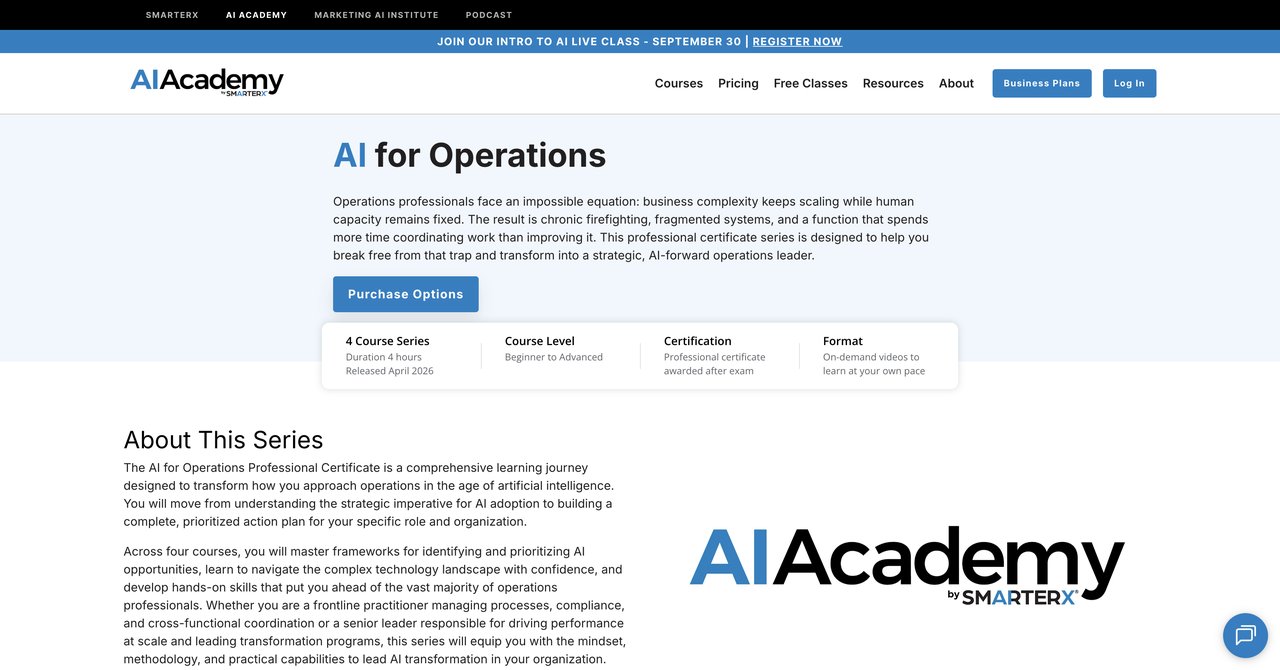
Course 4: AI Academy | AI for Operations - SmarterX
This course was built specifically for operations practitioners and leaders, not for the general public. It provides frameworks for prioritizing AI opportunities, so you can say what to do first and what not to do. It also includes quite hands-on skills like building your own custom AI assistants and using AI for research.
The strengths are the specificity - it's made for operations, and it gets to practical details. The biggest unknowns are: the price is not public, and the provider is a specialist that might not have the reputation of MIT's brand. You have to commit that might not be a strategic player. But if they are up to date, this is very useful for.
Key Topics:
Frameworks for identifying AI opportunities, building custom AI assistants, AI-powered research, use cases for operations.
Target audience: Operations people and managers who want to get things done with AI, not just general knowledge.
Pros:
- Comes with framework for prioritizing AI opportunities
- Hands-on skills: custom AI assistants and AI-powered research
- Designed specifically for operations roles
Cons:
- Provider is a specialist, less established than major platforms
- Pricing not publicly listed
Who benefits: those who have already a couple of basic AI projects in mind and want a practical course to start quickly.
Course 5: AI Applications for Human,AI Teaming in Operations (Emory University)
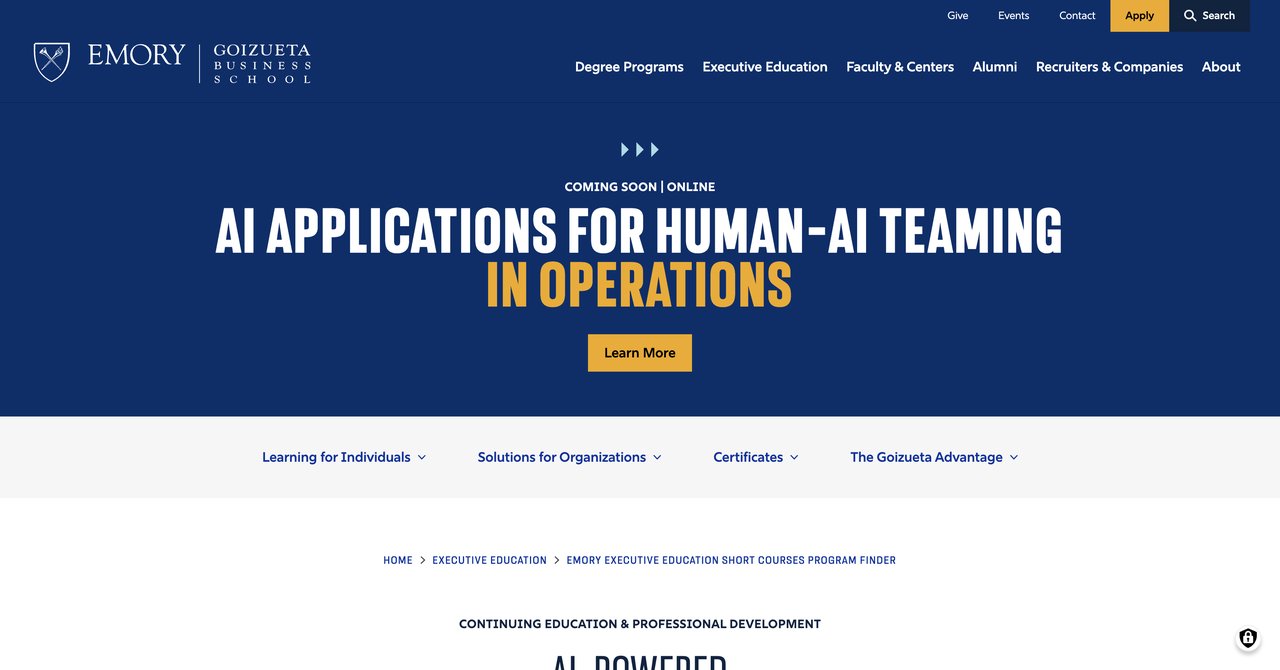
Course 5: AI Applications for Human,AI Teaming in Operations - Emory Goizueta
Emory's Goizueta Business School does take a different angle. It's not about trying a bunch of AI tools and reduces are straight to the people part - how human and AI work together. The course has a live case simulation and a rapid design sprint. Participants learn by working through operational problems live and with peer feedback.
The good side is the practical, non-technical approach. In a two-day session, you get layered and iterative strategy not over. But it's short and relatively focus on some specific operational processes like demand forecasting or customer support triage - very narrow. It's an executive education that might be expensive.
Key Topics:
Human-AI collaboration and workflow redesign, simulation, and design sprints.
Audience: Senior ops leaders who are focused on the human and culture side of AI adoption and need a structured approach. Non-technical.
Pros:
- Live case and design sprint
- Focus on redesigning operational workflows for human,AI collaboration
- Non-technical and practical
Cons:
- Short duration
- Limited to specific processes like demand forecast or support triage
Who Benefits: If you need to address how your team actually handles the shift to AI-how workers and bots co-exist. This is not the course for an AI introduction.
Emory Goizueta , AI Applications
Course 6: Leading the AI-Driven Organization by MIT Sloan
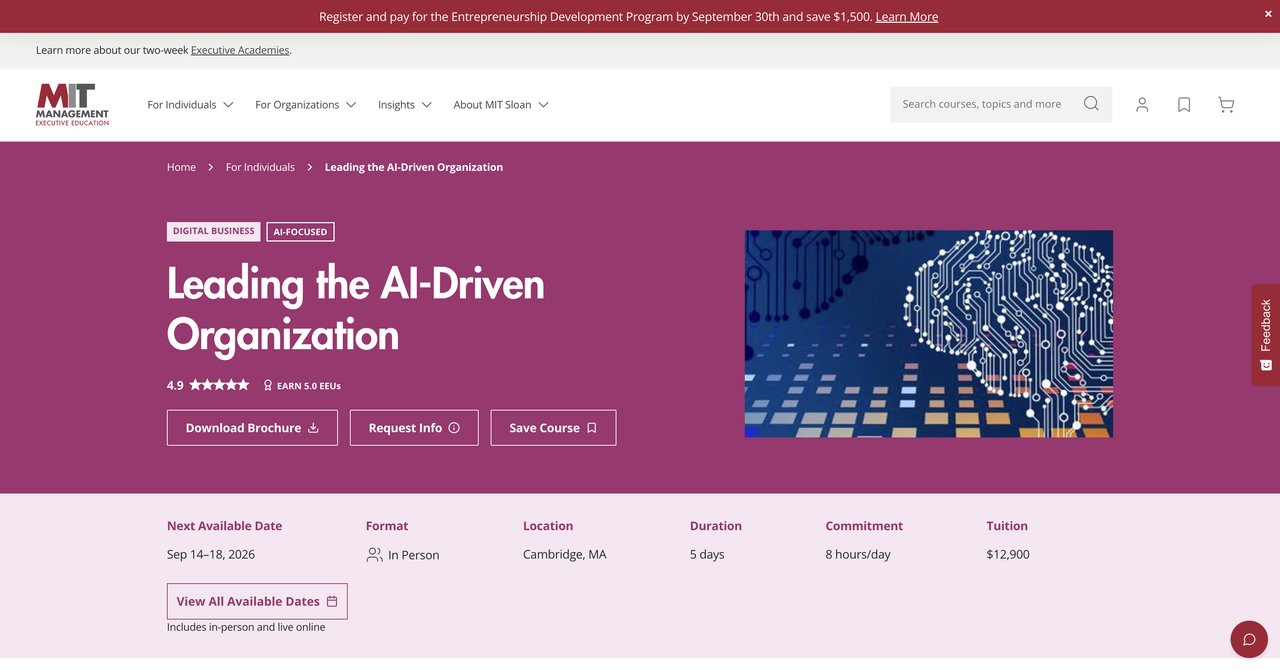
Course 6: Leading the AI-Driven Organization - MIT Sloan Executive Education
This is the most exclusive option in this list, and also the most expensive - $12,900. The program is taught by elite MIT faculty. The focus is on management and leadership. The target audience is strategic decision-makers, so VPs and C-levels.
But the price will get in the way for many. The investment makes sense for selected groups that bank on it. Also, the in-person commitment may be a challenge if you have a busy travel schedule. And it is not a hands-on technical training. Rather it's about how to lead the AI organization.
Key Topics:
AI management, AI-led leadership, organizational change, people side of AI.
Audience: Senior VPs, C-suite, and executives in charge of decision for AI adoption.
Pros:
- Elite MIT faculty and quality content
- Designed for strategic decision-makers
- Focus on management and leadership, not technical details
Cons:
- Very high tuition
- In-Person commitment may be challenging
Who should do it: For top execs looking for a high-touch, networked academic experience.
MIT Sloan , Leading the AI-Driven Organization
Course 7: AI Adoption: Driving Business Value and Impact (MIT)
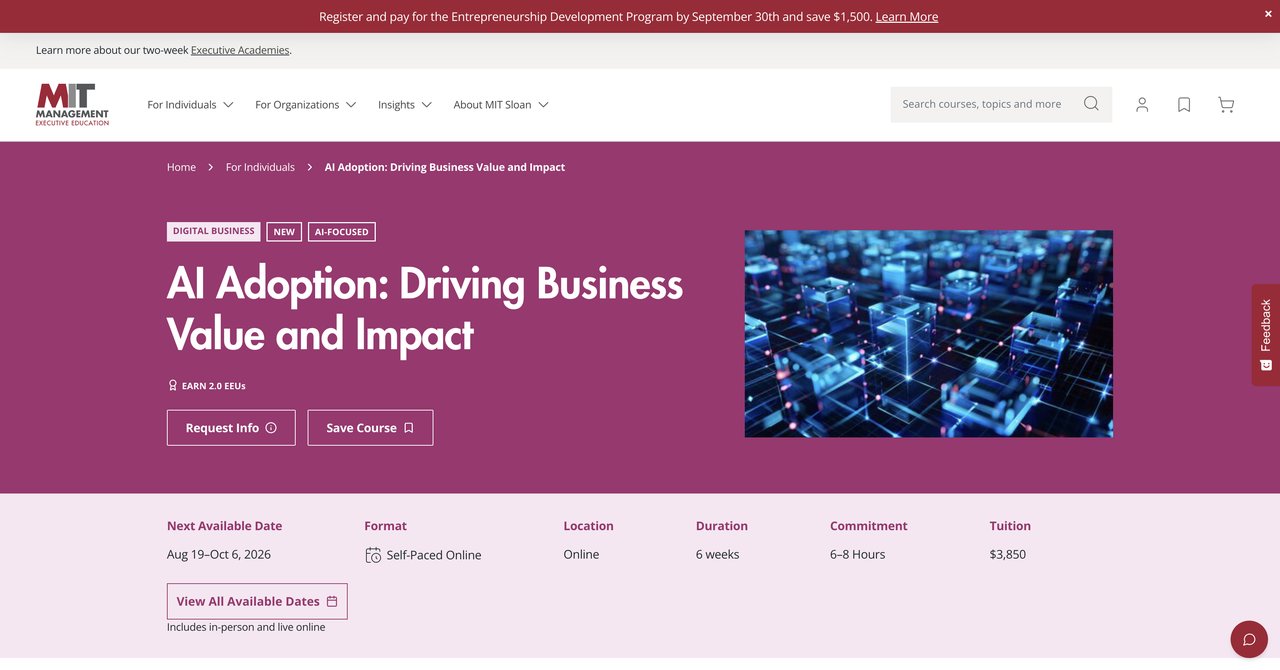
Course 7: AI Adoption: Driving Business Value and Impact - MIT Sloan
This is a slightly less expensive MIT program, at $3,850, but still an investment. It focuses more on business alignment. You get to map AI for core business challenges, navigate the adoption barriers, and create co-creation practices with team collaboration.
The structure is built for strategic decision-makers and they use the latest examples and actionable tools. It's not hands-on technical training, but the program will be especially helpful for defining an adoption roadmap.
Key Topics:
Value mapping, strategic planning, adoption barriers, AI adoption strategy with a business-perspective.
Audience: experienced leaders with decision-making authority, those who decide budgets and business strategy.
Pros:
- Maps AI technologies to critical business challenges
- Focus on adoption barriers
- Emphasizes co-creation practices, oft overlooked
Cons:
- Requires strategic decision-making authority
- Not hands-on training
Who Benefits: Business leaders who want high-level strategic alignment with measurable results, not technician courses for coders.
Course 8: AI Automation Bootcamp for Operations Leaders (Maven)
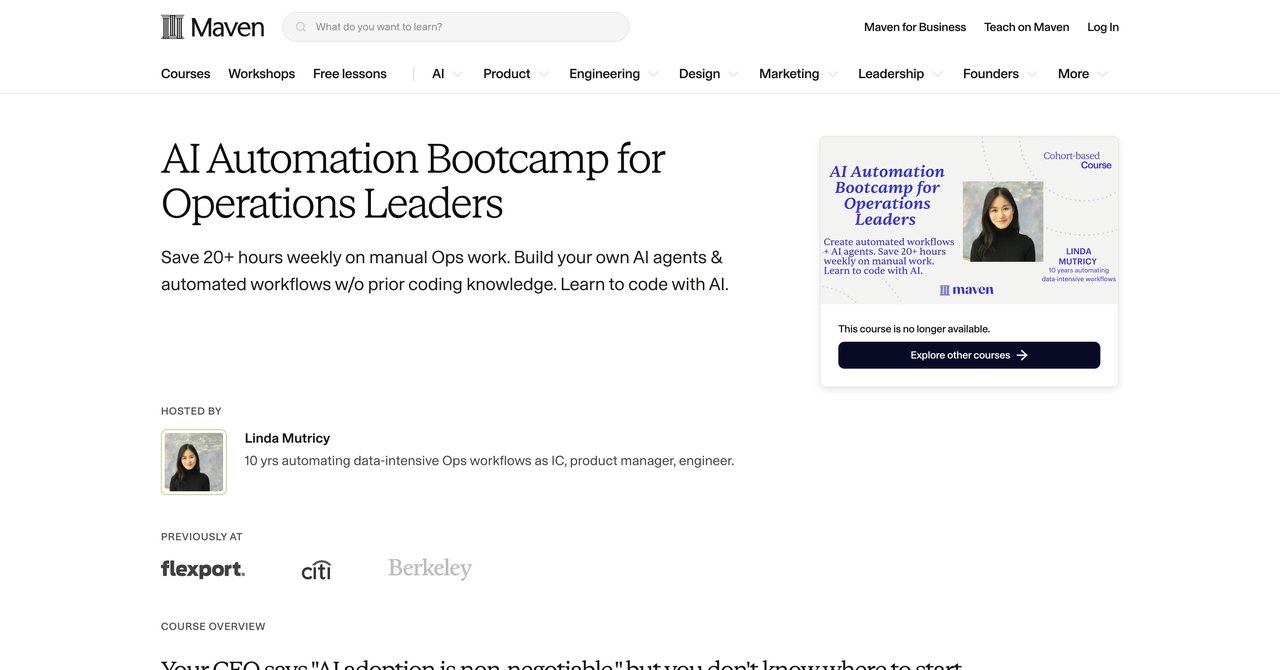
Course 8: AI Automation Bootcamp for Operations Leaders - Maven (Linda Mutricy)
The best part about the Maven bootcamp is the emphasis on learning by doing. It has a hands-on practical approach, where you actually build AI powered tools, workflow automations, and even an AI autonomous agents. No coding experience is required.
The nature of it is a short bootcamp with a particular instructor. The depth of a bootcamp is focused. Not quite the same as continuous or deep academic program.
Key Topics: Building AI tools, workflow automations, ANC-autonomous agents, no-code.
Audience: Operations leaders who want working AI run apart of projects.
Pros:
- Hands-on, learn-by-doing
- Build AI tools, automations, and AI agents
- Easy to access automation has no coding
Cons:
- Specialist instructor
- Limited duration for deep strategic coverage
Who Benefits: VPs who are ready to implement the actual automated solutions now, and not just talk about it.
Maven Bootcamp , AI Automation for Operations Leaders
Course 9: Certified AI for Operations and Process Improvement Professional (CAIOPI) , Tonex
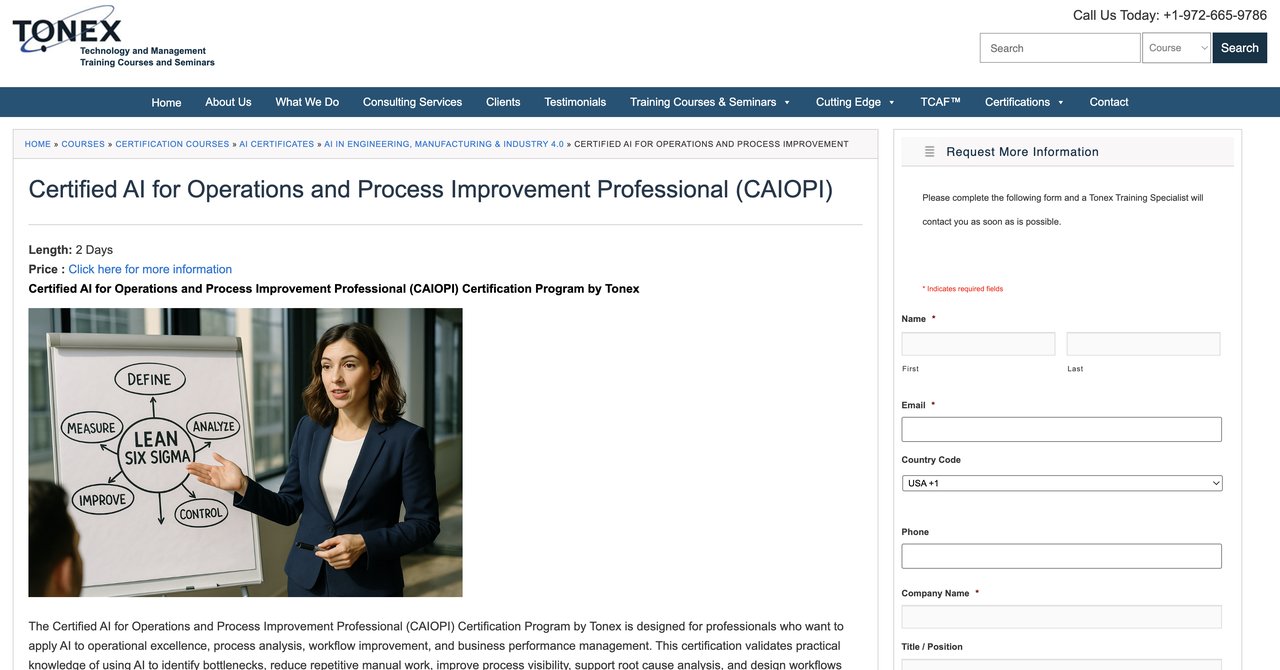
Course 9: Certified AI for Operations and Process Improvement - Tonex
Tonex wants you to be certified in the practical side of AI. The course covers bottleneck identification, workflow improvement, and intelligent automation readiness. It also includes root cause analysis. The credential is further validator.
But Tonex is not a big name, and everything, and the course usually requires prior process improvement knowledge. Everyone's time and money.
Key Topics:
AI for operational excellence, bottleneck analysis, workflow improvement, automation readiness, root cause analysis.
Audience: Ops professionals and process improvement specialists.
Pros:
- Certification validates AI knowledge for operational excellence
- Covers bottleneck, workflows and smart readiness
- Includes root cause analysis
Cons:
- Less brand recognition
- Pricing not public
Who Benefits: A person with a process improvement background, excellence six sigma, that needs AI Plus a formal certificate.
Course 10: AI Wise for Operations Managers (AI Wise)
Course 10: AI Wise for Operations Managers , AI Wise Training
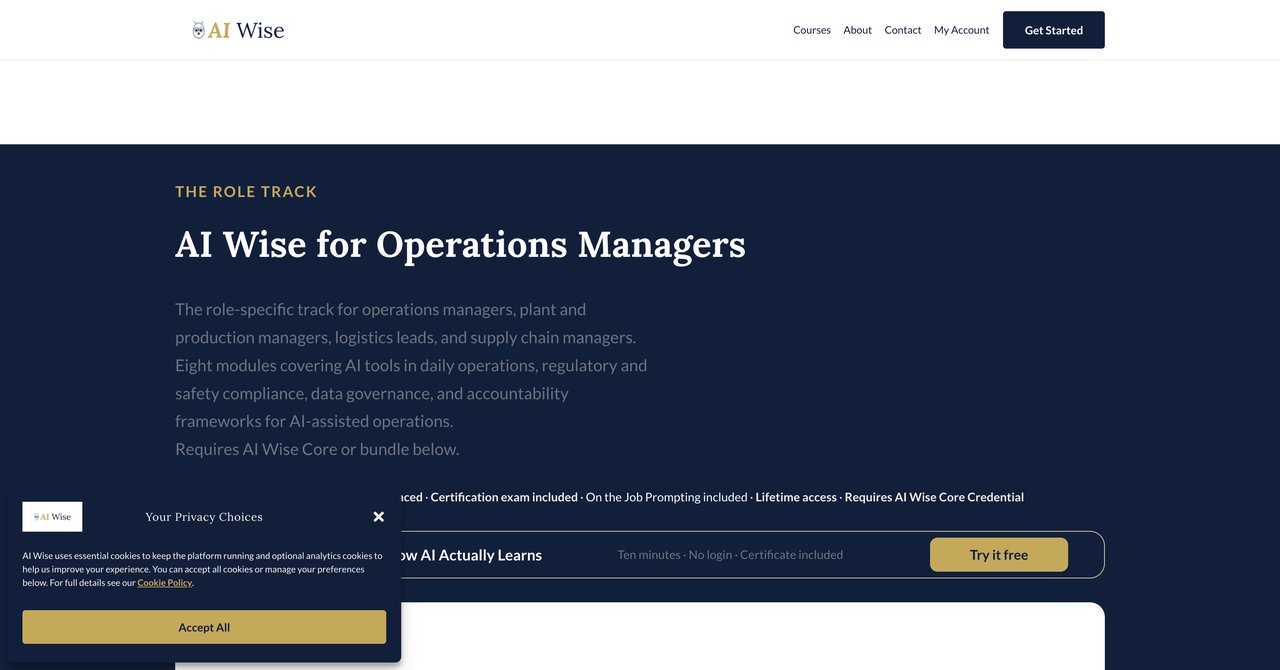
This course includes role-specific AI training for ops, plant, production, logistics and supply chain. It stands out because it covers important compliance topics: regulatory and safety compliance, data governance, and accountability frameworks. It includes a certification exam, and lifetime access to materials.
The catch: it requires the AI Wise Core credential first. That can add cost to the program. The self-paced micro-learning modules might be less contextualized to leadership. But if you want to check on your auditing, it's a solid track.
Key Topics: Compliance (regulatory, safety), data governance, accountability, roles specific for logistics and production.
Trend: for ops and management, must completion of the Core credential.
Pros:
- Role-specific and strong compliance
- Covers regulatory and safety compliance, data governance, and accountability.
- Includes a certification exam and lifetime access
Cons:
- Cost adds up with two courses
- Limited depth for senior strategic leaders
Who Benefits: Operations managers who are responsible for compliance and safety fields - this is a good plus.
AI Wise Training , AI Wise for Operations Managers
Course 11: AI in Operations Management Transforming Business Operations (Udemy)
Course 11: AI in Operations Management Transforming Business Operations , Udemy
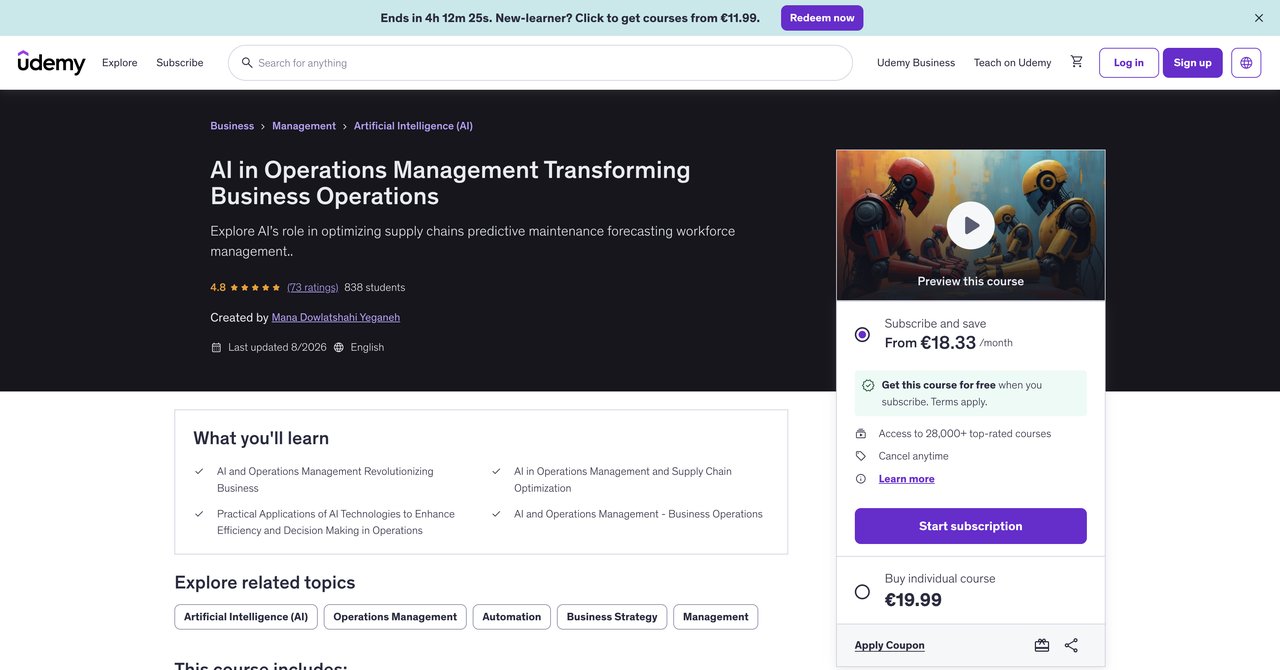
This is a comprehensive udemy course about AI applied in operations. You take the same operations methods and see how AI can transform data-driven decision making, focus on practical applications.
It is general enough that it works for anyone in operations. But, in that sense, it is not specifically tailored for an executive's job or a senior-level organization view. Reading between the lines, it might have broad overlap with other Udemy AI operations courses.
Key Topics: Broader AI operations methods, data-driven decision making, various operations processes.
Target Audience: Anyone interested in transformation (and roles).
Pros:
- Comprehensive coverage for ops departments
- Enhances data-driven decision making
Cons:
- Not for C-level
- Overlapping with other Udemy operations AI courses
Who Benefits: Strong fans of Udemy who take courses for operations to learn the basics, not necessarily core senior planning/strategic process.
Udemy , AI in Operations Management
Course 12: AI Wise Core Credential (AI Wise)
Course 12: AI Wise Core Credential , AI Wise Training
This is the foundational AI literacy credential that serves as a gatekeeper for the Operations Manager track. It's basic, but is mandatory to take if you want the Operations track. It is covered in the $397 bundle, but if you choose the core alone it costs you extra plus it is not worth it unless you have to take the role-specific track.
Key Topics: Fundamentals of AI, core topics, beginner level.
Target: AI novices, or those who accord for role-specific track at AI Wise.
Pros:
- Foundation credential, works as a pre-requisite for ops track
- Lifetime access
Cons:
- Cost of the base course
- Basic level
Who Benefits: Like I said, it's only useful if you decide to take the "AI Wise for Operations Managers" Track. If you need a deeply foundational AI, then that.
Summary & Final Recommendations
Here is the situation. You have one subscription library, three university-level programs, two Udemy one-timers, one no-code bootcamp, plus two very specific AI training vendors. VPs value time and results, and the different choices show different levels of time and breadth.
If you want the most sizable ROI for cost, CompleteAI Training separates itself from the others being a complete platform. It's hard to beat $8.25/month for an entire library-because there's no limit on what you can learn. The alternative is a single course or a bootcamp, and a one-off MIT course costs up to $12,900. For mid-level budgets, CompleteAI Training is easier to justify.
MIT has more brand prestige. But is that worth the tuition? Probably not-unless your company expects that brand and wants you in the network. For strategy, but not project implementation, MIT is fine, yet for a busy Executive in charge of operations, I feel you can get the same knowledge at a far lower cost.
For executives with their own way and with room to spend, the Emory program is very good if you want to focus on the human side of AI. For direct implementation of automation, the Maven Bootcamp is very practical to build actual tools. But again, the deeply tactical and operational day to day side is better covered by CompleteAI Training due to the library of courses.
Me personally-if we're talking about a solution that actually be effective 12 months down the line-I would subscribe to CompleteAI Training. With the AI continuously evolving, you have the changing new course material for the same monthly fee. You don't stay with outdated content.
So, pick the course that actually matches what you're going to be using it.
If you need prep for day-today operations, or you're the VP who looks in every area of the company: choose CompleteAI Training.
If you need deep negotiation with governance or want MIT brand, choose the $12.900 course or lower tier $3,850. If you want building agents: Choose Maven. For compliance and safety: choose AI Wise, or if you want a human approach, choose Emory.
But for the majority of VPs in operations: an all-access platform can deliver the highest relative value.