15 Best AI Courses for eLearning Developers to Future-Proof Your Career in 2025
Discover top AI courses tailored for eLearning developers, designed to enhance skills and future-proof your career by 2025. Boost your expertise and stay ahead in the evolving landscape of AI-driven education.

The influence of artificial intelligence (AI) on the professional landscape is undeniable, and its relevance continues to surge. For eLearning Developers professionals, understanding AI is not just an advantage—it's becoming a necessity. As AI technologies become more integrated into educational tools and platforms, the opportunity to upskill in this domain is crucial. With AI's ability to automate processes, enhance decision-making, and personalize learning experiences, eLearning Developers need to equip themselves with the knowledge and skills to stay competitive and effective in their roles. This article explores a range of AI courses designed to provide eLearning Developers with the insights and expertise they need to thrive in a tech-driven world.
Why AI matters for eLearning Developers today
AI is no longer a futuristic concept—it is a present-day reality impacting various industries, including eLearning. As of recent reports, 69% of businesses have already adopted AI technologies in some form, highlighting the growing trend and its importance. For eLearning Developers, AI can streamline content creation, enhance learner engagement, and provide valuable data insights. The purpose of this article is to assist eLearning Developers in identifying the best AI courses that can equip them with the necessary skills and knowledge to harness AI's potential effectively.
The Growing Role of AI in eLearning Developers
AI is transforming the eLearning landscape by automating repetitive tasks, enabling data-driven decision-making, and personalizing learning experiences. Applications such as AI-driven analytics provide insights into learner behavior, while chatbots and virtual assistants offer support and guidance around the clock. These advancements are reshaping how eLearning Developers design courses, interact with learners, and assess educational outcomes. By understanding and applying AI, professionals in this field can improve efficiency and deliver more impactful learning experiences.
Benefits of becoming an AI expert in eLearning Developers
Becoming proficient in AI offers numerous advantages for eLearning Developers. It opens up opportunities to innovate and create more engaging, adaptive learning environments. Professionals who understand AI can develop more effective training programs that cater to diverse learning needs. Additionally, AI expertise can lead to career advancement and open doors to new roles that require specialized knowledge in AI-driven technologies. As AI continues to grow in significance, possessing these skills will become increasingly valuable for eLearning Developers looking to remain relevant and successful in their careers.
Comparison: All AI Courses for eLearning Developers (Updated Q2' 2025)
| Course Name | Provider | Price | Key Topics | Pros | Cons | Best For |
|---|---|---|---|---|---|---|
| AI for eLearning Developers | Complete AI Training | $29/month (monthly), $8.25/month billed annually | Video Courses, Certifications, AI Tools, Industry News | Highest rating, Extensive course range, Daily updates, Affordable pricing | Subscription based | eLearning Developers |
| Artificial Intelligence Nanodegree Program | Udacity | $148.50/month or $504.90 for 4-month bundle | Optimization Algorithms, Bayesian Networks, Decision-Making Agents | Expert instructors, Hands-on projects, Career support | Requires Python knowledge | General learners |
| AI, Deep Learning and MLOps Courses | DeepLearning.AI | Free, $39-$99/month on Coursera | Machine Learning, MLOps, Deep Learning, Generative AI | High-quality instruction, Flexible pricing, Broad topic coverage | Some courses require prior knowledge | General learners |
| Certificate in AI and Machine Learning | CIAT | Varies with financial aid | AI Engineering, Industry Frameworks, Practical Labs | Instructor-led, Career-focused, Practical labs | Requires IT experience, Variable pricing | General learners |
| Big Data, AI and Ethics | UC Davis via Coursera | Free to audit; paid for certificate | AI Fundamentals, IBM Watson NLP, Ethical Considerations | Beginner-friendly, Free audit option, Ethical focus | Short duration, Introductory level | General learners |
| AI for Business Specialization | University of Pennsylvania via Coursera | $79 for 4-month specialization | AI in Business, Ethical AI Strategies, Hands-on Projects | Business-focused, Practical projects, Affordable | Time commitment | General learners |
| CS50’s Introduction to AI with Python | Harvard University | Free to audit; $299 for certificate | Graph Search, Reinforcement Learning, AI Projects | Harvard quality, Practical coding skills, Deep AI concepts | Time-intensive, Intermediate level | General learners |
| Interpretable Machine Learning | Cynthia Rudin (Duke University) | Free | Statistical Learning, Kernel Density Estimation, Advanced Topics | Free, Theoretical focus, Advanced topics | Challenging for beginners | General learners |
| AI Business Strategy | Johns Hopkins University | $2,600 with financial assistance | AI Strategy, Ethical AI, Risk Management | Industry mentorship, Strategic focus, Live sessions | High cost, For experienced professionals | General learners |
| Develop LLM Powered Applications | Udemy | $12.99 | LangChain, Prompt Engineering, RAG | Affordable, Practical, Up-to-date content | Requires Python experience | General learners |
Understanding AI Training for eLearning Developers Professionals
As the integration of artificial intelligence continues to influence various industries, eLearning developers are increasingly seeking specialized AI training to enhance their skills and keep up with evolving technologies. This article compares some of the leading AI courses available for eLearning developers, evaluating their features, costs, and suitability for different professional needs.
Course 1: CompleteAI Training
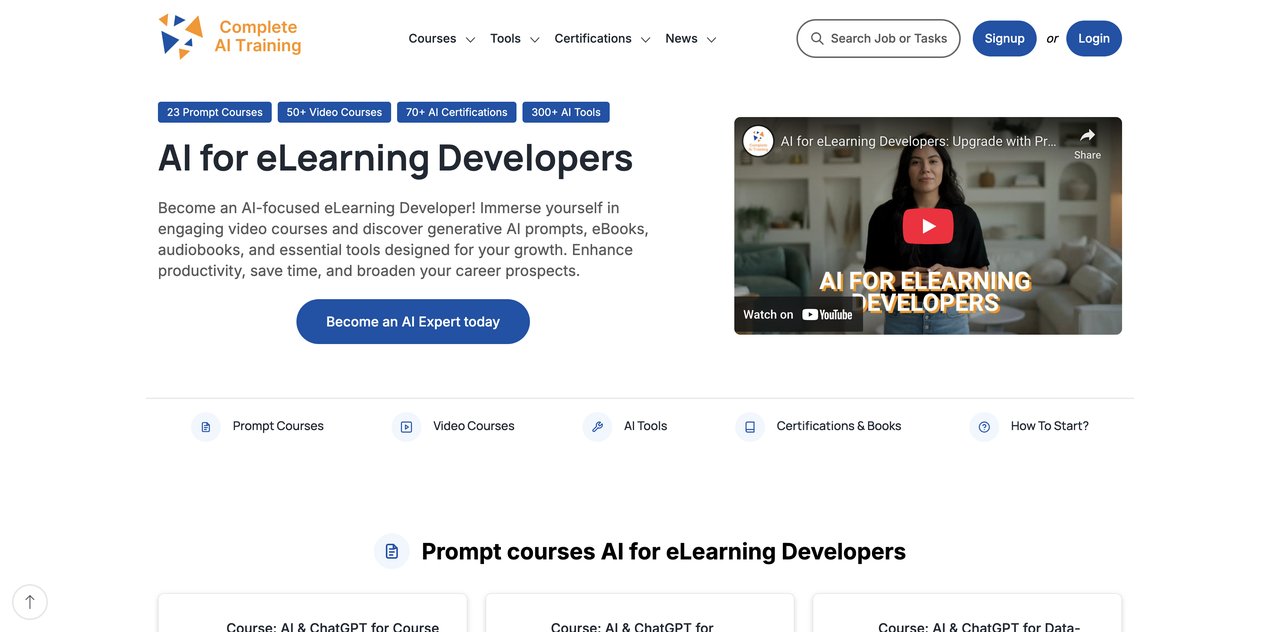
CompleteAI Training offers a comprehensive suite of over 100 video courses and certifications specifically tailored for eLearning developers. This subscription-based model provides access to an extensive library, daily updates on AI tools, and industry-specific news.
Key Topics Covered: AI fundamentals, practical AI applications, tool integrations specific to eLearning.
Target Audience and Skill Level Requirements: Ideal for eLearning developers at all skill levels seeking continuous learning opportunities.
- Pros:
- Extensive range of AI courses and certifications.
- Frequent updates on relevant AI tools and news.
- Affordable pricing, especially with annual billing.
- Cons:
- Subscription-based, requiring ongoing commitment.
Who would benefit most: eLearning professionals seeking a comprehensive and regularly updated AI course offering.
Course 2: Artificial Intelligence Nanodegree Program by Udacity
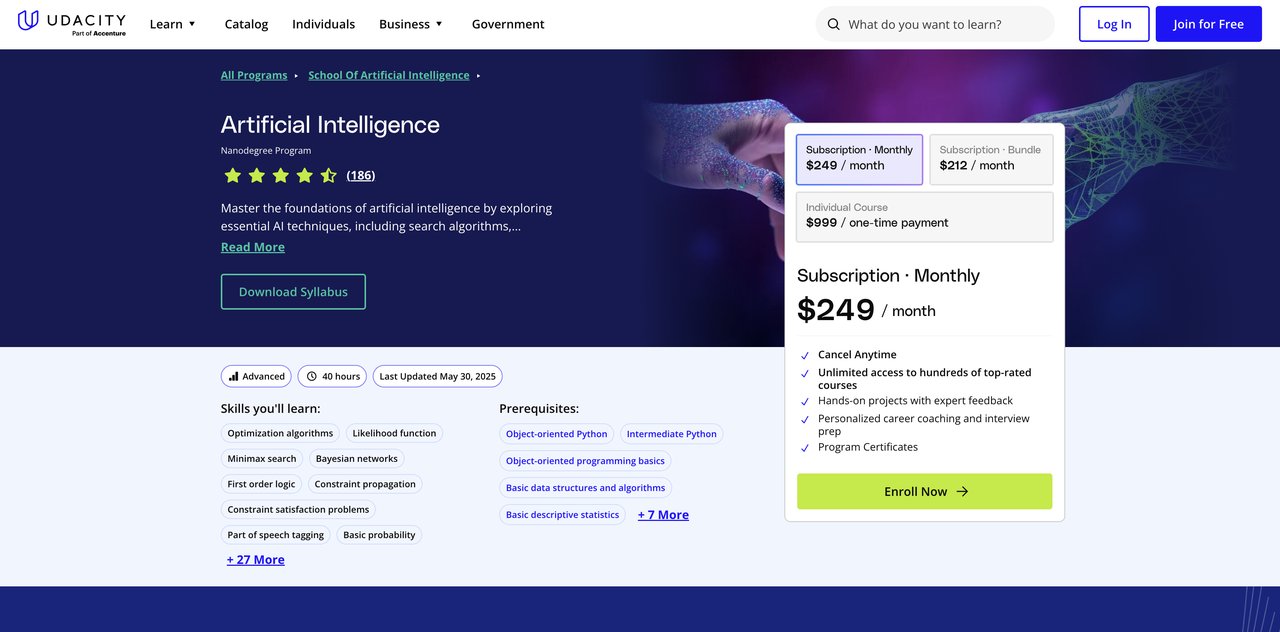
Udacity's Artificial Intelligence Nanodegree is a detailed program taught by AI industry leaders. It covers essential AI concepts and includes hands-on projects to apply theory to real-world scenarios.
Key Topics Covered: Optimization algorithms, Bayesian networks, strategic decision-making agents.
Target Audience and Skill Level Requirements: Suitable for those with object-oriented Python programming knowledge.
- Pros:
- Instruction from industry experts.
- Hands-on projects foster practical learning.
- Career support services available.
- Cons:
- Requires prior Python knowledge.
Who would benefit most: Developers with Python experience looking to deepen their AI knowledge through a structured program.
Course 3: AI, Deep Learning and MLOps Courses by DeepLearning.AI
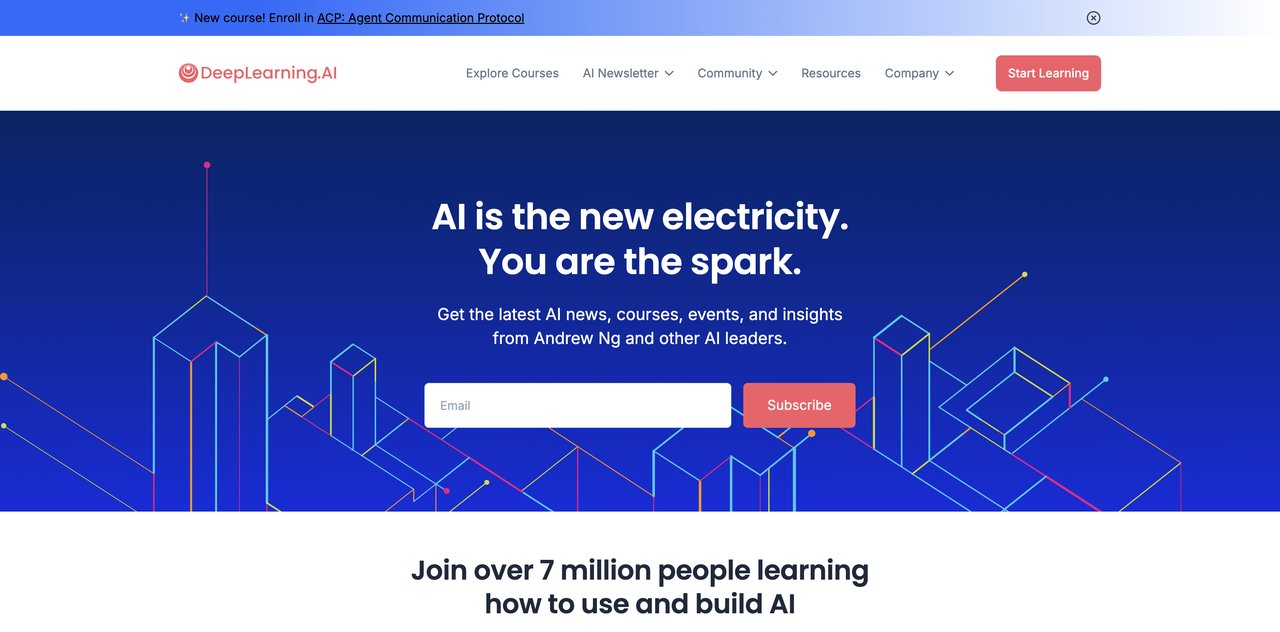
DeepLearning.AI offers courses by renowned AI expert Dr. Andrew Ng, ranging from introductory to advanced levels, covering a broad spectrum of AI and machine learning topics.
Key Topics Covered: Machine learning, MLOps, deep learning, generative AI.
Target Audience and Skill Level Requirements: Flexible offerings suitable for beginners to advanced learners.
- Pros:
- High-quality instruction from a leading AI expert.
- Flexible pricing and extensive topic coverage.
- Cons:
- Advanced courses may require prior knowledge.
Who would benefit most: Learners seeking flexible learning options from a reputable source.
Course 4: Certificate in Artificial Intelligence and Machine Learning by CIAT
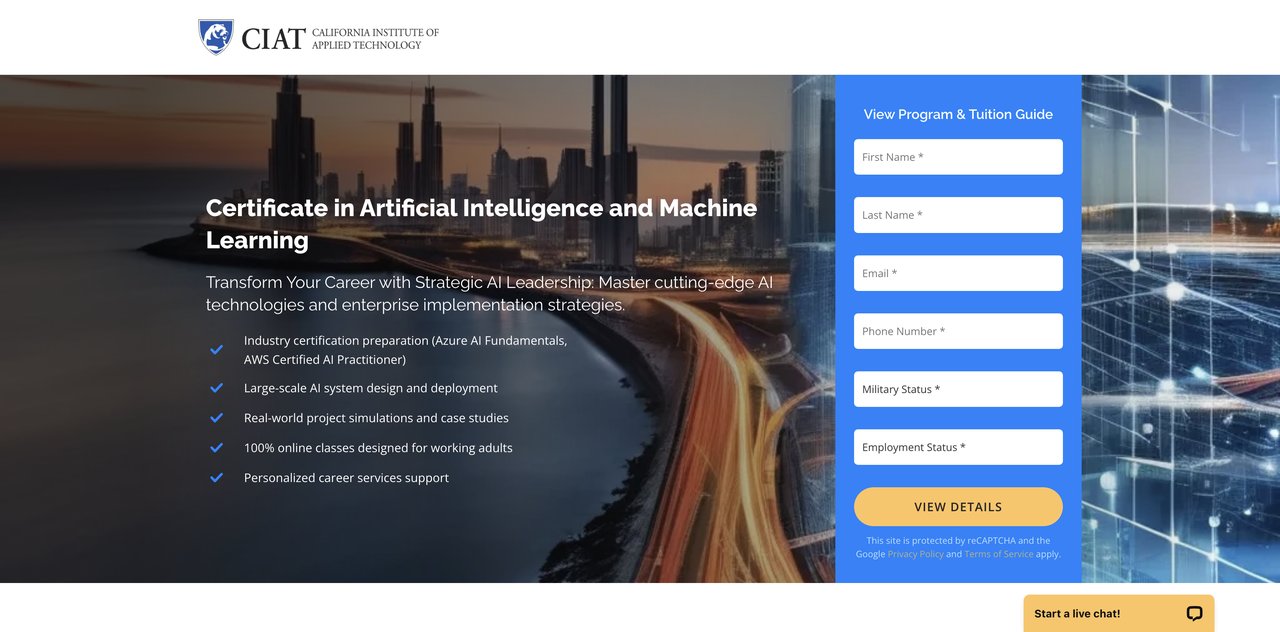
The Certificate in AI and Machine Learning by CIAT is a live, instructor-led program designed to prepare participants for advanced roles such as Senior Machine Learning Engineer.
Key Topics Covered: Industry-standard AI frameworks, practical labs, real-world applications.
Target Audience and Skill Level Requirements: Geared towards professionals with 2+ years of IT experience and cloud familiarity.
- Pros:
- Interactive instructor-led sessions.
- Focus on career-oriented skills.
- Cons:
- Requires prior professional experience.
Who would benefit most: Experienced IT professionals aiming to advance into AI engineering roles.
Course 5: Big Data, Artificial Intelligence and Ethics by UC Davis
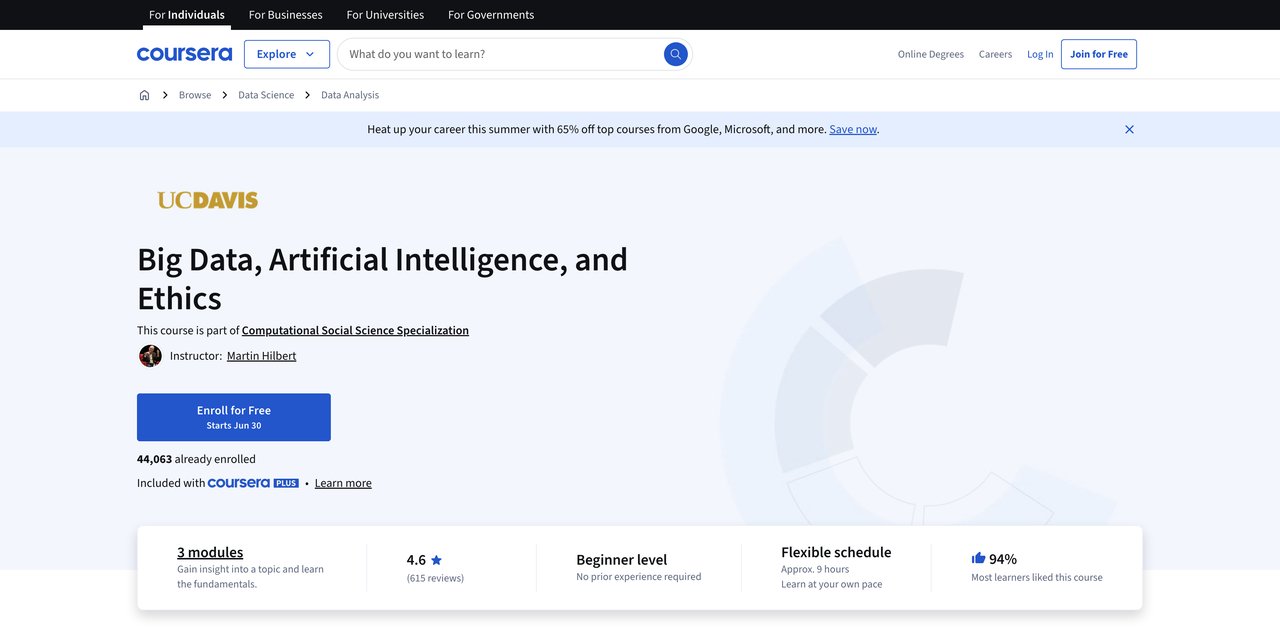
Offered by UC Davis via Coursera, this course introduces big data and AI fundamentals alongside IBM Watson NLP experience, focusing on ethical AI use.
Key Topics Covered: Big data fundamentals, AI ethics, IBM Watson applications.
Target Audience and Skill Level Requirements: Suitable for beginners interested in AI fundamentals and ethical considerations.
- Pros:
- Beginner-friendly with a free audit option.
- Focus on AI ethics.
- Cons:
- Short course duration.
Who would benefit most: Newcomers to AI looking to understand its ethical dimensions.
Course 6: AI for Business Specialization by University of Pennsylvania
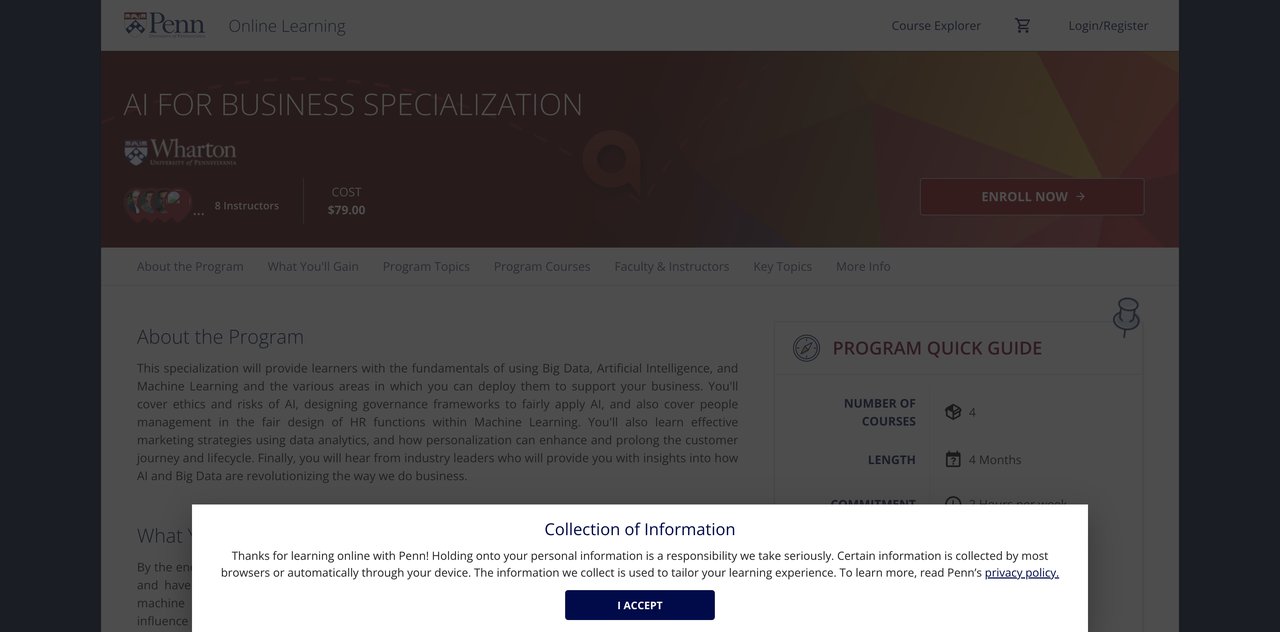
This specialization teaches AI applications in business functions, providing hands-on projects with tools like TensorFlow and AutoML.
Key Topics Covered: AI in marketing, finance, HR; ethical AI strategies.
Target Audience and Skill Level Requirements: Designed for business professionals seeking AI integration skills.
- Pros:
- Business-focused with practical projects.
- Affordable specialization.
- Cons:
- Requires a multi-month commitment.
Who would benefit most: Business professionals looking to integrate AI into their functions.
Course 7: CS50’s Introduction to Artificial Intelligence with Python by Harvard University
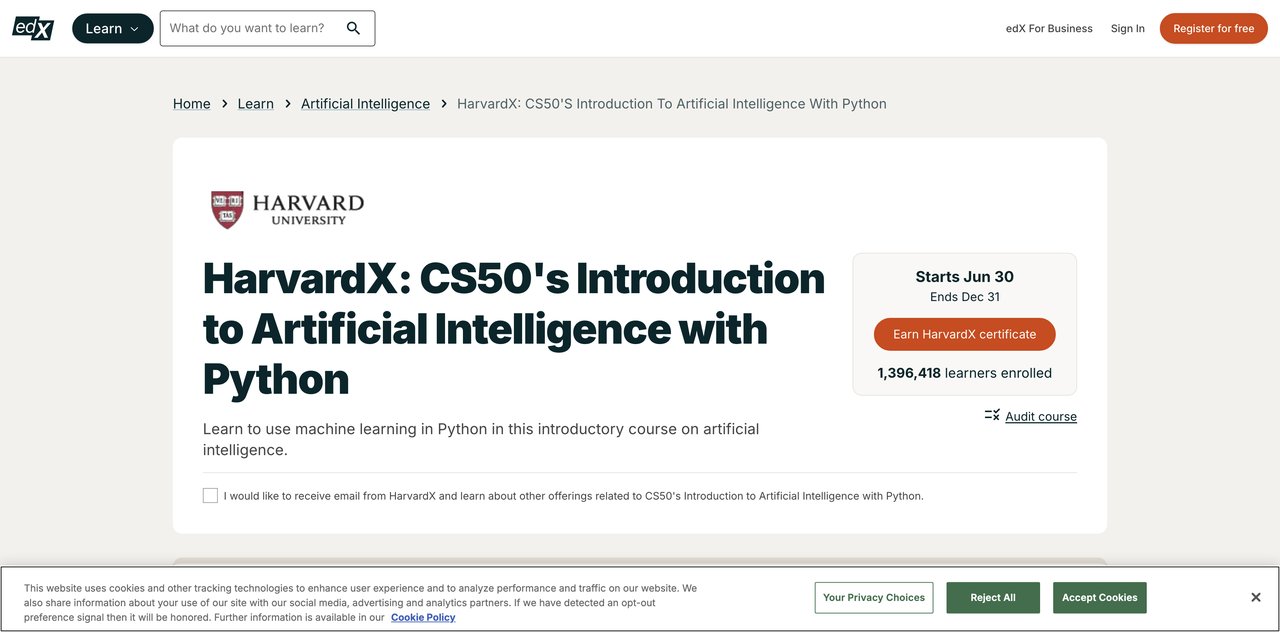
Harvard's CS50 course offers a deep dive into AI and machine learning using Python, featuring practical projects such as game-playing engines.
Key Topics Covered: Graph search, reinforcement learning, practical coding with Python.
Target Audience and Skill Level Requirements: Intermediate-level course for those with basic Python skills.
- Pros:
- Harvard-quality instruction with practical coding skills.
- Comprehensive AI concept coverage.
- Cons:
- Time-intensive with a weekly hour commitment.
Who would benefit most: Intermediate learners seeking a rigorous introduction to AI with Python.
Course 8: Andrej Karpathy’s YouTube Channel — AI & ML Education
Andrej Karpathy's YouTube channel offers comprehensive tutorials on AI and machine learning, focusing on building GPT models and advanced AI concepts.
Key Topics Covered: GPT models, tokenization, large language models.
Target Audience and Skill Level Requirements: Best for self-directed learners with a programming background.
- Pros:
- Free access to expert insights.
- In-depth technical content.
- Cons:
- Requires a programming background.
Who would benefit most: Programmers interested in deep technical AI insights.
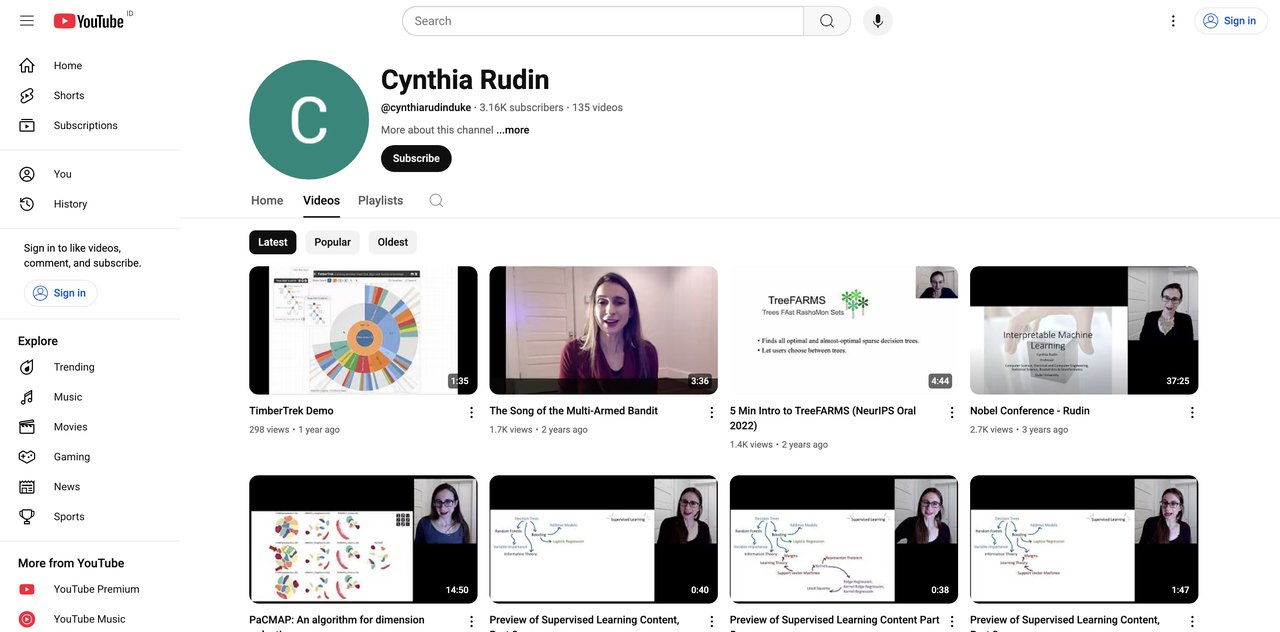
Course 9: Cynthia Rudin’s YouTube Channel — Interpretable Machine Learning
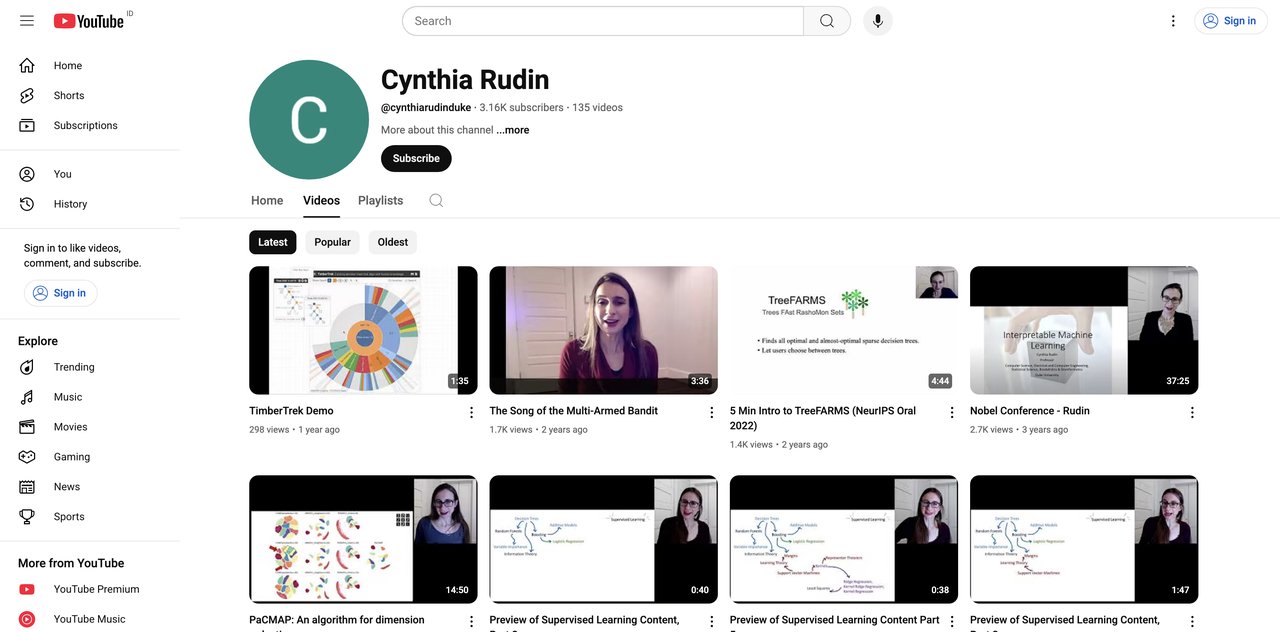
Cynthia Rudin's YouTube channel focuses on interpretable machine learning, covering advanced topics with an emphasis on theory.
Key Topics Covered: Statistical learning theory, Kernel Density Estimation, Multi-Armed Bandits.
Target Audience and Skill Level Requirements: Advanced learners with a strong mathematical background.
- Pros:
- Free access to deep theoretical content.
- Focus on interpretable AI concepts.
- Cons:
- May be challenging for beginners.
Who would benefit most: Advanced learners interested in the theoretical aspects of AI.
Course 10: Certificate Program in AI Business Strategy by Johns Hopkins University
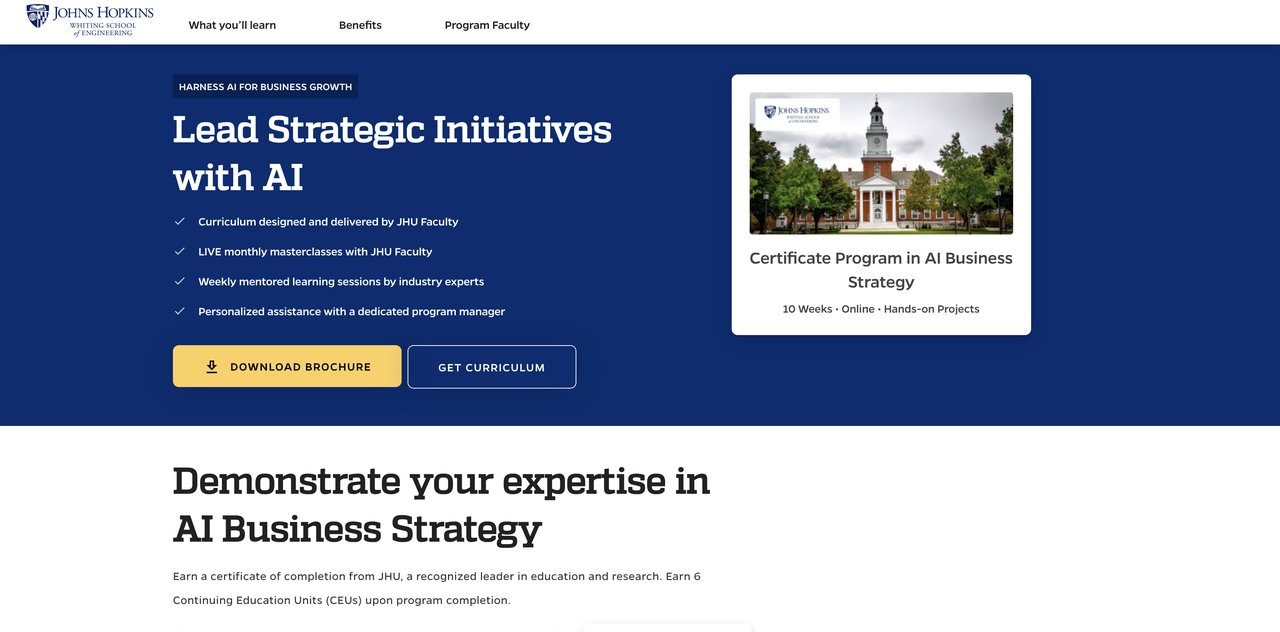
Johns Hopkins offers a 10-week program focusing on AI business strategy, ethical AI, and risk management, ideal for technology leaders.
Key Topics Covered: AI business strategy, ethical considerations, risk management.
Target Audience and Skill Level Requirements: Targeted at experienced professionals in management roles.
- Pros:
- Industry mentorship and live sessions.
- Strategic and management focus.
- Cons:
- High cost.
Who would benefit most: Experienced professionals in leadership roles seeking strategic AI insights.
Course 11: Develop LLM Powered Applications with LangChain by Udemy
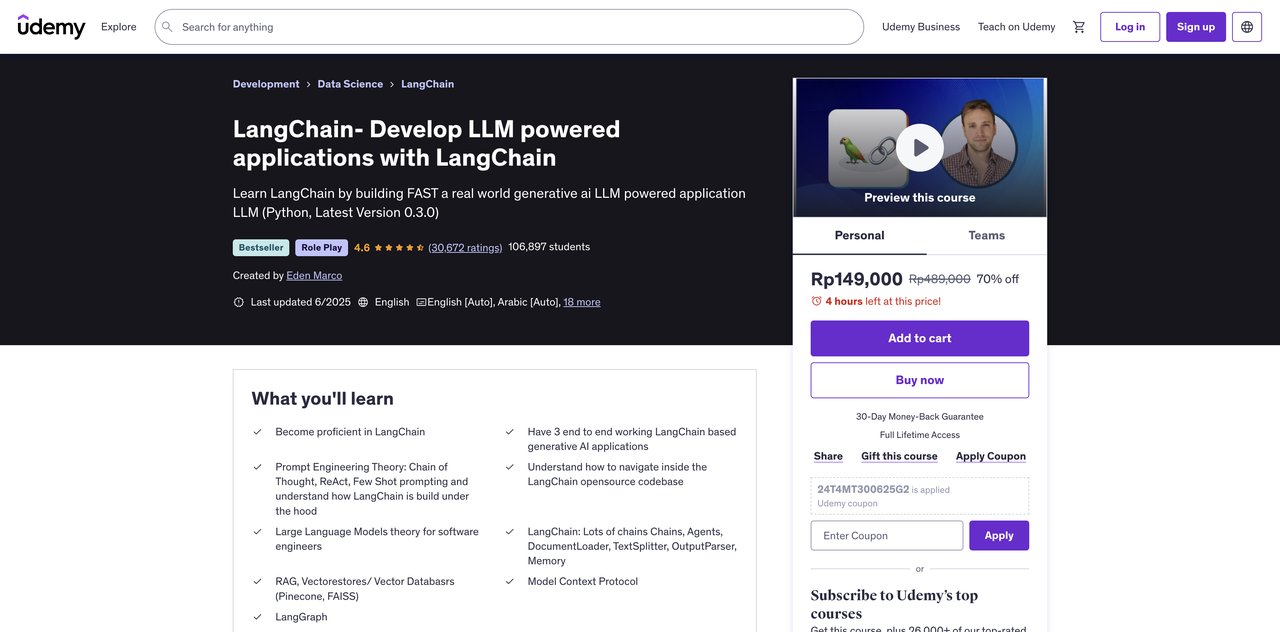
This Udemy course teaches the development of large language model applications using LangChain, including hands-on projects and prompt engineering techniques.
Key Topics Covered: Prompt engineering, ReAct agents, Retrieval Augmented Generation.
Target Audience and Skill Level Requirements: Suitable for Python developers.
- Pros:
- Affordable with practical, up-to-date content.
- Cons:
- Requires Python experience.
Who would benefit most: Python developers interested in building LLM-powered applications.
Course 12: OpenAI Academy: Utah
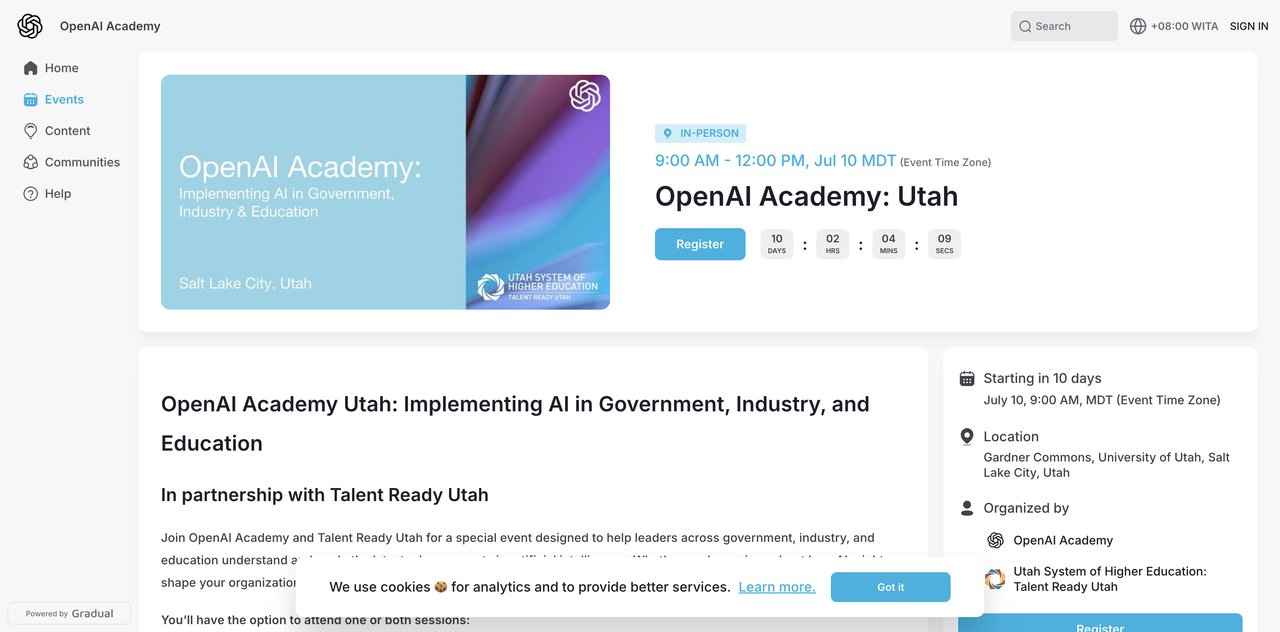
OpenAI Academy Utah is a live event offering free, expert-led sessions on AI applications, ideal for eLearning developers looking to integrate AI tools like ChatGPT.
Key Topics Covered: AI tool integration, community collaboration, practical AI applications.
Target Audience and Skill Level Requirements: eLearning developers interested in hands-on AI learning.
- Pros:
- Free access with networking opportunities.
- Expert and community-led learning.
- Cons:
- Location and date-specific event.
Who would benefit most: eLearning professionals seeking practical AI applications and networking opportunities.
Course 13: OpenAI Academy: Mississippi
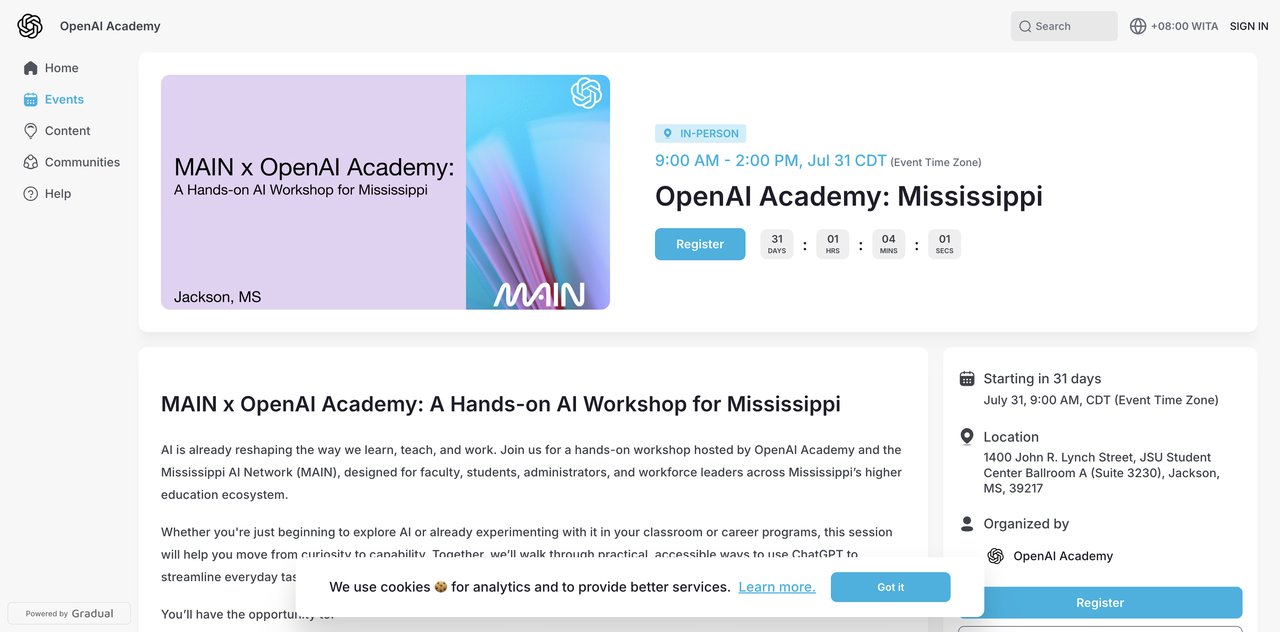
This OpenAI Academy event introduces participants to ChatGPT and AI applications, aimed at integrating AI into educational content.
Key Topics Covered: ChatGPT introduction, AI applications in education, community engagement.
Target Audience and Skill Level Requirements: Suitable for eLearning developers new to AI tools.
- Pros:
- Free, interactive format.
- Focus on ChatGPT introduction.
- Cons:
- Limited to a specific date.
Who would benefit most: eLearning developers seeking to incorporate AI in their work.
Course 14: Evals: The Key to Production-Ready AI Apps by OpenAI Academy
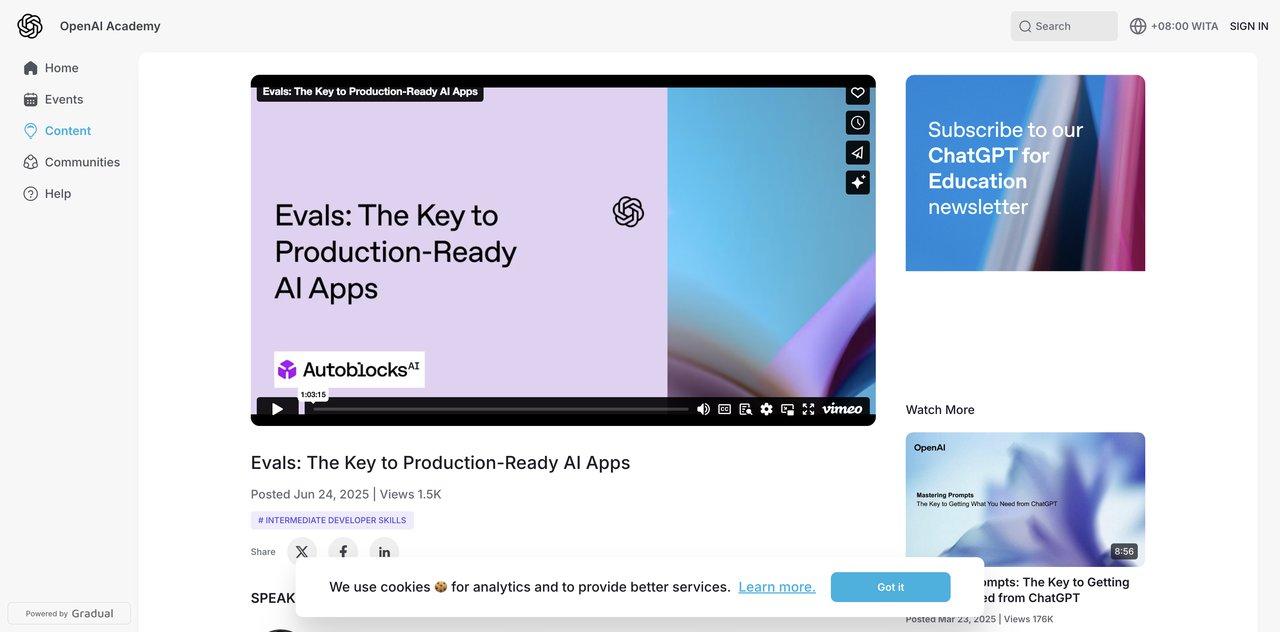
This video session highlights the importance of evaluation processes for deploying trustworthy AI applications with practical strategies for scaling AI integrations.
Key Topics Covered: AI application evaluations, real-world case studies, trustworthy AI deployment.
Target Audience and Skill Level Requirements: Suitable for developers with some AI knowledge.
- Pros:
- Practical insights with real-world examples.
- Focus on trustworthy AI deployment.
- Cons:
- Technical focus may require prior knowledge.
Who would benefit most: Developers focused on deploying reliable AI applications.
Course 15: Navigating the AI Policy Landscape in Schools by OpenAI Academy
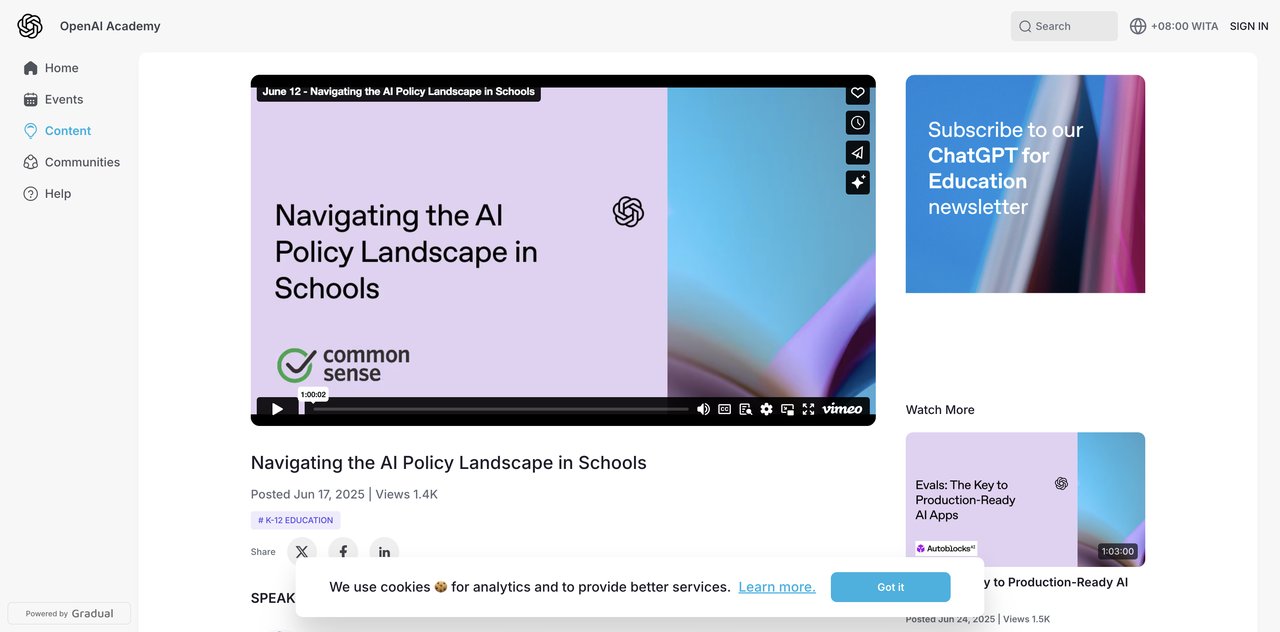
This session is aimed at K-12 administrators and school leaders, focusing on establishing AI policies in educational settings.
Key Topics Covered: AI policy alignment, educational compliance, ethical AI use.
Target Audience and Skill Level Requirements: School administrators and educational developers.
- Pros:
- Focus on policy and ethical considerations.
- Useful for educational developers.
- Cons:
- More policy-oriented than technical.
Who would benefit most: Educational developers ensuring AI compliance in schools.
Overall Recommendations for eLearning Developers
Choosing the right AI training course depends heavily on the specific needs and current skill levels of the eLearning developers. For those seeking comprehensive and continuously updated content, CompleteAI Training provides an extensive library of courses and is particularly cost-effective. Those with a solid foundation in Python may find Udacity's Nanodegree or Harvard's CS50 course more beneficial due to their depth and project-based learning.
For developers looking to explore AI applications within a business context, the University of Pennsylvania’s specialization is a practical and affordable choice. Meanwhile, OpenAI Academy events offer free opportunities for community learning and practical applications, though they are limited by location and scheduling.
Ultimately, each course offers unique benefits, and the best choice will align with the learner's professional goals and current experience. Whether the focus is on technical depth, strategic business application, or ethical policy development, there is a suitable course available to enhance the skills of eLearning developers in the AI domain.