AI app for customer support · no coding needed
Support demand planning tool
Transparent event assumptions and error tracking for support-specific planning.
Made for: Workforce planners at seasonal online retailers
What it does for you
The problem
Staffing plans ignore launches and seasonal ticket spikes.
What it gives you
Demand scenarios and staffing recommendations
What you give it
Historical ticket countscampaign datesstaffing capacity
How it works, step by step
- Import volume history
- Flag missing periods
- Model seasonal patterns
- Add event assumptions
- Compare capacity scenarios
- Backtest forecasts
What you see on screen
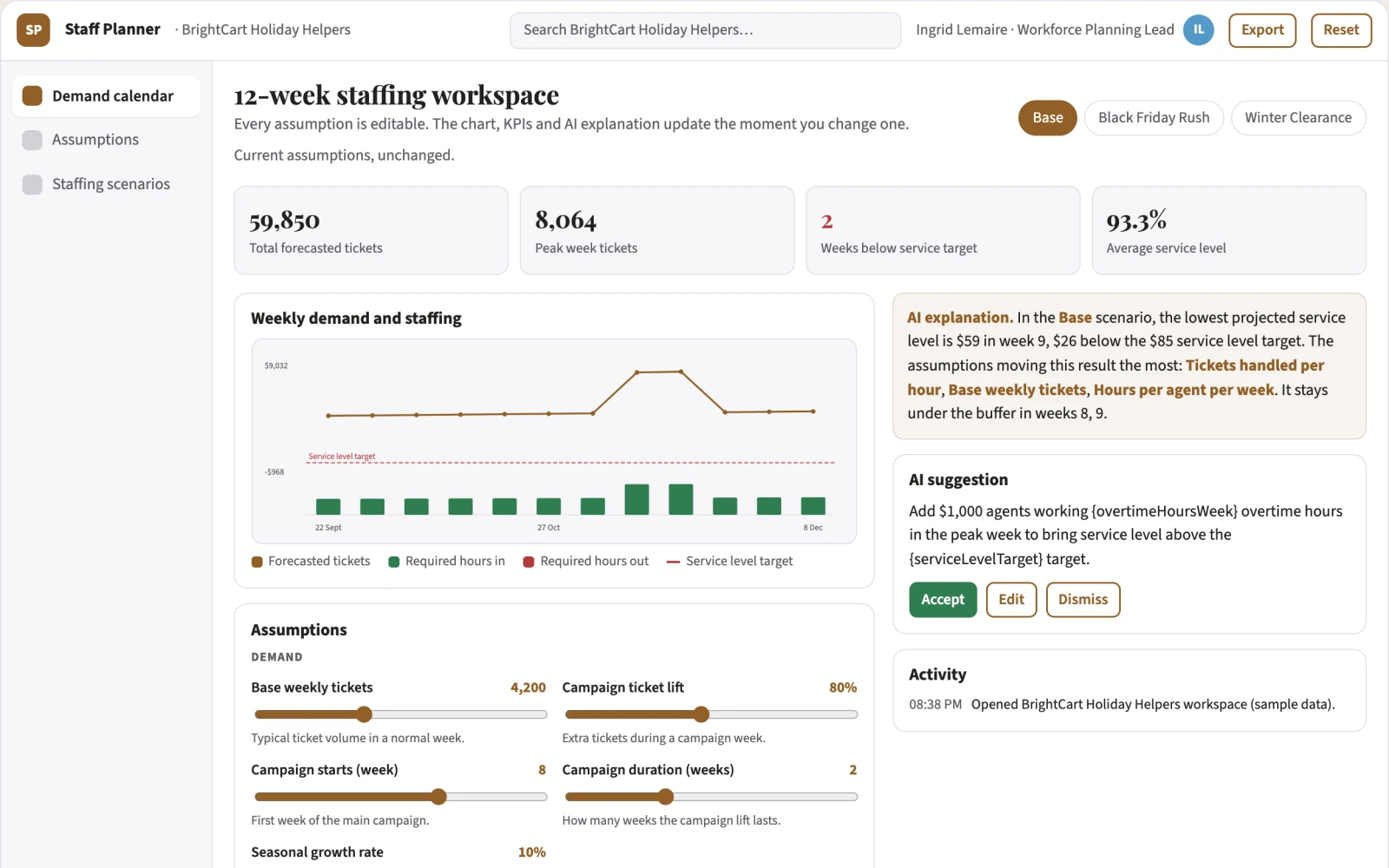
- Demand calendar
- assumptions
- staffing scenarios
Jobs this app suits
Our AI checked this app against 500 jobs; these get the most out of it. Each job links to its learning path.
Build it yourself with your AI system
Build this app yourself, no coding needed
Start with a quick version you can try in a few minutes. Like it? Then build the full app by copying and pasting our step-by-step instructions: everything is prepared for you.
Sign in to see how to build it yourself
Build a quick version to try, or get the full app pack for Support demand planning tool with the step-by-step building instructions. You don't need any technical skills: you copy, paste and answer a few questions. Both are included in the membership.
4 Have it built for you days to a few weeks
Rather not do it yourself, or want it fully tailored to your data, your way of working and your brand? Nexibeo builds Support demand planning tool with you.
What's in the app pack
Included in the Complete AI Training membership.
- The building instructions your AI follows, step by step
- The questions your AI will ask you about your business before it starts
- A clickable demo you can open in your browser, to see how it should work
- A detailed blueprint of the screens, the information it keeps and the checks it runs
Become a member to get the app packAlready a member? Sign in
The files, for the technically curious
- START-HERE.mdHow to build it with your own AI (read first)3 KB
- README.mdOverview and links1 KB
- questions.mdQuestions to answer before you build2 KB
- prompt-cloudflare.mdThe full build prompt, hosted on Cloudflare22 KB
- prompt-vps.mdThe same build on your own server (Docker)22 KB
- spec.jsonData model, API, AI pipeline, acceptance criteria12 KB
- demo/index.htmlThe working demo on sample data196 KB
Questions
Do I need to know how to code?
No. You copy and paste the prompts on this page into ChatGPT or Claude, and the AI does the building. When it asks you something, you answer in your own words.
What does it cost?
The quick version, the app pack and the step-by-step instructions are for members: you pay the membership price, not a price per app (see the plans). Building the full app uses your own ChatGPT or Claude subscription. Putting it online is often cheap or no cost at the start, and your AI tells you before anything costs money.
How long does it take?
The quick version: about two minutes. The real app: an afternoon for a first version you can use, longer if you want every feature.
Can I change it to fit my business?
Yes. Tell your AI what to change in plain words, like “add a column for the price” or “use our logo and colours”. Or have Nexibeo build and customise it for you.
More detailsHow the AI works, safeguards and what to build first
For workforce planners at seasonal online retailers, turn historical ticket counts, campaign dates and staffing capacity into demand scenarios and staffing recommendations. Address the recurring problem: staffing plans ignore launches and seasonal ticket spikes. The pilot measures forecast error and understaffed intervals against the buyer's current method, before the larger build.
Validate baseline inputs, confirm definitions and constraints, select editable assumptions, calculate feasible alternatives, inspect sensitivities, let the responsible person approve a plan, and compare later actuals with the recorded assumptions. Start with historical ticket counts, campaign dates and staffing capacity and finish with demand scenarios and staffing recommendations.
How the AI works
Extract input context and explain scenario differences. Use deterministic calculations or explicit optimization for quantities, compatibility, dates and prices. Show uncertain assumptions. Never let generated prose silently change the calculation rules.
Safeguards
Keep customer account access scoped. Escalate missing evidence and consequential exceptions to staff. Review quality alongside any speed measure. Validate source access and reviewer availability during the pilot. Maintain customer-level access, data deletion controls and a record of final approvals.
What to build first
Begin with workforce planners at seasonal online retailers and one recurring use case. Build the first two modules: import volume history; flag missing periods. Provide operator assistance for the third module: model seasonal patterns. Deliver demand scenarios and staffing recommendations through a manual review queue. Perform other necessary full-scope functions manually during the pilot. Include all applicable access, accuracy and professional-review controls from the start.
What it can connect to
Support inboxes, help centers, order records and customer feedback systems. Read-only operational exports, calendars and finance or inventory records as relevant. Start with plan exports and retain human approval for execution. These are candidate integration categories, not verified supported connectors.
The screens in detail
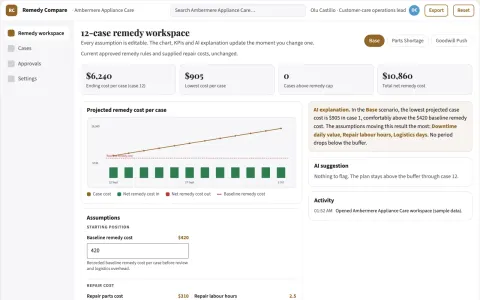
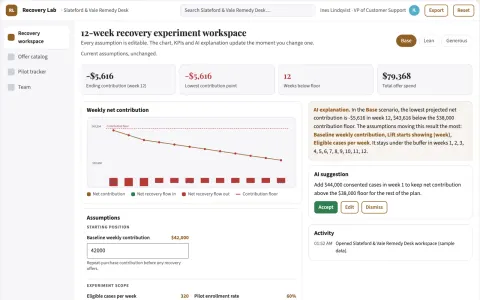
Place editable drivers and constraints beside a clearly labeled scenario output. Include a baseline view, comparison chart or schedule, and an assumptions history. Let users trace a proposed quantity or date back to its inputs. Keep forecasts distinct from actual results. In this product, the first view is demand calendar, followed by assumptions and staffing scenarios.