AI app for healthcare · no coding needed
Referral Triage and Routing
The system learns each clinic's specific queue structure and referral language, so it routes more accurately over time than a generic inbox filter.
Made for: Operations leads at multi-disciplinary clinics and allied health networks
What it does for you
The problem
Inbound patient referrals are hand-sorted and often miss urgency, causing delays and wrong inboxes.
What it gives you
Structured referral summaries with suggested queue and urgency flag
What you give it
Inbound referral emailsportal submissionsfaxes
How it works, step by step
- Extract patient demographics, reason for referral and provider notes from email, portal or fax
- Classify the case into a predefined clinical queue
- Assign an urgency flag based on keywords and phrases
- Route routine referrals to the correct clinician's task list
- Push urgent referrals to the top with a notification to the on-call clinician
- Log all routing decisions and overrides for audit
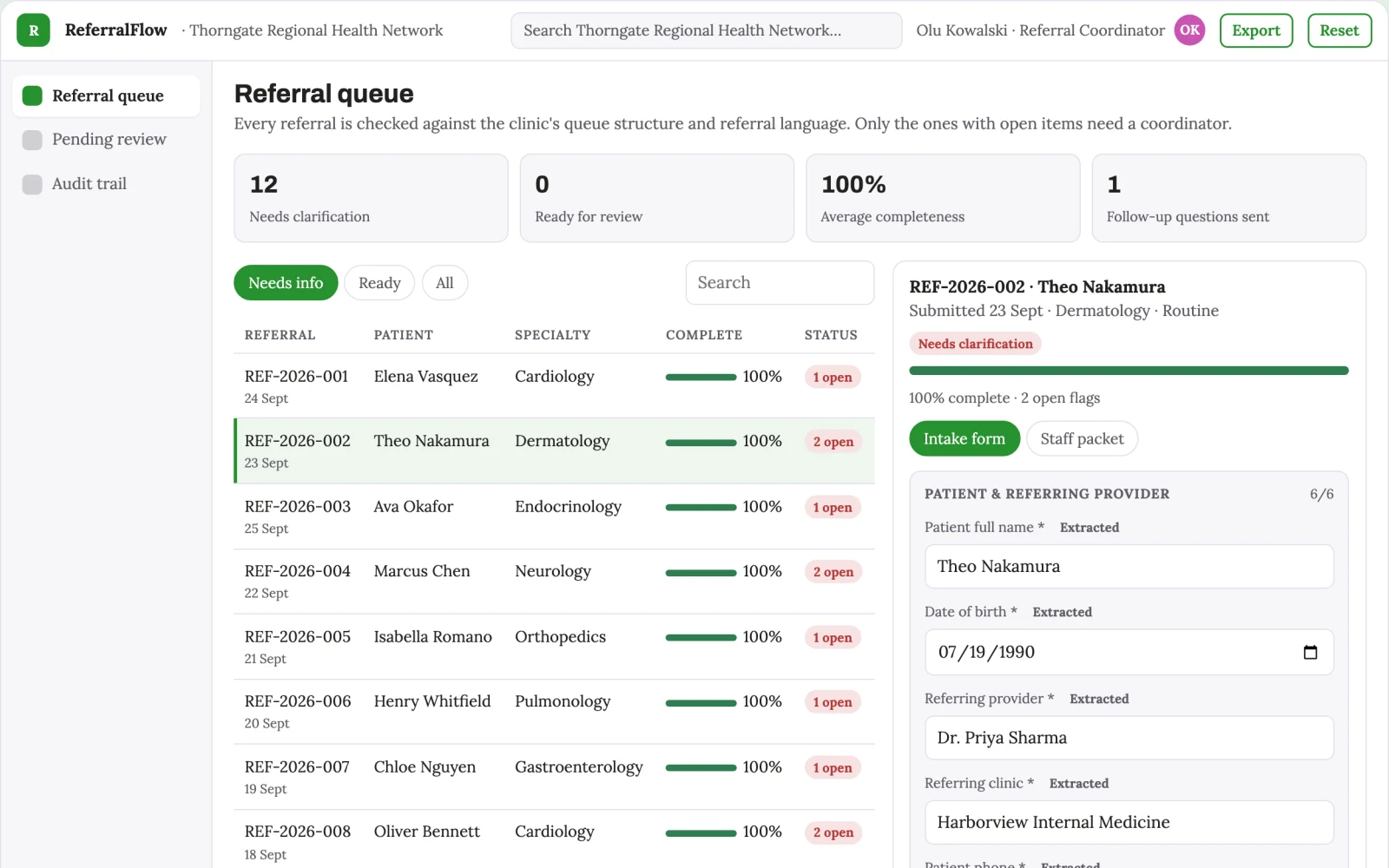
What you see on screen
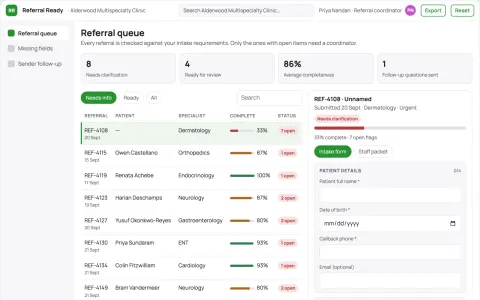
- Inbox monitor
- referral summary
- queue board
Jobs this app suits
Our AI checked this app against 500 jobs; these get the most out of it. Each job links to its learning path.
Build it yourself with your AI system
Build this app yourself, no coding needed
Start with a quick version you can try in a few minutes. Like it? Then build the full app by copying and pasting our step-by-step instructions: everything is prepared for you.
Sign in to see how to build it yourself
Build a quick version to try, or get the full app pack for Referral Triage and Routing with the step-by-step building instructions. You don't need any technical skills: you copy, paste and answer a few questions. Both are included in the membership.
4 Have it built for you days to a few weeks
Rather not do it yourself, or want it fully tailored to your data, your way of working and your brand? Nexibeo builds Referral Triage and Routing with you.
What's in the app pack
Included in the Complete AI Training membership.
- The building instructions your AI follows, step by step
- The questions your AI will ask you about your business before it starts
- A clickable demo you can open in your browser, to see how it should work
- A detailed blueprint of the screens, the information it keeps and the checks it runs
Become a member to get the app packAlready a member? Sign in
The files, for the technically curious
- START-HERE.mdHow to build it with your own AI (read first)3 KB
- README.mdOverview and links1 KB
- questions.mdQuestions to answer before you build2 KB
- prompt-cloudflare.mdThe full build prompt, hosted on Cloudflare22 KB
- prompt-vps.mdThe same build on your own server (Docker)22 KB
- spec.jsonData model, API, AI pipeline, acceptance criteria12 KB
- demo/index.htmlThe working demo on sample data209 KB
Questions
Do I need to know how to code?
No. You copy and paste the prompts on this page into ChatGPT or Claude, and the AI does the building. When it asks you something, you answer in your own words.
What does it cost?
The quick version, the app pack and the step-by-step instructions are for members: you pay the membership price, not a price per app (see the plans). Building the full app uses your own ChatGPT or Claude subscription. Putting it online is often cheap or no cost at the start, and your AI tells you before anything costs money.
How long does it take?
The quick version: about two minutes. The real app: an afternoon for a first version you can use, longer if you want every feature.
Can I change it to fit my business?
Yes. Tell your AI what to change in plain words, like “add a column for the price” or “use our logo and colours”. Or have Nexibeo build and customise it for you.
More detailsHow the AI works, safeguards and what to build first
For operations leads at multi-disciplinary clinics and allied health networks, turn inbound referral emails, portal submissions and faxes into structured summaries with a suggested clinical queue and urgency flag. Address the recurring problem: hand-sorting is slow, inconsistent and a single point of failure, with urgent cases sometimes sitting unseen for days.
Referral arrives, system reads text and attachments, extracts structured fields, classifies queue, assigns urgency, routes to clinician or flags urgent, and logs the decision. Start with inbound referral emails, portal submissions and faxes and finish with structured summaries, suggested queue and urgency flag.
How the AI works
Use language models to read referral text and attachments, extract demographics and reason for referral, and classify queue and urgency. A clinician reviews all high-urgency flags within a short window and audits a sample of routine referrals to catch edge cases before anything is used.
Safeguards
Limit AI to suggesting queue and urgency, never making final routing decisions without a human override. Require clinician review of all high-urgency flags. Restrict access to authorised staff only. Must not access patient records beyond the referral content and must not share data outside the clinic's secure environment.
What to build first
One buyer: a single multi-disciplinary clinic. One use case: email referrals only. First two modules: extraction and queue assignment. Manual review of every referral by a coordinator before it is routed.
What it can connect to
Start with a monitored email inbox, then add a secure portal upload and fax-to-email gateway. Later connect to practice management systems for task creation.
The screens in detail
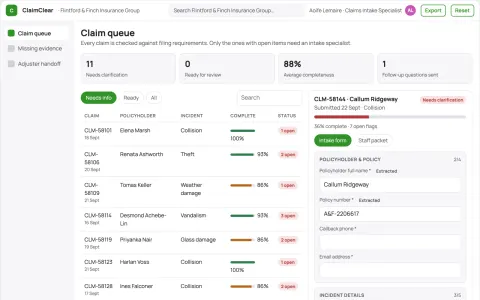
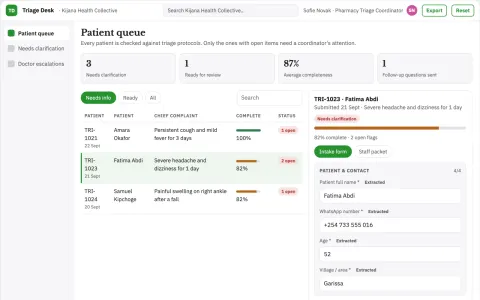
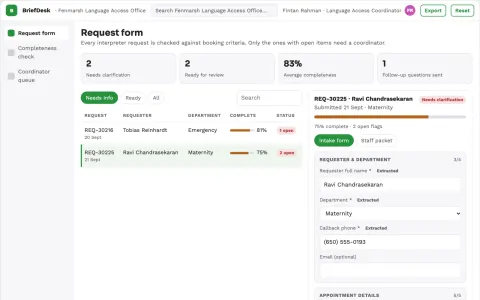
Use a central inbox feed showing incoming referrals with a status badge, a detail panel for the extracted summary and original document, and a queue board showing each clinician's task list with urgent items pinned to the top. Let users open a referral to review the AI's extraction and override the queue or urgency. Display routed, pending and flagged states. In this product, the first view is inbox monitor, followed by referral summary and queue board.