AI app for management · no coding needed
Knowledge concentration continuity map
Focus knowledge transfer on routines with no verified backup.
Made for: Small business owners with specialist teams
What it does for you
The problem
Critical routines depend on one person without usable documentation.
What it gives you
Team-approved knowledge continuity register
What you give it
Voluntarily declared task ownershipapproved process records
How it works, step by step
- Catalog critical routines
- Record declared backups
- Link usable documentation
- Flag single-owner tasks
- Draft transfer priorities
- Export continuity plan
What you see on screen
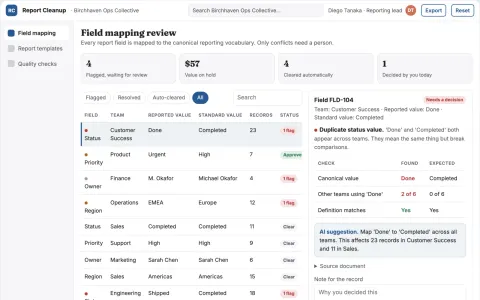
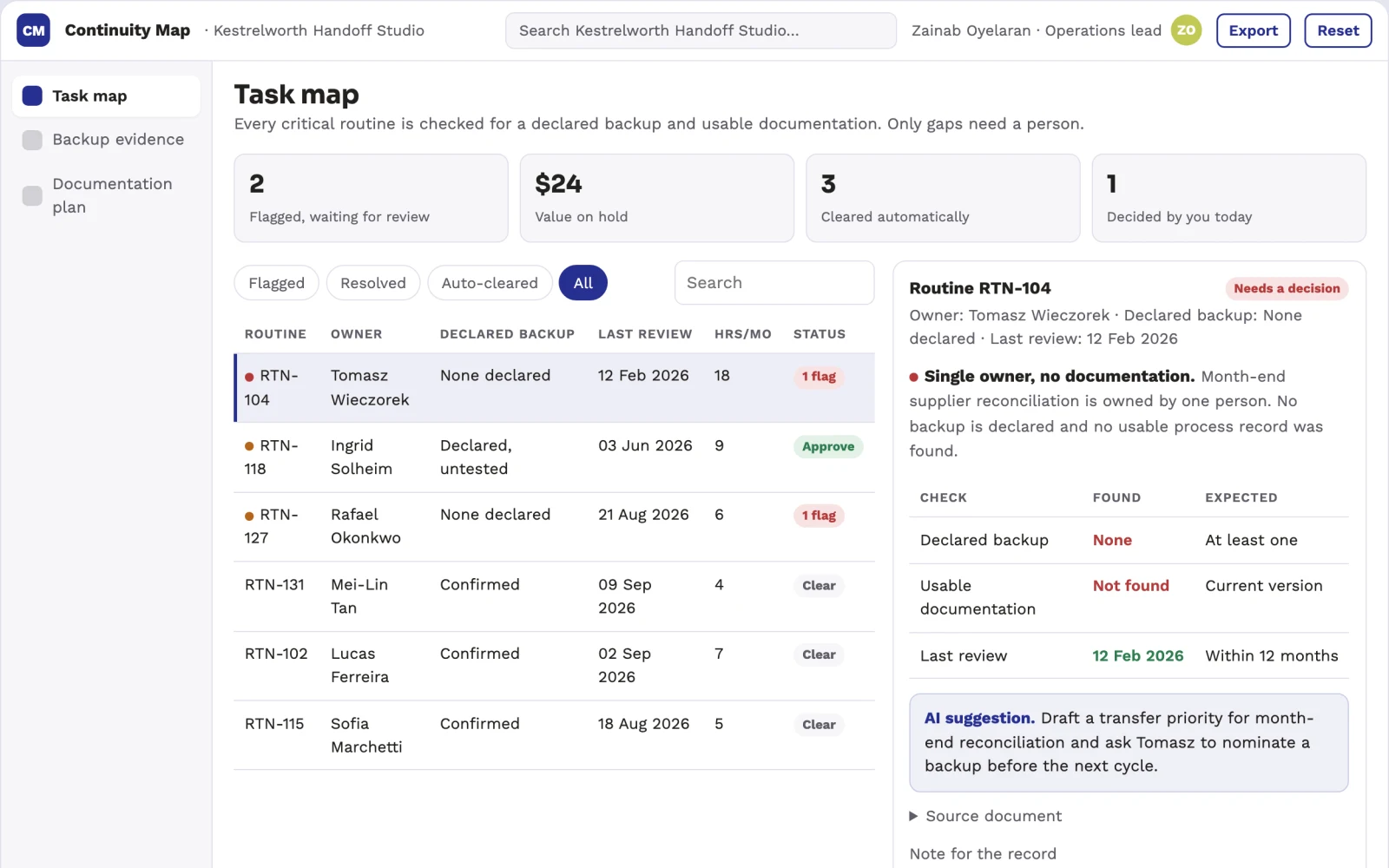
- Task map
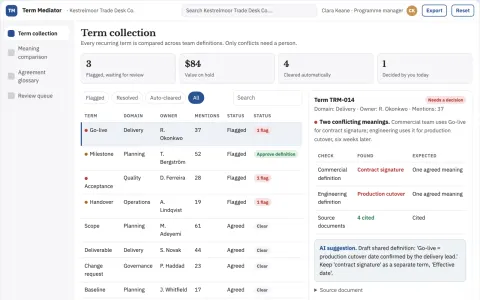
- Backup evidence
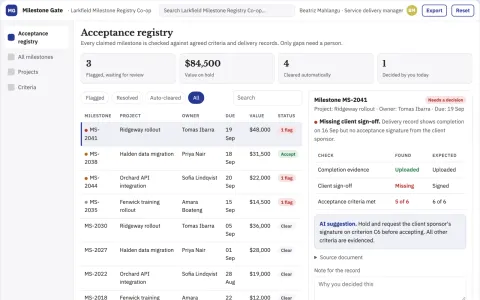
- Documentation plan
Jobs this app suits
Our AI checked this app against 500 jobs; these get the most out of it. Each job links to its learning path.
Build it yourself with your AI system
Build this app yourself, no coding needed
Start with a quick version you can try in a few minutes. Like it? Then build the full app by copying and pasting our step-by-step instructions: everything is prepared for you.
Sign in to see how to build it yourself
Build a quick version to try, or get the full app pack for Knowledge concentration continuity map with the step-by-step building instructions. You don't need any technical skills: you copy, paste and answer a few questions. Both are included in the membership.
4 Have it built for you days to a few weeks
Rather not do it yourself, or want it fully tailored to your data, your way of working and your brand? Nexibeo builds Knowledge concentration continuity map with you.
What's in the app pack
Included in the Complete AI Training membership.
- The building instructions your AI follows, step by step
- The questions your AI will ask you about your business before it starts
- A clickable demo you can open in your browser, to see how it should work
- A detailed blueprint of the screens, the information it keeps and the checks it runs
Become a member to get the app packAlready a member? Sign in
The files, for the technically curious
- START-HERE.mdHow to build it with your own AI (read first)3 KB
- README.mdOverview and links1 KB
- questions.mdQuestions to answer before you build2 KB
- prompt-cloudflare.mdThe full build prompt, hosted on Cloudflare24 KB
- prompt-vps.mdThe same build on your own server (Docker)24 KB
- spec.jsonData model, API, AI pipeline, acceptance criteria13 KB
- demo/index.htmlThe working demo on sample data195 KB
Questions
Do I need to know how to code?
No. You copy and paste the prompts on this page into ChatGPT or Claude, and the AI does the building. When it asks you something, you answer in your own words.
What does it cost?
The quick version, the app pack and the step-by-step instructions are for members: you pay the membership price, not a price per app (see the plans). Building the full app uses your own ChatGPT or Claude subscription. Putting it online is often cheap or no cost at the start, and your AI tells you before anything costs money.
How long does it take?
The quick version: about two minutes. The real app: an afternoon for a first version you can use, longer if you want every feature.
Can I change it to fit my business?
Yes. Tell your AI what to change in plain words, like “add a column for the price” or “use our logo and colours”. Or have Nexibeo build and customise it for you.
More detailsHow the AI works, safeguards and what to build first
For small business owners with specialist teams, turn voluntarily declared task ownership and approved process records into team-approved knowledge continuity register. Address this specific problem: critical routines depend on one person without usable documentation. The aim: focus knowledge transfer on routines with no verified backup. The pilot tests whether that benefit holds up against reviewer effort and real operating costs.
The buyer creates a project, supplies voluntarily declared task ownership and approved process records, and confirms scope and access. Users correct extracted facts, resolve flagged uncertainties and approve the final team-approved knowledge continuity register before use. Retain source links and a version history for the next cycle.
How the AI works
Identify documentation gaps from declared information. Keep model suggestions separate from verified facts. Link factual outputs to authorized input evidence and show missing information explicitly. Use deterministic checks for counts, dates, identifiers and arithmetic where applicable. A designated reviewer validates consequential outputs and signs off the delivered result.
Safeguards
Confirm owners, decisions and commitments. Keep employee discussion notes access-controlled and avoid covert individual performance inference. Role-level continuity; no worker replaceability scoring. Require appropriate access and publication approval. Preserve source material, label AI drafts and make corrections traceable. Measure false positives and missed cases alongside speed.
What to build first
Costed pilot: Role-level continuity; no worker replaceability scoring. Start with one buyer organization and a bounded set of representative inputs. Implement the first two modules: catalog critical routines; record declared backups. Support the third task through an assisted review queue: link usable documentation. Handle the remaining required functions manually until validated. Include input upload, source references, user correction, a reviewer approval step and export of team-approved knowledge continuity register. Authentication, account isolation, deletion controls and basic operational logging are included. Specialized production certification, live write integrations and broader rollout are not included unless explicitly stated.
What it can connect to
Team updates, calendars, project records and agreed management routines. Source systems, catalog exports and cloud file storage. Start with reversible CSV or file imports and validate identifiers before any direct writes. Begin with uploads and exports of voluntarily declared task ownership and approved process records. Any named system or connector is a candidate requiring current access and compatibility checks; no live connection is included by default.
The screens in detail
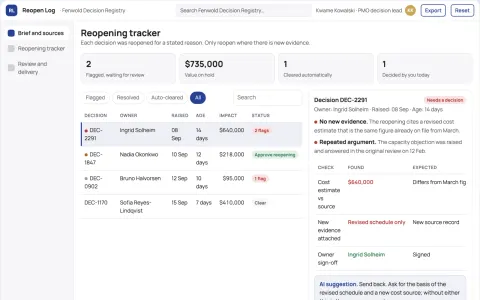
Use a searchable table or visual gallery with filters for the domain’s important attributes. Open each item into a detail drawer containing source records, ownership and history. Put proposed merges and field changes in a separate review queue. Provide a preview before any bulk export. Open with task map; move into backup evidence for the detailed task; finish in documentation plan for review and handoff. Show the source record, uncertainty and approval status beside each proposed output.