
Certification
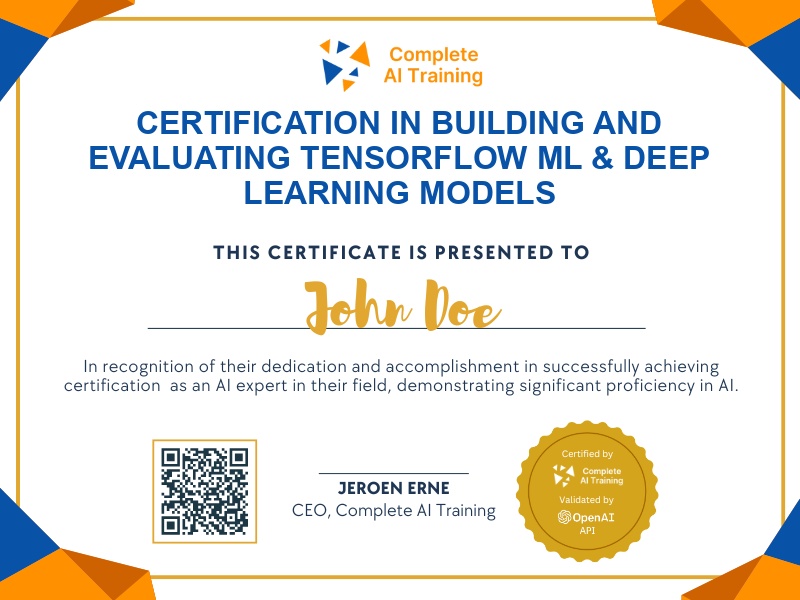
Certification in Building and Evaluating TensorFlow ML & Deep Learning Models
Get certified in Data Science & AI. Prove you can clean messy data, use SQL and web scraping, build TensorFlow ML and deep learning models, run NLP and time series, deploy and monitor MLOps pipelines, and deliver results across industries.
The exam
Take the certification exam
Multiple-choice questions about the course. Pass with 70% or more and your certificate is issued at once, with a public page and an "Add to LinkedIn" button.
What the exam covers
2 questions from each of the 15 chapters of the course
20 multiple-choice questions, drawn fresh for every attempt. Pass with 70% or more.
- 01What is data science40:12
- 02Data science basics and the lifecycle56:51
- 03Statistics and probability92:30
- 04Hypothesis testing52:53
- 05ML and linear regression43:33
- 06Logistic regression48:30
- 07Decision trees45:21
- 08Random forest27:12
- 09KNN and Naive Bayes52:43
- 10SVM and k-means45:37
- 11Apriori29:42
- 12Reinforcement learning and deep learning45:20
- 13Introduction to Keras31:27
- 14Roadmap and analytics vs science47:09
- 15Interview questions51:56
Data Science & AI Beginner Course: ML, Deep Learning, TensorFlow (Video Course) is a hands-on certification that guides you from raw data to deployed models. You'll gain practical skills that drive Increased Productivity, Improved Decision-Making, and a Competitive Advantage, building a Future-Proof Career with Higher Income Potential through Adaptability and Growth. Enroll to turn messy data into decisions in just 12 hours,learn the math that matters, SQL, web scraping, ML, deep learning, NLP, time series, and MLOps, then build, deploy, and monitor models across finance, healthcare, retail, and tech.
This certification covers the following topics:
- The essential math that matters for data science
- SQL for data management
- Web scraping for data collection
- Data acquisition, cleaning, and feature engineering
- Core machine learning paradigms and commonly used algorithms
- Model evaluation, bias-variance, regularization, and classification metrics
- Deep learning and neural networks
- Building and training models with TensorFlow
- Natural Language Processing (NLP)
- Time series forecasting and anomaly detection
- MLOps: deployment, monitoring, and lifecycle management
Jobs this certification suits
Our AI checked this certification against 500 jobs; these get the most out of it. Each job links to its learning path.