
Certification
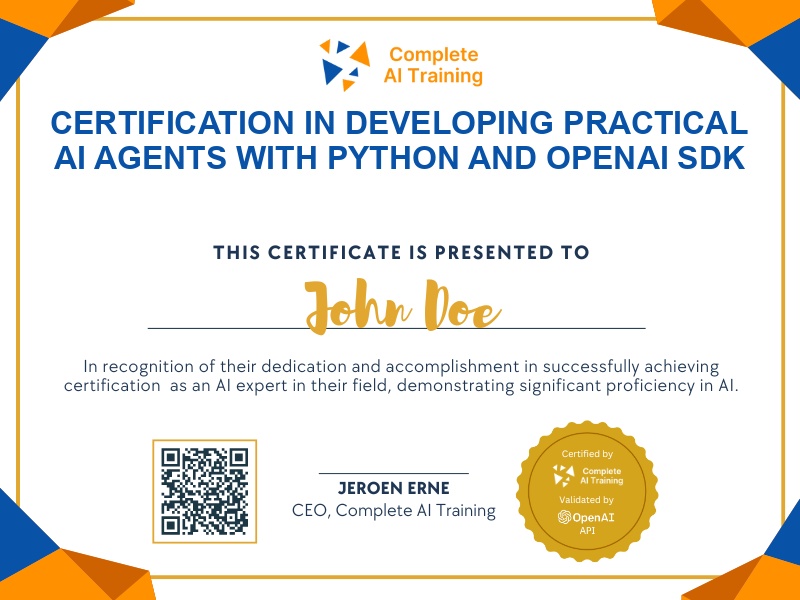
Certification in Developing Practical AI Agents with Python and OpenAI SDK
Get certified in AI Agent Development with Python and demonstrate your ability to build and deploy practical OpenAI-powered agents that automate tasks, adapt to environments, and deliver real solutions to business challenges.
The exam
Take the certification exam
Multiple-choice questions about the course. Pass with 70% or more and your certificate is issued at once, with a public page and an "Add to LinkedIn" button.
What the exam covers
2 questions from each of the 7 chapters of the course
14 multiple-choice questions, drawn fresh for every attempt. Pass with 70% or more.
- 01Are AI agents just hype?1:57
- 02Applications and project ideas2:51
- 03Ways to build an agent2:38
- 04Coding agents1:05
- 05Crash course on agents7:00
- 06Building your first agent36:19
- 07Conclusions1:00
Earn your certification in AI Agent Development with Python and gain the expertise to build intelligent, task-automating agents using the OpenAI SDK. Mastering these skills will boost your productivity, enhance your adaptability in a rapidly evolving field, and open doors to greater career opportunities. Enroll now to future-proof your skill set and create impactful AI-powered solutions.
This certification covers the following topics:
- The Rise of AI Agents: Why They’re More Than Just Hype
- Defining AI Agents: The Anatomy of an Intelligent System
- The Agentic Workflow: How Agents Think Differently
- LLMs and Their Impact on Agent Development
- Challenges and Limitations of Current AI Agents
- Low-Code/No-Code vs. Coding from Scratch for AI Agents
- Using OpenAI’s Agents SDK for Python Development
- Building a Social Media Content Assistant: Step-by-Step Project
- Tracing and Debugging for Reliable AI Agents
- Current Applications and Specialized AI Agents
- Strategies for Building Reliable, Adaptable Agents
Jobs this certification suits
Our AI checked this certification against 500 jobs; these get the most out of it. Each job links to its learning path.