MCP server · Research
UAP Pulse MCP server
by davidmosiah
Let your AI search declassified U.S. government UFO and UAP records and hand you the official source links.
This is a small helper that lets your AI look through a big pile of declassified U.S. government files about UFOs, which are officially called UAPs. The files come from the Pentagon's public releases on war.gov, plus a handful of official cases from other countries. It is handy if you are curious about the topic or you are researching it and want the real documents instead of rumors.
What is an MCP server? The 30-second version
On its own, your AI can only chat with you using what it already learned. An MCP server is a small helper program that gives your AI a new skill or a connection to something outside the chat. This one connects your AI to a set of declassified UAP records from the U.S. government. Once it is connected, your AI can search those files and pull up the official links for you when you ask.
What this MCP server does
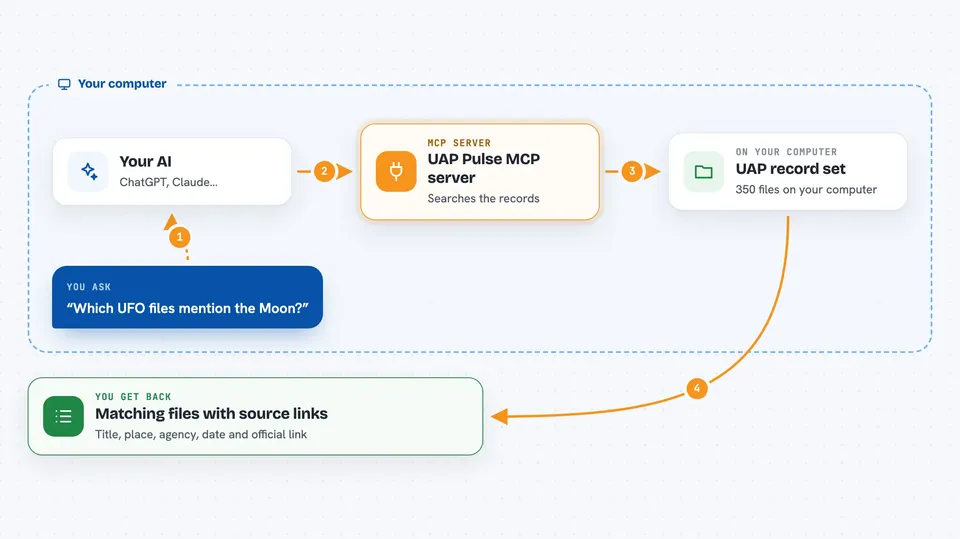
You ask your AI a question about UFO or UAP records, like which files mention a certain place or year. Your AI passes that question to this helper program running quietly in the background. The helper looks through its bundled set of 350 records and finds the ones that match. It sends the matching records back to your AI, including the title, location, agency, date and a direct link to the official source. Your AI then shows you the results in plain language in the chat.
 Click to zoom
What you can do with it
- Search records by release number, agency, type of file, year range or location
- Find incidents near a specific place using latitude and longitude
- Pull up the full record for one file, like pursue-042, with its war.gov link
- Run a ranked keyword search across titles, locations and descriptions
- See the locations with the most declassified records
- Get totals and breakdowns by release, agency, file type and era
- View a timeline of records per decade or year from 1944 to 2026
Try asking your AI
- “What UAP files mention the Moon?”
- “Show me all records from release 4.”
- “Which agencies have the most declassified UAP files?”
- “Give me a timeline of UAP records by decade.”
What it gives back to you
You get back a list of matching records, each with a title, location, agency, date and a link to the official source. Some answers come as counts or breakdowns, like how many files each agency has. Others come as a timeline or a list of hotspots. Everything shows up in the chat as text you can read and click through.
Before you start
What you need
- An MCP client like the Claude desktop app
- Node.js installed on your computer (the free program that runs npx)
Good to know
It only reads the bundled records and does not change anything, but the files are historical government documents, so treat what they say as claims in those files rather than proven facts.
Install it with your AI
Add UAP Pulse MCP server to your AI, no technical skills needed
You don't install anything by hand. You copy one prompt, paste it into an AI that can work on your computer, and it checks, installs and connects the server for you, asking you when it needs something.
Sign in to get the install prompt
Members get a ready-made prompt that lets the Claude desktop app check UAP Pulse MCP server, install it and connect it for them, step by step. You don't need any technical skills: you copy, paste and answer a few questions. Your connected AI can also find and install any of the 4,609 MCP servers here for you.
Who it's for
People who are curious about UFO and UAP history, plus researchers, journalists and students who want to work with the official declassified records.