MCP server · Analytics
André MCP server (French elections)
by joelgombin
Ask your AI about French election results since 1999, down to the polling station, with maps and INSEE data.
This is a helper for your AI that gives it access to French election results from 1999 to 2026, all the way down to the polling station level. It also brings in INSEE population data, the list of elected officials, and official administrative boundaries. It is handy if you work with local politics, journalism, research, or just want to dig into how a town or area votes.
What is an MCP server? The 30-second version
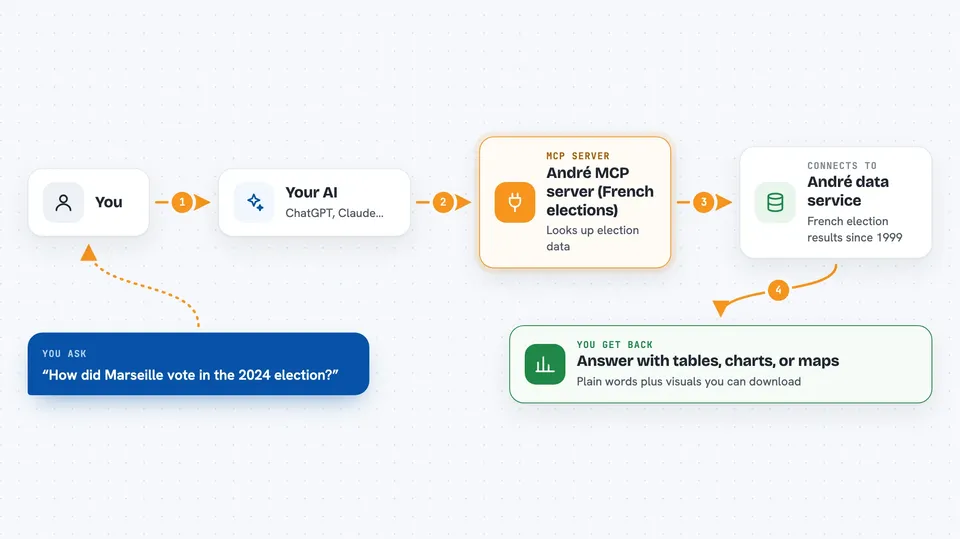
On its own, your AI can only chat with you using what it already learned. An MCP server is a small helper program that gives your AI a new skill or a connection to a service. This one connects your AI to André, a French election data service. Once connected, your AI can look up real election numbers, compare votes, and make maps for you when you ask.
What this MCP server does
You ask your AI a question in plain words, like what happened in a specific town during the last election. Your AI sends that request to this helper, which talks to the André data service. The service looks through 55 French elections, INSEE data, elected officials, and administrative boundaries. Then the answer comes back to your AI, which explains it to you or shows a table, a chart, or a map.
 Click to zoom
What you can do with it
- Look up election results for any French town, department, or polling station
- Compare two elections to see how votes shifted
- Find where a political party has room to gain more votes (vote reserves)
- Cross election results with INSEE population and income data
- See which candidates won in each constituency
- Generate a map of election results for a department
- Export the data as a CSV or JSON file
Try asking your AI
- “Analyse the 2024 legislative results in Marseille”
- “Which communes in Bouches-du-Rhône had the highest abstention in the 2024 European elections”
- “Compare the 2017 and 2022 presidential results in Lyon”
- “Show me a map of the left vote in Gironde in the last election”
What it gives back to you
You get back answers in plain words, plus tables, charts, or maps depending on what you asked. For example, you might see a table of results by polling station, a bar chart comparing two elections, or a map of a department coloured by vote share. You can also ask for the data as a CSV or JSON file to download.
Before you start
What you need
- An AI app that supports MCP servers, like Claude Desktop or Claude Code
- An internet connection (the server is hosted, nothing to install)
Good to know
The server only reads public data and cannot change or delete anything, but very deep analyses may hit Claude's limit of around 15 to 20 tool calls per turn, in which case you just click Continue to resume.
Install it with your AI
Add André MCP server (French elections) to your AI, no technical skills needed
You don't install anything by hand. You copy one prompt, paste it into an AI that can work on your computer, and it checks, installs and connects the server for you, asking you when it needs something.
Sign in to get the install prompt
Members get a ready-made prompt that lets the Claude desktop app check André MCP server (French elections), install it and connect it for them, step by step. You don't need any technical skills: you copy, paste and answer a few questions. Your connected AI can also find and install any of the 4,361 MCP servers here for you.
Who it's for
Journalists, researchers, local government staff, political analysts, and anyone curious about how French towns and neighbourhoods vote.