
AI news ·
$1.4 Trillion Question Puts Sam Altman on Edge as Satya Nadella Backs OpenAI's Big Bet
A blunt $1.4T-vs-$13B question tightened the room; Altman pushed back and Nadella laughed. OpenAI is betting on capacity and multiple revenue engines, with execution to match.
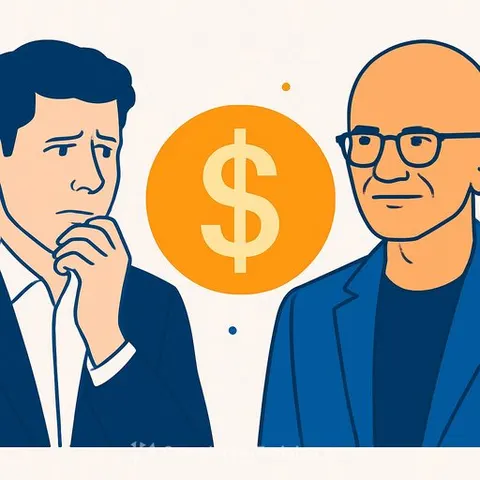
Sam Altman's uneasy moment, a $1.4T question, and why Satya Nadella laughed
A blunt question landed, the room tightened, and Satya Nadella laughed. The prompt: how can OpenAI plan $1.4 trillion in spend with "$13 billion in revenue"? Sam Altman pushed back fast, said the revenue figure was understated, and challenged skeptics directly: if you want to sell, he'll find a buyer.
The message to operators and boards: OpenAI is willing to commit ahead of the curve, confident that its revenue engines can carry the load. The subtext is capital-intensive AI demands conviction, scale contracts, and a high-tolerance appetite for scrutiny.
The spend vs. revenue tension
The friction point was spending on infrastructure at a level most firms would avoid without public-market proof. Altman rejected the premise that OpenAI's current revenue can't support it, insisting the business is bigger than critics assume. He also signaled deep secondary-market demand: "Brad, if you want to sell your shares, I'll find you a buyer."
Translation for executives: in AI, capacity precedes opportunity. If you wait for clean trailing numbers, you lose the next cycle.
Four growth engines OpenAI is betting on
- ChatGPT as a scaled consumer and enterprise product
- An "AI cloud" that competes as a core platform
- Consumer devices tied to assistant use-cases
- AI that automates parts of scientific work to create new value
Altman's stance: revenue is growing steeply across multiple lines, and the company is planning as if that continues. He even said that if OpenAI were public, he'd invite short sellers-clearly confident in the trajectory.
Nadella's read: execution over commentary
Satya Nadella's take was simple: as both partner and investor, he hasn't seen a single OpenAI plan that the team didn't beat. He called the execution "unbelievable," reinforcing that results-not narratives-have carried the relationship this far.
For leaders, that's a signal. A strategic partner with line of sight into your models is vouching for your hit rate. That buys time, capital, and distribution.
Strategic takeaways for executives and boards
- Capacity first, then demand: In AI, compute is the factory. Under-procure and you cap growth. Over-procure and you carry balance-sheet weight-by design.
- Multi-engine revenue: Don't depend on a single product. Build a stack (assistant, platform, device, R&D automation) that reinforces itself.
- Investor narrative matters: If you invest ahead of revenue, be explicit about milestones, unit economics, and the trigger points for unlocking more spend.
- Partnership leverage: The right partner de-risks capex, accelerates distribution, and validates plans in the market.
- Critic-proofing: Expect scrutiny. Prepare clean metrics, cohort performance, and capacity utilization data. Let numbers do the talking.
Board-level questions to pressure test your own AI plan
- What are our leading indicators that justify forward spend-usage, conversion, retention, attach, and gross margin by SKU?
- How much capacity do we need to hit the plan, and what's our staged path to secure it at favorable terms?
- Where does our revenue stack come from in the next 18 months-assistant, API/platform, embedded features, devices, or services?
- Do we have a clear view on cost per inference, efficiency roadmap, and pricing power as models improve?
- What concentration risks exist (vendors, models, channels), and how are we hedging them?
- What's our public narrative, and could we withstand the "short it then" test if we were listed?
What to do next
- Model a 12-24 month capacity plan tied to measurable demand triggers. Pre-sell where possible to reduce cash risk.
- Stand up a multi-product revenue map. Each line should have its own pricing thesis, margin path, and customer proof points.
- Lock strategic partnerships that lower capital intensity and open distribution. Align incentives tightly.
- Publish an internal scoreboard (weekly) that tracks signups, active use, conversion, ARPU, gross margin, and utilization.
- Rehearse the skeptic's argument. Have the receipts ready: cohorts, payback, churn, and capacity utilization.
Why this moment matters
AI is forcing leaders to choose between comfort and scale. OpenAI is choosing scale-publicly. Whether you agree or not, the operating lesson is clear: pick a thesis, tie spend to measurable signals, and move with conviction.
Context links:
If you're structuring AI capability by role across your org, this curated list can help: