From 1984 to AI: PR That Still Works
In 1984, Lori Rosen launched the Rosen Group on a simple premise: use media awareness and thought leadership to build client authority. Decades later, the tools changed, but the core job hasn't-earn meaningful coverage and create momentum that compounds.
A profile in the New York Times carried weight then. It still does. Proof that channels evolve, but credibility endures.
What Hasn't Changed
Good crisis work looks the same today as it did in the 80s. Be proactive, get in front of the story, prep message points, designate a spokesperson, and be transparent.
- Move first: acknowledge the issue and set the frame.
- Align fast: talking points, approvals, and spokespeople locked.
- Tell the truth: clarity beats spin every time.
- Follow through: updates, accountability, and closing the loop.
What Has Changed (And Why It Matters)
Media used to be local and fleeting. Miss a weekly issue of TIME and the moment was gone.
Online changed the half-life of press. Coverage became searchable, shareable, and recirculating. Then social amplified it across platforms, multiplying reach and impact. PR moved from one-and-done hits to assets that continue to work.
For Agency Leaders: How to Break Through
If you're not already the default source, safe is invisible. You need a point of view that makes editors and audiences lean in.
- Take a stance. Say what others won't-backed by evidence and earned insight.
- Be a thoughtful contrarian. Challenge trends, offer a better frame, bring data or case studies.
- Favor quality over quantity. The right audience beats a bigger but irrelevant one.
- Say yes to formats that stretch you: op-eds, contributor roles, podcasts, panels.
- Deliver consistently. Show up on schedule and editors will come back.
- Remember: media begets media. One strong hit seeds the next.
Agency leaders can also build organizational AI strategy and leadership through the AI Learning Path for Business Unit Managers, which helps align AI capabilities with PR and marketing goals.
Google vs. AI: Which Shift Matters More?
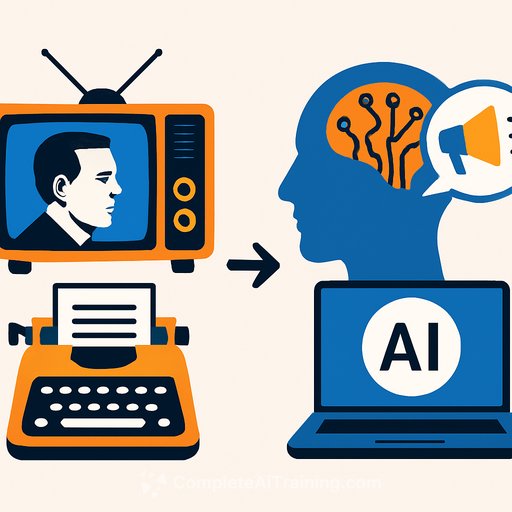
Both changed how we find and publish information. But zoom out: AI edges it. It's reshaping how we write, research, ideate, produce, and distribute-and how newsrooms work at every step.
Google laid the rails; AI accelerates everything riding on them. Still, the fundamentals hold: clear positioning, timely angles, and relationships built on trust.
What's Next for Media
Expect healthy growth across independent media and newsletters-on platforms like Substack, YouTube, Beehiiv, and whatever is next. Journalists are resilient, and audience-supported models keep getting smarter.
The pendulum will swing: more independents will move back into larger newsrooms, while legacy outlets adopt startup-like models. We're already seeing it: Status (launched in 2024) is hiring and scaling, and The New Yorker is experimenting with newsletter plays. Net result: more viable paths to reach focused audiences.
And AI won't replace a source-building reporter. As Jeff Zucker put it, it won't meet someone in an underground garage and break stories. That human edge is why journalism will stay vital-and why great PR still wins.
What To Do Now
- Refresh your crisis plan. Test your rapid-response workflow quarterly.
- Define a sharp POV. Write three contrarian takes your competitors won't touch.
- Build a contributor cadence. Pitch one column series and ship on time.
- Stretch distribution. Cross-promote every hit across owned, earned, and social.
- Set up measurement that matches permanence: track search lift, referral traffic, and repurposed impressions over time.
- Level up your AI literacy-take AI Research Courses for research, drafting, angle testing, and media monitoring; these skills make workflows faster and better.
If you want a structured path to upgrade AI skills for PR and marketing, explore the AI Certification for Marketing Specialists.
Bottom Line
The channels change. The principles don't. Be bold, be useful, be consistent-and your coverage will compound.
Your membership also unlocks: