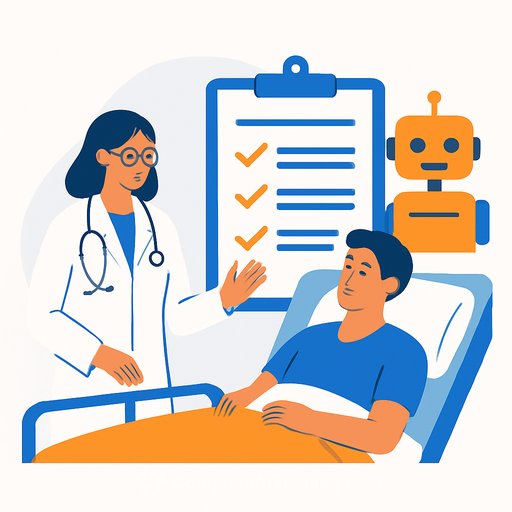
2025's AI policy wave hits healthcare
By mid-2025, most states were either passing or drafting rules for AI in healthcare. Federal agencies are also moving, setting expectations for transparency, patient safety, and accountability. The message is clear: AI that touches care must earn its place at the bedside.
The catch is that policy doesn't always match clinical reality. Depending on how rules are written and implemented, they can remove friction-or add it. Your job is to make sure they do the former.
Why lawmakers care
AI tools are no longer pilots or novelties. They summarize charts, draft notes, flag gaps, and answer patients at midnight. That influence carries risk-clinical, operational, and reputational-so regulators want proof that the tech works across populations and doesn't create new harms.
What new rules are asking for
- Transparency: Tell patients and clinicians when AI is involved, and what data sources influenced its output.
- Fairness testing: Evidence that models perform consistently across demographics and clinical subgroups.
- Accountability: Clear lines of responsibility if an AI suggestion contributes to a bad outcome.
- Safety controls: Human oversight, audit logs, and a path to escalate or disable tools that misbehave.
- Documentation: Model purpose, limitations, known failure modes, monitoring plan, and change history.
Where policy meets practice
AI can help: pre-visit summaries surface what matters, and ambient note capture gives clinicians more time to listen. Patients feel the difference when the screen doesn't steal the visit. But privacy, data use, and validation still need to be airtight-especially for tools that touch PHI.
Practical steps for health systems now
- Stand up AI governance: Clinical, compliance, privacy, security, risk, and patient safety at the same table.
- Create a model inventory: Track purpose, datasets, version, owner, risk level, and where it lives in workflow.
- Risk-tier your use cases: High-risk = clinical recommendation or triage; low-risk = admin support. Calibrate controls accordingly.
- Bias and safety evaluation: Test performance across age, sex, race/ethnicity, language, insurance status, and comorbidities.
- Human-in-the-loop by default: Clinicians review and sign off on anything that could steer care.
- Disclosure templates: Plain-language notices for patients and staff when AI is used.
- Monitoring and incident response: Drift detection, quality checks, and a fast path to rollback.
- Training: Teach clinicians how to use, verify, and override AI. Document competencies.
Vendor due diligence checklist
- BAA and data rights: Will PHI be used to train or improve models? Opt-out options? Data residency?
- PHI flow map: Where data is stored, processed, and transmitted; encryption in transit/at rest; key management.
- Retention and deletion: Default timelines, secure deletion guarantees, and customer-controlled policies.
- Access controls: Role-based access, least privilege, SSO, and audit logging for all actions.
- Performance by subgroup: Provide metrics and known limitations backed by real-world evidence.
- Change control: Versioning, release notes, and approval gates for model updates.
- Monitoring: Real-time error rates, safety signals, and alerting; customer visibility into logs.
- Liability and support: Indemnification, response SLAs, and a named clinical safety officer.
Privacy and PHI: questions for ambient and summarization tools
- Is audio transcribed on-device or in the cloud? Is streaming used? Where are files stored?
- Are recordings kept? For how long? Can we disable retention entirely?
- Is PHI used to fine-tune models? If so, how is it segregated and audited?
- What redaction methods are applied? Can we verify with samples?
- How are patient consents captured and honored across visits and devices?
Clinical value that survives scrutiny
Pre-visit summaries reduce chart diving and bring context to the room. Ambient documentation returns time to patient conversation. These gains are real, measurable, and achievable-if privacy, fairness, and oversight are built in from day one.
Federal signals to watch
- FDA work on AI/ML-enabled medical devices for safety expectations and change-control concepts.
- ONC's HTI-1 rule for transparency and decision support disclosures inside EHR-certified tech.
Action plan for the next 90 days
- Publish an AI policy that covers procurement, evaluation, clinical use, and off-label experimentation.
- Inventory every AI-enabled feature already live in your EHR and point solutions.
- Run a bias and safety check on at least one high-impact model and present results to governance.
- Pilot an ambient tool with strict PHI controls and a clear success metric (minutes saved, note quality, patient experience).
- Standardize patient and staff disclosures; add them to intake and clinician workflows.
Bottom line: AI can reduce admin load and improve the visit. It also increases your duty to prove safety, fairness, and accountability. Do the groundwork now so your teams can use the tools with confidence-and your patients can trust the outcomes.
Need focused upskilling for clinical, compliance, and IT teams? Explore role-based options here: Complete AI Training - Courses by Job.
Your membership also unlocks: