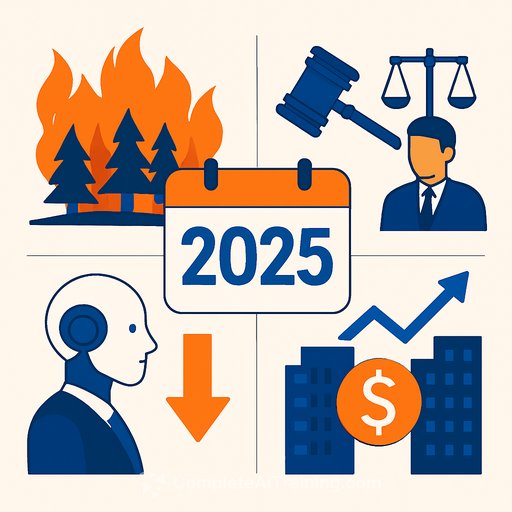
Wildfires, Lawsuits, AI, and M&A: Insurance's Defining Themes in 2025
2025 pressed the industry on every front. Historic wildfire and flood losses, sharp shifts in litigation trends, mega-broker deals, cyber outages, AI-driven workforce changes, and tariff pressures all moved from headlines to balance sheets.
Here's what mattered-and what to do about it going into 2026.
Climate Losses: Wildfires, Floods, and Parametrics Go Mainstream
California's wildfire season is set to produce large economic and insured losses again. Texas floods reinforced the state's status as a crisis epicenter for severe convective storms and inland flood risk. Jamaica's catastrophe bond trigger put a spotlight on parametric structures as fast, objective capital for governments and carriers.
Practical next steps:
- Recalibrate PMLs with fresh event sets and exposure drift; tighten aggregate control at the ZIP+4 and sub-peril level.
- Expand parametric and micro-deductible options for high-volatility geographies; pre-clear claims playbooks to speed relief.
- Push mitigation: defensible space, home hardening, roof age rules. Incentives beat moratoria for long-term stability.
- Lock reinsurance early; blend rated paper, ILS, and cat bonds to stabilize net volatility.
For macro context on US weather losses, see NOAA's data on billion-dollar disasters here.
Litigation Tightens: Georgia's Surge, Florida's Shift, New York's Push
Georgia saw a rush of filings ahead of new litigation limits-echoing Florida's pre-reform surge. Early Florida indicators look better: reduced assignment-of-benefits abuse and more rate stability. In New York, stakeholders-including rideshare-are pressing for reforms to address commercial auto and general liability costs.
What to change now:
- Price venue risk explicitly. Use county-level factors and verdict trend data in both GL and auto.
- Update defense panels and settlement authority bands to respond faster to nuclear verdict risk.
- Negotiate structured settlements earlier; track plaintiff bar tactics by venue.
- Educate agents and insureds on documentation and incident reporting to cut frictional cost.
Florida's Property Market: Quiet Momentum Beneath the Surface
Citizens is no longer Florida's largest property insurer-a sign that private capital is creeping back. That doesn't mean a return to 2018 pricing. It means measured growth where homes are hardened, roofs are younger, and deductibles align with peril frequency.
Actions to consider:
- Grow through curated takeouts with tight inspection and roof age rules.
- Pair HO with admitted flood or parametric wind to control retention and improve policy stickiness.
- Use renewal reunderwriting to reward mitigation and clean books without surprise churn.
M&A and Talent: Scale vs. Specialization
Brown & Brown's plan to acquire Risk Strategies and One80's parent for $9.8B signals more concentration at the top of brokerage. At the same time, Marsh is suing Aon and a former leader over a 20-person surety team exit-proof that niche talent remains the real asset.
Broker and carrier takeaways:
- Expect portfolio reshuffles: market clout rises, but placement strategies and niches will shift.
- Defend relationships with service-level guarantees, market access roadmaps, and coverage innovation.
- Retain specialists: career paths, comp tied to profitable growth, and succession plans matter more than ever.
Cyber and Ops Resilience: Outages Are Everyone's Problem
Erie and Philadelphia Insurance continued work to restore networks-another reminder that carriers, MGAs, and vendors are joined at the hip. Downtime hits service KPIs, claims cycle time, and even regulatory timelines.
Make the basics non-negotiable:
- Segment networks, enforce MFA everywhere, rotate keys, and test backups for full restore.
- Run red-team exercises with claims and billing in scope; rehearse executive communications.
- Map vendor dependencies; require timelined incident response commitments in contracts.
AI and Workforce: Productivity Gains, Real Human Impact
Acrisure is laying off about 400 employees, citing tech advancements and AI integration. Expect more carriers and brokers to reassign or reduce roles in processing-heavy functions as copilots move from pilots to policy.
What to do now:
- Target use cases with clear ROI: intake, summarization, subrogation cues, FNOL triage, bordereaux checks.
- Stand up model governance: PII handling, prompt logs, human-in-the-loop, and audit trails.
- Upskill teams before redeploying work. Change management beats surprise pink slips.
If you're building skills for AI-enabled roles, see AI Productivity Courses for curated training paths.
Tariffs and Costs: Inflation Isn't Done With Us
AM Best flagged tariffs as a negative for insurers, flowing through to parts, materials, and claims severity. Commercial auto, inland marine, and property are in the splash zone.
Immediate moves:
- Refresh severity curves quarterly for parts and labor; adjust ILFs and deductibles accordingly.
- Renegotiate DRP and vendor terms with surge pricing clauses and quality controls.
- Accelerate salvage and total-loss decisions to cut storage and rental leakage.
AM Best's site is a solid reference point for market outlooks and sector notes: ambest.com.
Signals Heading Into 2026
- Capacity: Reinsurance is available but selective; earlier placements and diversified panels will win.
- Rates: Adequate in many property lines, still climbing in challenged GL and auto segments.
- Litigation: Venue-specific. Florida stabilizing; watch Georgia and parts of the Midwest.
- Cat risk: Secondary perils drive volatility; mitigation and parametrics move from "nice" to "need."
- Ops: AI expands. Winners pair workflow redesign with guardrails and human oversight.
Quick Checklist for Leaders
- Re-underwrite cat aggregates; tighten UW guardrails where attritional losses hide.
- Codify a litigation playbook per venue; measure defense outcomes like a P&L.
- Commit to cyber readiness drills that include business teams, not just IT.
- Stand up an AI council to own risk, ROI, and training across functions.
- Model tariff scenarios into rate filings and renewal strategies.
2025 forced hard choices. 2026 rewards the firms that act on them-with better risk selection, cleaner operations, and teams built to use new tools responsibly.
Your membership also unlocks: