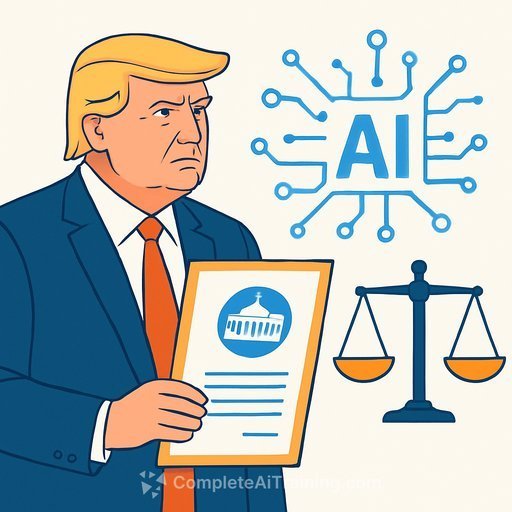
State AGs oppose FCC bid to preempt state AI laws
On December 17, 2025, a bipartisan coalition of 23 Attorneys General submitted comments to the Federal Communications Commission (FCC) opposing any attempt to preempt state laws governing artificial intelligence. Their message was direct: the FCC lacks authority to displace state AI statutes, and doing so would harm consumer protection and state interests.
The signatories represent Arizona, California, Colorado, Connecticut, Delaware, Hawai'i, Illinois, Maine, Maryland, Massachusetts, Minnesota, Nevada, New Jersey, New Mexico, North Carolina, Oregon, Rhode Island, Tennessee, Utah, Vermont, Washington, Wisconsin, and the District of Columbia. The letter responds to an FCC notice of inquiry issued in September signaling potential preemption.
Context: a federal push for a lighter-touch AI regime
Six days before the AGs' filing, President Trump signed Executive Order 14365 (December 11, 2025). It directs the Secretary of Commerce to evaluate state AI laws, flag "onerous" provisions that conflict with the administration's policy of minimal federal burden, and, "to the maximum extent allowed by Federal law," make states with such laws ineligible for certain non-deployment funds.
That move raises the stakes. Even without a sweeping federal statute, the administration is testing whether conditional funding and agency action can pressure states to step back from stricter AI rules.
The core legal dispute: can the FCC preempt here?
The AGs argue the FCC's authority does not extend to wholesale preemption of state AI regulation. Preemption requires clear congressional authorization or a conflict that makes compliance with both federal and state law impossible or frustrates federal objectives. The letter leans on classic federalism principles: states retain police powers to protect consumers, and there is a strong presumption against preemption in areas of traditional state concern.
Expect challengers to invoke recent Supreme Court signals limiting agency overreach in matters of vast economic and political significance. A preemption attempt that sweeps beyond communications-specific concerns into broad AI governance will draw "major questions" scrutiny, on top of Administrative Procedure Act challenges.
Why AGs are pushing back
State enforcers see the front lines of AI harms through consumer complaints, investigations, and local enforcement actions. As California AG Rob Bonta put it, states have built privacy and technology safeguards to address risks in automated decision-making, and they're well-positioned to spot and respond to emerging threats quickly.
Giving one federal agency veto power over diverse state frameworks would blunt those tools. That's the essence of the coalition's case.
Legislative backdrop: prior preemption efforts stalled
This letter follows a November effort by 36 AGs urging Congress to strip a preemption provision from the National Defense Authorization Act. That provision did not make the final bill. Earlier in May 2025, a proposal to impose a 10-year freeze on state AI lawmaking also failed.
Translation: the votes aren't there for broad statutory preemption, so the battle has shifted to agencies and executive action.
Executive Order 14365: funding leverage and legal risk
The EO's directive to identify "onerous" state laws and condition funding is likely to face challenges. Conditional spending must be clearly stated, related to the federal interest, and not coercive. The EO's "to the maximum extent allowed by Federal law" caveat signals awareness of those limits, but it won't insulate a sweeping funding penalty from litigation.
For state recipients, the practical question is how agencies define "onerous" and what programs count as "non-deployment funds." Watch the Commerce Department's evaluation and any follow-on policy notice closely-timelines point to action within 90 days of the EO.
What this means for legal teams
- Do not assume preemption will wipe the slate clean. Multi-jurisdiction AI compliance is the base case for 2026.
- Inventory applicable state AI and automated decision-making obligations now. Prioritize risk areas tied to consumer protection, bias, disclosures, and high-risk use cases.
- Tighten vendor governance. Bake AI-specific representations, testing/monitoring duties, data provenance, bias mitigation, incident notice, and audit rights into contracts.
- Strengthen model and feature release gates. Require documented risk assessments, human oversight plans, and rollback triggers for high-impact systems.
- Prepare for AG scrutiny. Stand up complaint intake channels, maintain decision logs, and preserve evidence of reasonable safeguards and post-deployment monitoring.
- Track federal funding exposure. If you rely on programs that could be conditioned by the EO, coordinate with grants and public affairs teams before new commitments.
- Coordinate with IT and executive leadership to align legal, risk, and operational controls-CIOs play a key role in governance and deployment strategy: AI Learning Path for CIOs.
What to watch next
- FCC's next procedural step. An advance notice or NPRM focused on preemption will draw intense comments and likely immediate litigation. For a refresher on where an NOI fits in the process, see the FCC's rulemaking overview: FCC Rulemaking Process.
- Commerce's 90-day evaluation under the EO. Definitions and criteria for "onerous" will signal how aggressive funding conditions might be.
- State legislative sessions. Expect more bills addressing high-risk AI, transparency, and consumer remedies, especially in AG-led states.
- Early test cases. Watch for suits asserting ultra vires action, lack of clear congressional authorization, Tenth Amendment principles, and Spending Clause limits.
Bottom line
The federal-state fight over AI governance is here. The administration favors minimal federal constraints; AGs are asserting states' consumer protection powers. Until courts or Congress say otherwise, plan for layered obligations and build documentation that shows your AI program is reasonable, tested, and defensible.
If your legal team needs to level up AI fluency to support policy and contract work, consider role-focused training such as the AI Learning Path for Regulatory Affairs Specialists.
Your membership also unlocks: