What Makes a Good AI Prompt? 4 Expert Tips
As AI tools like ChatGPT and Copilot become part of daily workflows, companies increasingly value employees who can work effectively with AI. Being able to prompt well, think alongside AI, and boost productivity is quickly becoming as essential as traditional office software skills once were.
We’ve all encountered generic, shallow responses from AI chatbots. The issue isn’t the AI itself—it’s the prompt. AI models predict the most common answer based on patterns learned from vast data. Without clear instructions, you’re likely to get a bland reply, like ordering “something good” at a restaurant and ending up with the default chicken.
Crafting Better Prompts
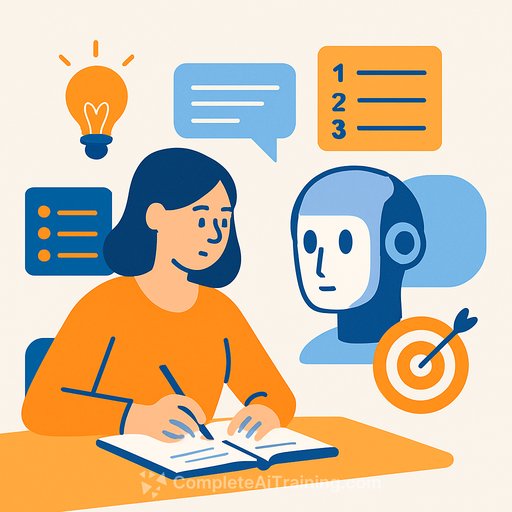
You might have heard the term “prompt engineering” and imagined complex scripting. In reality, it’s about clear communication. Today’s chatbots understand natural language well, so focus on what you say, not how you say it. A simple, structured prompt can deliver much better results. Try using the CATS approach:
- Context: Give the AI background details. Instead of “How do I write a proposal?” say “I’m a nonprofit director writing a grant proposal to a foundation funding environmental education for urban schools.” Add relevant documents or constraints to clarify.
- Angle: Specify the perspective or tone. Ask the AI to “Act as a critical peer reviewer to find weaknesses” or “Be a supportive mentor improving my draft.” This guides the kind of response you get.
- Task: Be precise about what you want. “Help me with my presentation” is vague. But “Give me three ways to make my opening slide more engaging for small business owners” is clear and actionable.
- Style: Define the format and voice. Do you want a formal report, a casual email, bullet points, or an explanation suitable for teenagers? Specify if it should be technical, conversational, or engaging.
Getting these four elements right can transform the AI’s output from generic to useful.
Context is Everything
Beyond the prompt itself, managing the surrounding information—called “context engineering”—matters a lot. This includes the AI’s memory of prior conversation, uploaded documents, instructions before the task, or examples of desired output.
Think of prompting as a back-and-forth conversation. If the first answer isn’t what you want, ask for clarification, request changes, or add more info. Don’t expect a perfect reply immediately. Use the AI to spark your ideas. If you get stuck, copy good parts into a new session and ask it to summarize or build on them.
Keep Your Wits About You
AI chatbots feel conversational and human-like, but remember: you’re the one thinking critically. Always verify facts and check for errors. AI can offer vast, generic knowledge, but it needs your input to make it relevant to your specific situation. Provide enough context, and AI can be a surprisingly helpful assistant.
If you want to improve your prompting skills and AI fluency for your job, consider exploring dedicated courses to sharpen these abilities. For more practical courses on AI and prompt engineering, check out Complete AI Training’s prompt engineering courses.
Your membership also unlocks: