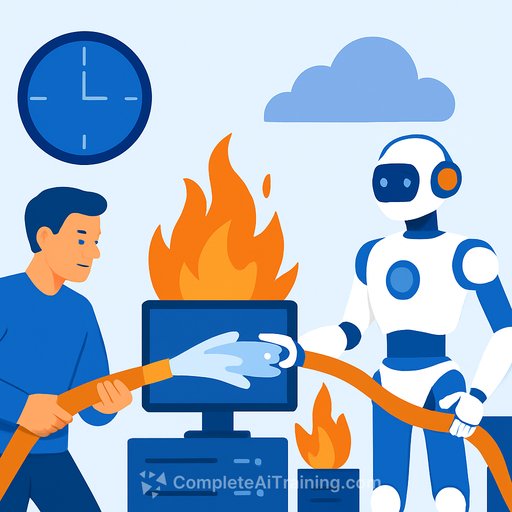
The 7 Non-Negotiables of AI-Driven Operations
Always-on experiences are the baseline. Meanwhile, incidents are spiking, systems are sprawling and headcount is flat. That's why AI and automation now sit at the core of modern incident response - cutting MTTR, shrinking downtime and keeping customers online.
IDC estimates that by the end of 2025, 67% of enterprise AI investment will be embedded in core operations. Budget alone won't move your metrics. Impact comes from disciplined execution and clear measurement.
How to use this scorecard
Review each non-negotiable. Score yourself with the checklist. Prioritize the gaps that move MTTR, customer impact minutes and incident volume within the next 90 days.
1) True end-to-end incident management
Detection, triage, engagement, diagnosis, remediation and learning - in one flow. Fragmented tools create handoff delays and data loss. Your stack should route work to the right owner, attach context automatically and capture everything for learning.
Scorecard:
- Single incident timeline from alert to post-incident review
- On-call coverage with clear ownership and auto-escalation
- Runbooks linked to services and callable from incidents
- Post-incident reviews completed within 5 business days
2) Signal intelligence and noise reduction
Alert floods hide real issues. AI should correlate, deduplicate and enrich events so responders see a small set of high-signal incidents instead of hundreds of pings. Less noise, faster action.
Scorecard:
- Alert-to-incident compression ratio (e.g., 20:1 or better)
- False-positive rate under 10%
- Actionable alerts per service per day trending down
- Context enrichment (top logs, metrics, changes) added automatically
3) Automated triage, routing and runbook execution
Humans decide; machines do the repetitive work. Use automation to classify incidents, assign owners, add context and trigger safe, pre-approved runbooks. Save human focus for analysis and decision-making.
Scorecard:
- ≥60% of incidents auto-triaged and routed without manual effort
- First response under 2 minutes for P1/P2
- Runbook success rate ≥90% with rollback on failure
- Toil minutes per incident trending down month over month
4) AI-assisted root cause and change intelligence
Most incidents tie back to change. Use AI to correlate symptoms with recent deploys, config updates, feature flags and infra drift. Surface the most likely cause and the safest next step fast.
Scorecard:
- Time-to-first-hypothesis under 5 minutes
- % of incidents with a linked change or config as primary factor
- Blast radius estimation available for major changes
- One-click rollback or flag disable where applicable
5) SLO-driven operations and measurable ROI
Reliability is a business metric. Tie AI/automation to SLOs, error budgets and customer impact minutes. Track MTTR, MTTD, incident count and cost per incident so you can prove value, not just activity.
Scorecard:
- Clear SLOs per critical service with shared dashboards
- MTTD and MTTR improving quarter over quarter
- Incident minutes impacting customers trending down
- Automation ROI tracked (hours saved, cost avoided)
6) Governance, guardrails and human-in-the-loop
Automation should be safe by default. Require approvals where risk is high, enforce least privilege and keep full audit trails. Humans stay in control; AI accelerates the work.
Scorecard:
- Risk-tiered automation with approvals and time-boxed access
- End-to-end audit logs for alerts, actions and changes
- Model performance and drift reviews at set intervals
- Privacy and data retention policies applied to incident data
7) Open, extensible and vendor-neutral integration
Your operations brain should plug into anything: observability, CI/CD, ITSM, chat, feature flags and cloud. Open APIs and event streams keep you flexible as your stack evolves.
Scorecard:
- Bi-directional integrations with monitoring, CI/CD and ticketing
- No manual copy-paste between tools during incidents
- Service catalog as the source of truth for ownership and dependencies
- Mean time to integrate a new tool measured in days, not weeks
Common traps that stall impact
- Vanity AI: pilots with no SLO, no control group and no baseline
- Alert theater: more dashboards, same response time
- Automation sprawl: scripts without ownership, tests or audits
Your 30-60-90 day plan
Days 1-30: Baseline MTTR, MTTD, alert volume and customer impact minutes. Map ownership. Enable alert deduplication and correlation for top 5 services.
Days 31-60: Automate triage and routing. Attach change data to incidents. Convert the top 10 manual runbooks into safe, revertible workflows.
Days 61-90: Roll out SLOs and error budgets. Add guardrails and audits. Review ROI and retire low-value alerts and automations.
Helpful references
Upskill your team
If you're formalizing AI-driven incident response, structured training helps. Explore role-based options and hands-on certifications focused on automation and operations.
AI in operations is about results, not optics. Measure what matters, wire it into your incident flow and let the numbers tell you what to fix next.
Your membership also unlocks: