76% of Americans Oppose Unrestricted AI Surveillance Access, But Congress Remains Inactive
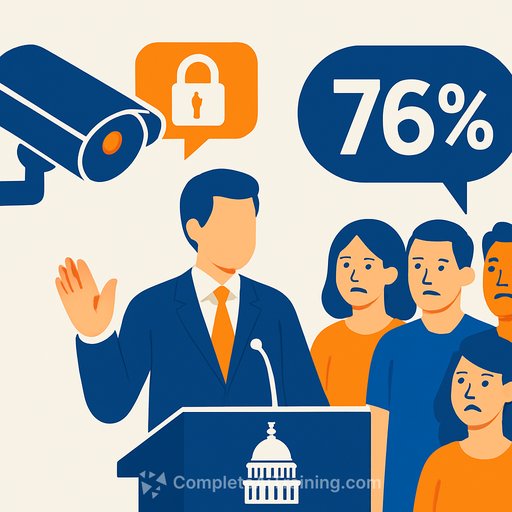
A majority of Americans understand the stakes of government AI surveillance better than most of Washington. A poll from Americans for Responsible Innovation found that 76% of Americans oppose allowing the government to force AI companies to hand over unrestricted access to their technology for surveilling citizens.
Yet Congress has taken no action to protect Fourth Amendment rights as the debate intensifies. The question facing policymakers is straightforward: should fundamental constitutional protections depend on the terms of service written by technology companies?
The Divergence Between Companies
Anthropic refused a Department of Defense contract for frontier AI use in mass domestic surveillance and autonomous weapons. OpenAI accepted the work, stepping in to replace Anthropic after the backlash.
Sam Altman acknowledged the rollout was "rushed" and "the optics don't look good." That understatement masks a larger structural problem: frontier AI model companies are only one piece of the surveillance infrastructure.
Infrastructure Is Where Surveillance Lives
Microsoft provides the cloud infrastructure powering OpenAI's government work. Every Pentagon query through GPT, every bulk data analysis, and every AI-assisted profile of an American citizen runs on Microsoft's Azure cloud. The company confirmed on February 27 that Azure remains the exclusive cloud provider for OpenAI's APIs, including government collaborations.
Other companies like Palantir build surveillance tools using these models. Palantir signed a reported billion-dollar contract with the Department of Homeland Security.
When The Guardian reported in February that Immigration and Customs Enforcement tripled its data storage on Azure in six months-from 400 terabytes to nearly 1,400 terabytes-while deploying Microsoft's AI tools to search images and video, Microsoft's response was minimal. The company said its policies "do not allow" mass surveillance and claimed it does "not believe ICE is engaged in such activity."
Microsoft took a different stance in Israel. Last September, the company terminated Azure access for an Israeli military intelligence unit after reporting confirmed the platform was being used for mass surveillance of Palestinians. Brad Smith, Microsoft's president, declared that Microsoft prohibits its technology from being used for mass surveillance of civilians "in every country around the world."
Terms of Service Cannot Stop Government Surveillance
Legal experts have explained why OpenAI's revised contract language is insufficient. The operative standard-"consistent with applicable law"-allows the U.S. government to accommodate sweeping surveillance programs under existing law.
The same problem applies to Microsoft and Amazon's terms of service. These standards have not substantially changed since Edward Snowden revealed the National Security Agency was conducting mass digital surveillance. Amazon is now extending this surveillance network into the physical world through its Ring service.
These companies' positions are strategically convenient and profitable. They are untenable for everyone else.
Congressional Action Required
The public consensus on this issue is rare in American politics. The 76% opposition cuts across partisan lines. That kind of agreement should prompt Congress to act.
For government professionals working on policy, the challenge is clear: understanding AI governance frameworks is essential to addressing these gaps. Companies like Microsoft, Amazon, and frontier AI firms should expect legislative scrutiny.
The alternative is a surveillance system at a scale that exceeds anything currently in operation. Americans have signaled they do not want to live in that world.
Your membership also unlocks: