Most Japanese Teens Now Use Generative AI-What Schools Should Do Next
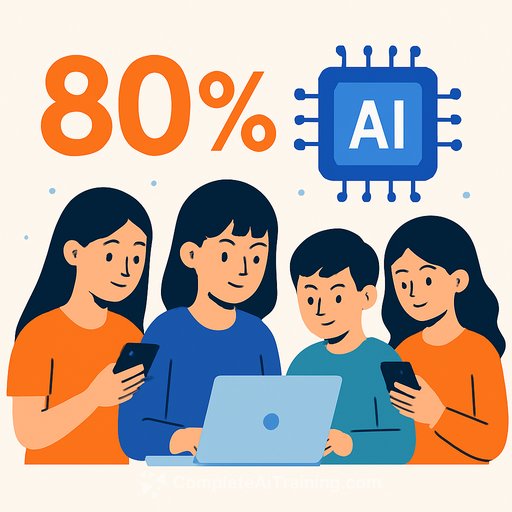
Generative AI is now part of daily life for students in Japan. A nationwide survey of 1,200 junior high and high school students in January 2026 found that nearly 80% use tools like ChatGPT or Gemini "frequently" or "occasionally."
Girls report heavier use: 46.8% of girls use AI "frequently," compared to 36.0% of boys. The survey was conducted by Kankō Gakuseifuku, a school uniform manufacturer.
What students are using AI for
Schoolwork leads. Over 70% use AI to check information for assignments and study. Many also lean on AI to get "hints" on how to think through a task or structure an answer.
Junior high students are more likely than high schoolers to use AI for hobbies, play, and casual chats. That difference matters for how you set rules by grade level.
AI as a sounding board-especially for girls
The sharpest gender gap shows up in advice and conversation. 49.9% of girls use AI to get advice or talk things through, more than double the rate among boys (23.0%).
For some students, AI is a low-pressure way to organize thoughts and share worries. That's a cue to pair AI guidelines with clear pathways to counselors and trusted adults.
How students use AI to study
- Idea scaffolding: The top use is getting hints on approaches, outlines, and structure.
- Writing support: Editing and proofreading short texts is common.
- Fact-finding: Quick lookups to check or expand on information.
- Full answers: About 20% say they rely entirely on AI for answers or calculations.
Just under 10% don't use AI for schoolwork or can't because their school prohibits it. Policies are still split across campuses.
What schools should do now
- Set clear guardrails: Define what's allowed (brainstorming, outlining, proofreading) and what isn't (submitting AI's final answer).
- Require visible thinking: Ask students to submit sources, drafts, and a brief explanation of their approach alongside any AI-assisted work.
- Teach verification: Show students how to fact-check AI outputs and compare multiple sources.
- Design resilient assessments: Use more oral checks, in-class writing, and multi-step projects to reduce copy-paste risks.
- Protect privacy: Prohibit uploading personal data or restricted school materials to public tools.
- Address wellbeing: Since many students-especially girls-use AI for advice, set boundaries and point to human support.
- Ensure access: Provide school-managed tools or time so policies don't disadvantage students without home access.
Practical ways to use AI in class
- Have AI generate two or three outline options for an essay, then students choose and refine one.
- Use AI to proofread a draft, but require students to highlight edits they accept and explain why.
- For math, ask AI for a step-by-step explanation-students then verify steps and correct any errors.
- Role-play practice (e.g., interviews, debates) with AI, followed by an in-person performance.
Policy snapshot from the data
Usage is widespread, motives are mixed, and a meaningful share of students fully outsource answers. Bans push use into the shadows; clarity and skill-building bring it into accountable practice.
Resources
- OECD: AI in Education - policy guidance and research.
- AI Learning Path for Teachers - practical steps to integrate and manage AI in K-12 classrooms.
About the survey
Survey of 1,200 junior high and high school students across Japan, conducted in January 2026 by Kankō Gakuseifuku. Data reflect self-reported use of generative AI tools such as ChatGPT and Gemini for schoolwork and free time.
Your membership also unlocks: