A11yShape helps blind and low-vision programmers build and check 3D models independently
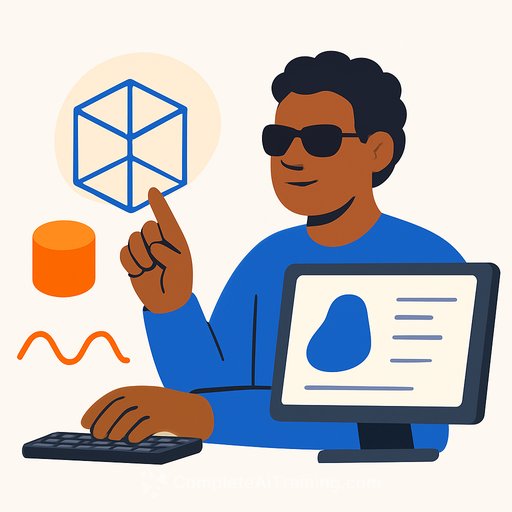
Researchers at The University of Texas at Dallas and collaborators have introduced A11yShape, an AI-assisted tool that makes 3D modeling workable for programmers with visual impairments. The system gives developers a way to create, edit, and verify complex models without relying on sighted colleagues.
Led by Dr. Liang He in the Erik Jonsson School of Engineering and Computer Science, the team set out to remove a recurring bottleneck: verifying geometry accurately when you can't see the screen. The approach focuses on synchronization between code, model views, and natural-language feedback so users can iterate with confidence.
How A11yShape works
- Code-first workflow in OpenSCAD: developers write parametric code and generate 3D models. Learn more about OpenSCAD at openscad.org.
- Multi-angle snapshots: the tool captures images of the rendered model from several viewpoints.
- Model descriptions: using GPT-4o and the code context, A11yShape produces detailed, structured descriptions of shapes, proportions, and relationships.
- Tight synchronization: as code changes, the descriptions and 3D rendering update in step, reducing guesswork.
- Conversational assistant: a built-in chatbot answers questions about geometry, points out inconsistencies, and explains the impact of edits.
Why it matters for teams and research
A Stack Overflow survey estimates that 1.7% of programmers have visual impairments. Many rely on screen readers and Braille displays, which are strong for code but less helpful for verifying spatial details in 3D.
A11yShape closes that gap. It gives developers a reliable way to check shape, scale, and alignment through text, making iterative modeling feasible without outside help. For labs and companies, that means fewer blockers, better autonomy, and more inclusive workflows.
From research to practice
The work was presented at ASSETS 2025, the Association for Computing Machinery's conference on accessible computing, in Denver. Conference information is available via ACM SIGACCESS: SIGACCESS ASSETS.
Collaborators include researchers from the University of Washington, Purdue University, Stanford University, the University of Michigan, MIT, The Hong Kong University of Science and Technology, and Nvidia. The UT Dallas Design & Engineering for Making Lab also produced a demonstration video showing the workflow.
Early testing
Four programmers with impaired vision used A11yShape to independently create and modify models of robots, a rocket, and a helicopter. Their feedback shaped improvements to the interface and the descriptive fidelity.
MIT PhD student Gene S-H Kim, a co-author who is blind, contributed extensive user insights after trying the first version. That input helped refine the assistant's explanations and the synchronization logic between code and model state.
What's next
The team plans to support the full pipeline from modeling to fabrication, including 3D printing and circuit prototyping. Those steps are especially challenging for blind users working solo, and better guidance could make hardware projects more accessible.
Dr. He's group will continue building tools that reduce dependence on sighted verification while keeping a code-centric workflow. The aim is straightforward: make creative technical work independently achievable for more people.
Practical takeaway for R&D leaders
- Evaluate code-first modeling with synchronized natural-language feedback for accessibility gains in your toolchain.
- Pilot with small teams to stress-test descriptive accuracy and iteration speed before broader rollout.
- Document best practices for prompt phrasing and code patterns that yield clearer model descriptions.
Interested in skills that help you build or adopt AI-assisted tooling? See curated programs by role at Complete AI Training.
Your membership also unlocks: