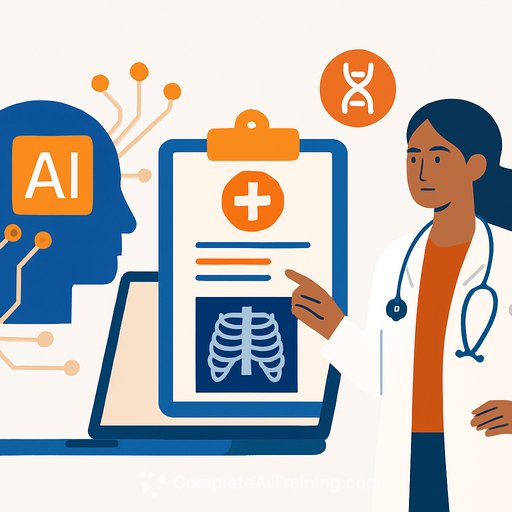
A Perspective on Adapting Generalist AI to Specialized Medical AI Applications and Their Challenges
The integration of artificial intelligence into healthcare is growing, but adapting generalist large language models (LLMs) for specialized medical use requires thoughtful approaches. This article outlines a practical framework focused on three key areas: modeling medical workflows, optimizing model performance, and system engineering. It also touches on real-world applications and the challenges that come with building medical AI powered by LLMs.
Adapting Large Language Models for Medical AI
1. Model Development: Building Medical-Specific LLMs
General-purpose LLMs like ChatGPT are trained on diverse datasets and understand language broadly. To improve their medical relevance, continual pretraining on medical sources—such as clinical notes, research articles, and electronic health records—is essential. Examples include models like MEDITRON and PANACEA, which have been refined with medical literature and clinical trial data to boost their performance in healthcare tasks.
Another effective strategy is using a mixture-of-experts approach, where several specialized LLMs are combined with a routing system to select the best expert for a given task. This yields strong results with lower computational cost compared to a single massive model.
Instruction tuning is also important. By training LLMs on paired task instructions and responses, models become better at understanding medical tasks. MedPaLM, for instance, improved medical exam question accuracy after instruction tuning.
Ensuring models align with human values and clinical safety is critical. Reinforcement Learning from Human Feedback (RLHF) helps steer models toward generating responses that are medically sound and clinically useful. Clinician feedback is key in this process, as demonstrated by models like LLaMA-Clinic which generate higher quality clinical notes through expert guidance.
2. Model Optimization: Strategies to Improve Performance
Prompt design plays a major role in guiding LLMs. Clear, structured instructions combined with examples help models produce accurate outputs. For example, carefully crafted prompts can direct an LLM to summarize clinical notes following specific standards.
Ensembling multiple prompts and synthesizing their outputs can increase reliability and accuracy. Tools like MedPrompt use this technique to outperform individual domain-tuned models. Similarly, TrialGPT applies prompt-based techniques to match patient records with clinical trial eligibility criteria.
Retrieval-Augmented Generation (RAG) integrates external medical databases dynamically to support factual accuracy, reducing the risk of hallucinated or incorrect information. This method taps into trusted sources like clinical guidelines and medical ontologies to supplement the model’s knowledge.
3. System Engineering: Architecture Development
Choosing the right architecture depends on the task. AI Chains follow fixed workflows ideal for repetitive or guideline-driven medical processes such as literature reviews or patient-trial matching. They break down complex tasks into clear sequential steps, enhancing transparency and control.
AI Agents offer more flexible, autonomous problem-solving capabilities. They can plan, retrieve knowledge from various tools, and reflect iteratively to tackle exploratory tasks. These agents combine a generalist LLM with specialized modules that collaborate with human experts to manage complex healthcare workflows.
4. System Engineering: Adaptations and Deployment
Selecting between proprietary and open-source models depends on resources and needs. Proprietary models like ChatGPT provide cloud-based access with minimal local infrastructure but come at higher costs. Open-source models allow more customization but require local computing resources.
For limited data scenarios, prompt optimization is the best starting point. When sufficient domain-specific data is available, continual pretraining helps adapt generalist models more thoroughly.
Evaluation must focus on medical standards—completeness, correctness, and conciseness are more relevant than generic language model metrics. Collaborations between AI developers and healthcare professionals are crucial to define meaningful evaluation criteria.
Use Cases for LLMs in Medical AI
- Clinical Note Generation: Ambient documentation records patient-provider conversations, and LLMs summarize these into notes. Challenges include variability of note formats and the need for EMR integration.
- Automated Medical Coding: AI chains with specialized modules can extract relevant conditions and complications for coding, improving efficiency and accuracy.
- Patient-Trial Matching: Automating the matching process reduces manual labor and errors, helping with recruitment and trial success.
- Medical Systematic Reviews: LLMs assist by synthesizing evidence across many research articles, addressing the volume of new medical literature.
Mapping Data Privacy Legislations
Aligning AI development with diverse privacy laws requires careful analysis. LLM-based pipelines can help identify overlaps and gaps in privacy legislation, ensuring compliance across different regions.
Opportunities and Challenges
Key challenges include expanding LLMs’ multimodal capabilities to handle text, images, and other data types common in medicine. Ensuring trustworthiness and regulatory compliance remains a priority, especially for patient-facing applications. Finally, managing the system lifecycle through continuous evaluation and improvement is essential to maintain performance and safety.
The future of medical AI involves combining domain-specific model adaptation, optimized prompting, and well-designed system architectures to deliver dependable and effective healthcare tools.
Your membership also unlocks: