
AI news ·
Adobe CMO outlines three-mode marketing framework for human and AI audiences
Brands must now market to three audiences at once: people, AI assistants, and the algorithms that filter recommendations on customers' behalf. Adobe's recent test with 145 marketers and 16 AI agents produced over 1,000 assets across 60 sessions.
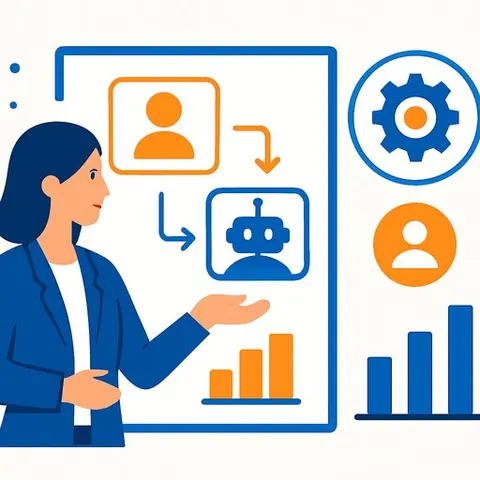
Marketers Must Now Reach Three Audiences: Humans, AI Agents, and Other Machines
Marketing strategy has entered a new phase. Brands no longer speak only to people. They must also engage AI assistants and algorithms that filter, rank, and recommend on customers' behalf.
This shift splits marketing into three distinct modes: human-to-human, human-to-agent, and agent-to-agent engagement. The challenge for marketing teams is orchestrating all three simultaneously, without abandoning the human judgment that builds lasting customer loyalty.
What happened at the Agentic Marketing Garage
Adobe brought 145 marketers and 16 AI agents together at its recent summit to test this theory in practice. The experiment, called the Agentic Marketing Garage, gave marketers direct experience working alongside AI agents on real campaign problems.
Agents built and deployed campaigns, identified audiences, produced assets, and recommended content strategy. Marketers orchestrated the overall customer journey while maintaining brand judgment at each step. The agents even worked with other agents to construct campaign frameworks, debating and grading each other's work.
The results: 60 sessions, over 1,000 assets created, 26 custom challenges, 61 personalized agents, and 415 documented lessons. Marketers reported moving faster than ever before when they actively redirected agent recommendations rather than accepting them wholesale.
Human-to-human marketing still requires human creativity
As AI-generated content floods digital channels, customers increasingly seek authentic brand experiences. Relevance, transparency, and taste now separate winners from the noise.
In-person activations matter more, not less. Experiential events allow brands to connect directly with customers in ways that feel personal and genuine. Marketers should attend events, roundtables, and customer meetups in person.
The core principle remains unchanged: humans must orchestrate the emotional connection between brand and customer. AI should handle repetitive tasks, generate insights, and manage individual journey steps. But the overall strategy, tone, and values come from people.
Human-to-agent marketing requires a different approach
When AI agents mediate discovery, brand awareness must happen upstream. Instead of influencing customers at the moment of decision, brands need to be embedded in the criteria that guide agent recommendations.
This means content must be designed for machine interpretation, not just human persuasion. Information needs to be accurate, well-structured, and easy for AI to parse while still reflecting human intent.
Brands like Dick's Sporting Goods, Ulta, Cisco Systems, and Dow Chemical all compete for preference long before an agent delivers a recommendation. Customers must know and trust a brand before an algorithm chooses it on their behalf.
Real-time brand reputation now matters operationally. AI agents scan thousands of signals in seconds, evaluating consistency across third-party validation, customer sentiment, and authority beyond owned channels. Marketing, public relations, social, and customer experience teams must coordinate how reputation is built and maintained across all systems.
Agent-to-agent marketing operates at machine speed
Discovery, evaluation, and preference decisions no longer wait for human intervention. These happen continuously across systems, often without a person involved.
Marketers must decide with intention what gets automated, what requires governance, and where human judgment still matters. Incomplete information or disconnected systems don't just slow performance-they can eliminate a brand from consideration entirely because agents act only on what they can verify in the moment.
Enterprises must be explicit about which decisions can be automated and where constraints apply. In this environment, the most valuable brands are often the most helpful ones. They offer smarter guidance, better constraints, or value-added services that improve outcomes for customer agents.
Technology and systems must operate independently when humans cannot intervene, while still expressing the intent and values behind the brand.
Customer experience orchestration ties it all together
Human-to-human, human-to-agent, and agent-to-agent aren't three separate strategies. They're three modes of engagement addressing one problem: how to show up with relevance and trust across audiences that experience your brand in fundamentally different ways.
The answer lies in customer experience orchestration-connecting insights, decisioning, and action into a continuous system of engagement instead of disconnected touchpoints. This requires structural changes in how marketing organizations approach data governance, system interoperability, and the enforcement of brand standards in automated interactions.
For more on how to lead marketing in this environment, see our AI Learning Path for CMOs and explore AI for Marketing resources.