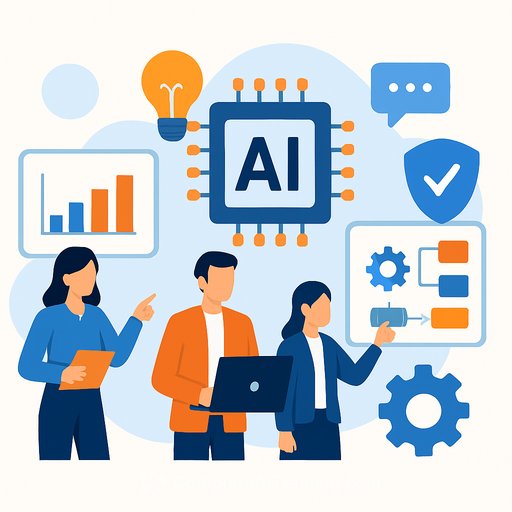
AI is everywhere in finance. Capability isn't.
AI tools have spread across financial services. The manual-only workflow is over. A joint Bank of England and FCA survey in 2024 found that 85% of firms were already using or planning to use AI - and that figure is almost certainly higher today. Source
Availability isn't the same as competence. Systems are present. Skills are missing.
Where AI already delivers value
Fraud detection, transaction monitoring, onboarding, credit decisions, customer service, risk scoring, and regulatory compliance all use AI today. In many teams, the first draft or first analysis now comes from an AI system.
That brings speed. It also shifts human work toward oversight, interpretation, and challenge. Those are new skills for most teams.
The skills gap you can't ignore
Despite fast adoption, 55% of financial services employees report no formal training on AI tools. Capability hasn't kept pace. Four gaps stand out:
- Practical use: Many staff don't know how to write effective prompts, validate outputs, or adjust inputs to reduce hallucinations. Industry bodies report a 35% gap between demand and availability of AI skills.
- Governance: Teams are unsure how to classify model risk, document decisions, or show alignment with internal policy and regulatory expectations.
- Ethics: Fairness, bias mitigation, explainability, and customer-impact thinking are underdeveloped. People lack simple frameworks and clear triggers for human-in-the-loop review.
- Critical interpretation: One study found 58% of workers relied on an AI output without checking its accuracy. That feeds over-reliance, weak challenge, and poor explanations to customers or regulators.
The pinch point: compliance, risk, and legal
Paradoxically, the teams tasked with oversight often receive the least training. Compliance, risk, and legal are expected to supervise AI, yet many haven't been equipped to do so. Recent UK workforce reporting highlights this gap and the accountability risk it creates.
Why this matters to your P&L and license
If employees can't use AI well, productivity and growth stall. If they can't govern it, you face customer harm, model drift, and supervisory issues.
That's not just an operational headache. It's a conduct, prudential, and reputational risk that compounds over time.
Regulation is raising the bar
The EU AI Act makes AI literacy a legal duty for in-scope organisations and Member States. Article 4 requires training so people understand how to use AI safely. Read the text
A practical training blueprint
- Hands-on skills for daily use: Prompt design, verification habits, red-teaming basics, data handling, and "when not to use AI."
- Governance and ethics for control functions: Risk classification, documentation standards, model inventory, testing protocols, monitoring, and incident playbooks.
- Executive capability: Accountability, risk appetite for AI, model ownership, thresholds for human review, and board reporting.
- Cross-functional learning: Joint sessions for product, data, engineering, risk, legal, and compliance using the same use cases.
- Workflow-first design: Put guidance into checklists, templates, and approvals - not just long theory modules.
What "good" looks like inside your firm
- Clear policy on where AI is allowed, restricted, or prohibited - and by whom.
- Standard prompts, review checklists, and sampling plans embedded in tools.
- Model register with owners, risks, controls, tests, and change logs.
- Defined human-in-the-loop points for high-impact decisions.
- Management information on adoption, accuracy, exceptions, incidents, and customer outcomes.
Quick actions this quarter
- Map AI use across teams; classify by risk and business impact.
- Run a baseline skills audit; prioritise gaps in compliance, risk, and legal.
- Pilot a 4-6 week training sprint tied to two live workflows.
- Create a lightweight documentation pack: model card, decision log, prompt library, review checklist.
- Set up an AI review forum with risk, legal, compliance, and data science. Meet monthly.
Helpful resources
- Bank of England & FCA: Artificial Intelligence in UK financial services (2024)
- EU AI Act (Article 4 on AI literacy)
Build capability now
The opportunity is real. So is the risk of weak skills. If you want practical, workflow-first training for finance roles, explore:
AI will help your teams go faster. Training makes sure they don't go off-course.
Your membership also unlocks: