
AI news ·
African artist-engineer teams showcase AI and music projects at Wits University
Five artist-engineer teams from seven African countries showed work at Wits University using AI to preserve traditional music. The projects aim to give African creators a role in shaping AI tools before outside standards take hold.
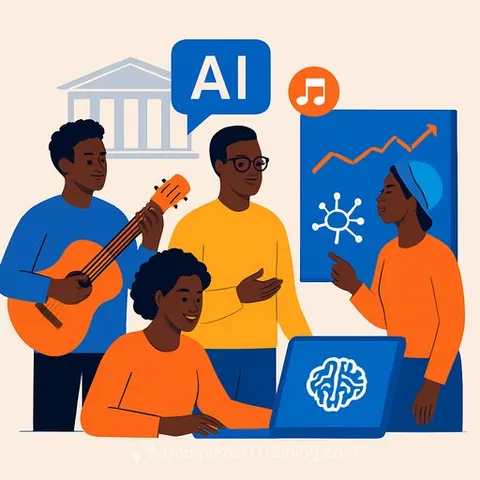
African music creators take center stage in AI development
Five artist-engineer teams from seven African countries presented work this week at the University of the Witwatersrand that demonstrates how African musical traditions can inform the development of AI technology on the continent.
The showcase, hosted by the Wits Innovation Centre and the Machine Intelligence and Neural Discovery Institute, featured projects from teams across Cameroon, Nigeria, Ghana, Ethiopia, Kenya, the Democratic Republic of Congo and South Africa. The work focused on using AI to preserve and recreate traditional music forms.
The timing matters. U.S. and UK markets currently set the commercial standards for AI in music. Generative AI tools have only recently shifted public attention toward what AI can create - a shift that accelerated in the past three and a half years, said Charles Goldstuck, a music executive and Wits alumnus who delivered the keynote address.
The music industry has moved through cycles of disruption, adoption, litigation and licensing at speed. African stakeholders have been largely absent from the rooms where those rules get made.
Preservation as strategy
The pilot projects took a different approach. Rather than focusing on what AI can generate from scratch, the teams oriented their work toward preserving traditional and indigenous music using AI models.
Christo Doherty, a professor at the Wits Innovation Centre, said this direction emerged organically from the teams themselves. The focus on traditional music reflects ongoing conversations about how indigenous work gets handled across the continent.
Who controls the tools
A panel discussion brought together music executives and technologists to address a core problem: most distribution platforms are not African. Ninel Musson, CEO of Music Business Lab, said this limits African control over outputs until the distribution infrastructure changes.
Thando Makhunga, managing director of Downtown Publishing and chair of the Music Publishing Association of South Africa, connected the issue to a broader pattern. "The more we start to get information from an African context - whether that is language, sounds, tone, context, or tradition - we'll have a better idea of how to solve for it," she said.
Nick Argyros, group CEO of INJOZI Digital, Audio Militia and Got Bot AI, said Africans need to build the foundational technology layer itself. Most underlying AI technology is currently built elsewhere. "That foundational layer fundamentally needs to change and have African businesses, entrepreneurs and techies create that," he said.
Regulation lags behind
Martha Huro, an East African music executive, framed AI as an opportunity rather than a threat, even as the continent catches up on earlier technology waves like streaming. "Africa, we are still catching up with technology. Now we have AI, and we'll figure it out!" she said.
The biggest constraint may be regulatory. Makhunga said policymakers must keep pace with how fast AI technology evolves. "The pace of our regulators grappling with the change and responding adequately is probably the biggest challenge," she said.
For creatives working with generative art and music, the stakes are clear: either African creators and technologists shape how AI develops on the continent, or they remain dependent on tools and rules designed elsewhere.